
World
Climate-Driven Wildfires Reverse Air Quality Gains in North America

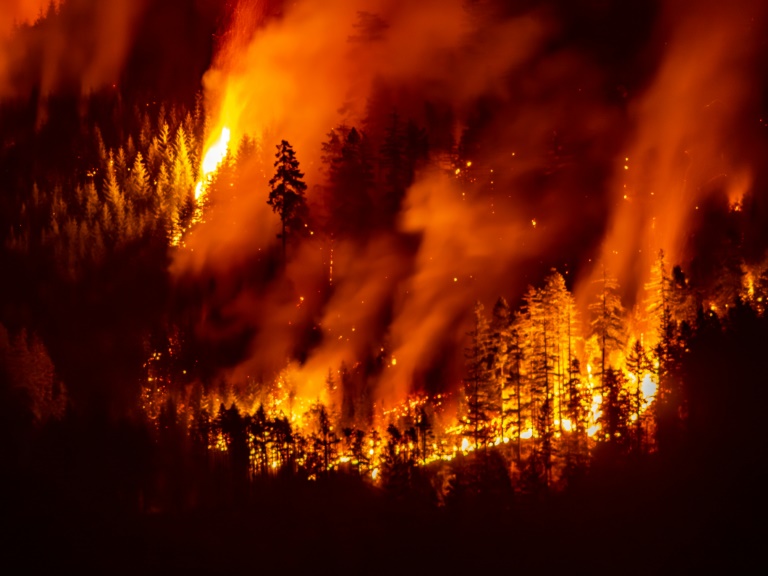
Global air pollution is deteriorating, with the United States and Canada witnessing significant increases attributed to wildfires exacerbated by climate change. A recent study from the Air Quality Life Index (AQLI) highlights how these record-breaking wildfires are reversing decades of progress in air quality. The annual report, which utilizes satellite data to evaluate particulate matter levels globally, indicates that these environmental challenges are severely impacting human health.
According to the report, Canada experienced a catastrophic wildfire season in 2023, leading to a more than 50 percent rise in particulate matter levels compared to the previous year. The United States recorded a 20 percent increase. The data, while only extending to 2023, suggests that these troubling trends are likely to continue as both countries confront intensifying wildfire seasons. These are driven by rising temperatures and drought linked to human-induced greenhouse gas emissions.
Michael Greenstone, an economics professor at the University of Chicago and co-creator of AQLI, expressed the gravity of the situation: “Particulate matter remains the greatest external threat to human health on the planet, period. It’s worse than tobacco smoke. It’s worse than child and maternal malnutrition. It’s worse than road accidents. It’s worse than HIV-AIDS, worse than anything in terms of losses.”
The report highlights that more than half of Canadians experienced air pollution exceeding their national standard of 8.8 micrograms per cubic meter, a dramatic shift from fewer than five percent in the past five years. The provinces most affected include the Northwest Territories, British Columbia, and Alberta, where pollution levels have reached numbers comparable to those in Bolivia and Honduras, reducing lifespans by up to two years.
Global Trends in Air Quality
On a broader scale, fine particulate levels worldwide, defined as 2.5 micrometers or smaller, rose from 23.7 micrograms per cubic meter in 2022 to 24.1 in 2023. This figure is nearly five times greater than the World Health Organization guideline of 5. Latin America reported its highest pollution levels since 1998, with Bolivia being the most adversely affected country. In South Asia, recognized as the world’s most polluted region, pollution increased by 2.8 percent. Even China, which had seen steady declines due to its “War on Pollution,” experienced a slight rebound of 2.8 percent.
While these statistics paint a grim picture, there were some positive developments. Within the European Union, particulate concentrations decreased by 6 percent, and Central and West Africa saw a drop of 8 percent in air pollution levels.
The alarming trends uncovered in this report underscore the urgent need for comprehensive strategies to address air quality and mitigate the effects of climate change. As wildfires continue to wreak havoc, the public health implications are profound, necessitating immediate action from governments and communities alike.










Darius Slay Cites Buffalo Weather in Decision Not to Join Bills

Surrey School Program Supports Families Facing Hardships

Discover the Comfort and Perks of American Airlines’ Premium Economy

Cowichan Tribes Land Case Sparks National Debate on Property Rights

St. John’s Church Hosts Holiday Gift Shop and Bake Sale This Weekend

Katy Perry and Justin Trudeau Connect with Former PM in Tokyo

Urgent Weather Alert: Over 22,000 Without Power in Atlantic Canada

Four Crashes in Three Years Force B.C. Family to Demand Action

Trump Secures Historic Peace Deal Between Congo and Rwanda

Secwepemc First Nation Seeks Aboriginal Title Over Kamloops Area

Scientists Unearth Ancient Antarctic Ice to Unlock Climate Secrets

Trump and McCormick to Announce $70 Billion Energy Investments

Four Astronauts Return to Earth After International Space Station Mission

TransLink Launches Food Truck Program to Boost Revenue in Vancouver

Apple Notes Enhances Functionality with Markdown Support in macOS 26

Manitoba’s Burger Champion Shines Again Amid Dining Innovations

Urgent Update: Fatal Crash on Highway 99 Claims Life of Pitt Meadows Man

Ukrainian Tennis Star Elina Svitolina Faces Death Threats Online
-
 Politics4 weeks ago
Secwepemc First Nation Seeks Aboriginal Title Over Kamloops Area
-
 World5 months ago
Scientists Unearth Ancient Antarctic Ice to Unlock Climate Secrets
-
 Entertainment5 months ago
Trump and McCormick to Announce $70 Billion Energy Investments
-
 Science5 months ago
Four Astronauts Return to Earth After International Space Station Mission
-
 Lifestyle5 months ago
TransLink Launches Food Truck Program to Boost Revenue in Vancouver
-
 Technology3 months ago
Apple Notes Enhances Functionality with Markdown Support in macOS 26
-
 Lifestyle3 months ago
Manitoba’s Burger Champion Shines Again Amid Dining Innovations
-
 Top Stories2 months ago
Urgent Update: Fatal Crash on Highway 99 Claims Life of Pitt Meadows Man
-
 Politics4 months ago
Ukrainian Tennis Star Elina Svitolina Faces Death Threats Online
-

 Sports5 months ago
Search Underway for Missing Hunter Amid Hokkaido Bear Emergency
-
 Politics5 months ago
Carney Engages First Nations Leaders at Development Law Summit
-

 Technology5 months ago
Frosthaven Launches Early Access on July 31, 2025