
World
U.S. Strikes on Caracas Lead to Maduro’s Capture, Claims Trump

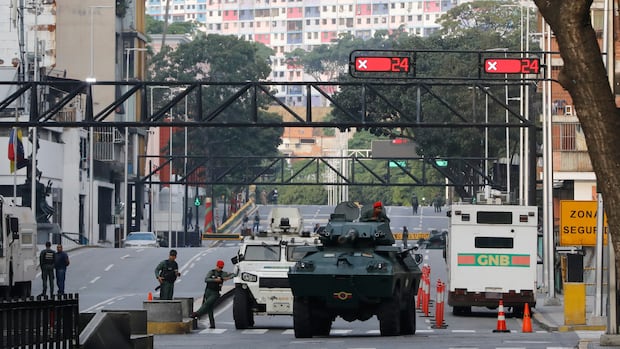
The United States conducted a significant military operation in Caracas early Saturday, reportedly capturing Venezuelan President Nicolás Maduro and transporting him out of the country. This unprecedented strike, announced by U.S. President Donald Trump on social media shortly after the attack, marks a dramatic escalation in U.S. efforts to remove Maduro from power. The operation involved multiple explosions and low-flying aircraft that rattled the capital of the oil-rich nation.
Witnesses reported hearing at least seven explosions in Caracas, prompting many residents to flee to the streets in panic. Maduro’s government quickly condemned the action, characterizing it as an “imperialist attack” and calling on citizens to mobilize in response. Details surrounding Maduro’s current status and the command structure of the country remain unclear, leading to confusion about who is in charge following the strike.
Trump’s announcement came at approximately 04:30 a.m. ET, stating that the operation was a coordinated effort with U.S. law enforcement. He confirmed that both Maduro and his wife, Cilia Flores, had been captured. “Details to follow,” he noted, adding that a news conference was scheduled for later that morning. The legal implications of the operation under U.S. law remain uncertain, and questions arose regarding the absence of congressional approval for such military action.
According to U.S. Secretary of State Marco Rubio, Maduro is set to face criminal charges in the U.S. This follows Maduro’s indictment in March 2020 on allegations of “narco-terrorism” conspiracy in the Southern District of New York. As the operation unfolded, the Federal Aviation Administration issued a ban on commercial flights operating in Venezuelan airspace due to “ongoing military activity.”
The Venezuelan government called for a state of emergency in response to the attack. “People to the streets!” it declared, urging all social and political forces to oppose what it labeled an imperialist assault. Maduro had “ordered all national defense plans to be implemented,” indicating a significant escalation in military readiness.
The context for this operation lies in months of increased pressure from Washington, with U.S. military operations targeting drug smuggling vessels in Caribbean waters. Trump had threatened military action against Maduro’s regime, stating that strikes on Venezuelan soil could occur in response to ongoing drug trafficking concerns. The CIA had previously executed a drone strike targeting a docking facility suspected of being used by Venezuelan drug cartels.
Video footage from Caracas captured the chaos, with explosions illuminating the night sky and smoke rising from military installations. Reports indicated that some areas of the city were without power, while others remained eerily quiet in the aftermath of the strikes. A resident, Carmen Hidalgo, described the scene, saying, “The whole ground shook. This is horrible. We heard explosions and planes.”
International reactions have begun to emerge, with Cuba’s President Miguel Díaz-Canel Bermúdez condemning the U.S. actions as a “criminal attack” on Venezuela. The European Union, which has consistently criticized Maduro’s legitimacy, called for restraint and adherence to international law. Kaja Kallas, the EU’s top diplomat, emphasized the need for peaceful resolution and respect for human rights.
As the situation develops, the world is closely monitoring further military actions and their potential consequences. The U.S. military has maintained a significant presence in the region, asserting that its operations are necessary to combat drug trafficking and support regional stability.
While Trump’s administration celebrates the operation as a success, it has raised serious questions about the legality and consequences of such a military strike. Lawmakers from both parties have expressed concerns about the lack of congressional authorization for military actions against Venezuela, marking a pivotal moment in U.S.-Venezuelan relations.









Morris Churches Unite for Annual Good Friday Walk With the Cross

Chloe Zhao’s ‘Buffy’ Reboot Cancelled: Sarah Michelle Gellar Speaks Out

Essential Ingredients for Life Found in Ryugu Asteroid Samples

Urgent Rescue: NSR Airlifts Injured Climber from Nanaimo

Riverside Heart Ball Achieves Record $815,000 for Mental Health

Cognizant Launches AI Factory to Enhance Enterprise AI Scalability

Samsung’s Galaxy Watch 9 to Feature Larger Battery Than Before

Toronto’s AIDS Memorial Faces Potential Redesign Amid Community Concerns

Bayern Munich Loses Luis Díaz Red Card Appeal Despite Referee’s Admission

Secwepemc First Nation Seeks Aboriginal Title Over Kamloops Area

Fatal Crash on Highway 11 Claims Three Lives, Major Closure Ongoing

Manitoba’s Burger Champion Shines Again Amid Dining Innovations

Canadian Curler E.J. Harnden Announces Retirement from Competition

Urgent Fire Erupts at Salvation Army on Christmas Evening

Scientists Unearth Ancient Antarctic Ice to Unlock Climate Secrets

Minister Faces Scrutiny Over Delayed Foreign Interference Watchdog Appointment

Trump and McCormick to Announce $70 Billion Energy Investments

Monika Hibbs Unveils Acres Market & Interiors in Major Rebrand
-
 Politics5 months ago
Secwepemc First Nation Seeks Aboriginal Title Over Kamloops Area
-
 Top Stories4 months ago
Fatal Crash on Highway 11 Claims Three Lives, Major Closure Ongoing
-
 Lifestyle7 months ago
Manitoba’s Burger Champion Shines Again Amid Dining Innovations
-
 Sports4 months ago
Canadian Curler E.J. Harnden Announces Retirement from Competition
-
 Top Stories4 months ago
Urgent Fire Erupts at Salvation Army on Christmas Evening
-
 World9 months ago
Scientists Unearth Ancient Antarctic Ice to Unlock Climate Secrets
-
 World5 months ago
Minister Faces Scrutiny Over Delayed Foreign Interference Watchdog Appointment
-
 Entertainment9 months ago
Trump and McCormick to Announce $70 Billion Energy Investments
-
 Lifestyle9 months ago
Monika Hibbs Unveils Acres Market & Interiors in Major Rebrand
-
 Science9 months ago
Four Astronauts Return to Earth After International Space Station Mission
-
 Lifestyle9 months ago
TransLink Launches Food Truck Program to Boost Revenue in Vancouver
-
 World2 months ago
Ranchman’s Cookhouse & Dancehall to Relocate by Early 2027