
Entertainment
Northern Saskatchewan Radio Bridges Cultures and Communities

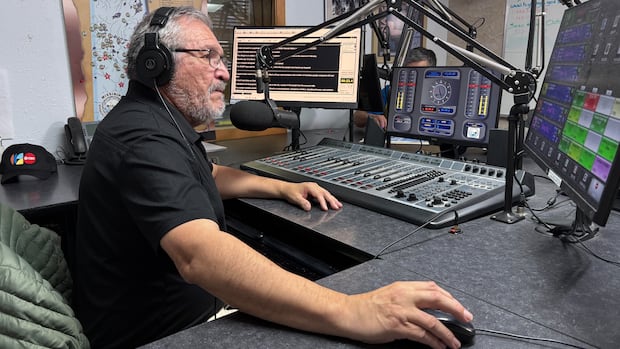
Radio plays an invaluable role in connecting communities and preserving culture in northern Saskatchewan. The **Missinipi Broadcasting Corporation (MBC)**, based in La Ronge, is at the forefront of this effort, particularly through its daily Cree-language program, **Missinipi Achimowin**. Host **Abel Charles**, who has dedicated over 15 years to the show, emphasizes the importance of storytelling and cultural expression in a language that resonates with local listeners.
Charles, 67, grew up on a trapline in northern Saskatchewan, where he first discovered his passion for radio while listening to broadcasts about the Vietnam War. His journey in broadcasting began with **Northern News**, a service that provided vital information to the northern communities until its closure in the early 1980s. Since then, he has been a key figure in promoting Cree culture and language through radio.
“In broadcasting, I’m supposed to be here, I think,” said Charles. “I get to listen to elders, visit elders, and my cultural knowledge is enriched.” His commitment reflects a broader mission among radio hosts in the region to share Indigenous perspectives and narratives.
Radio as a Cultural Lifeline
Across the vast and often remote landscapes of northern Saskatchewan, radio stations serve as critical lifelines. They provide not only entertainment but also essential information during emergencies, such as forest fires. **Tom Roberts**, a former broadcaster with both CBC and MBC, describes radio as “a lifeline to the land and to the people” of the north. He recalls the days before FM signals reached these communities when two-way radios were the primary means of sharing stories and information.
Roberts highlights how radio broadcasts often mirror the structure of the Cree language, which places a strong emphasis on descriptive storytelling. “Whatever you’re talking about, you describe what you’re talking about,” he noted. This personal touch enhances the connection between broadcasters and listeners.
**Tammy Cook-Searson**, Chief of the **Lac La Ronge Indian Band**, recognizes the significance of radio during critical times. During the recent forest fire season, she relied on MBC to communicate directly with her community, particularly to reach those who primarily speak Cree and Dene. “When you give a message out there that’s in Cree, then our community members are able to understand it,” Cook-Searson explained.
Listeners, particularly elders, find comfort in these broadcasts. Cook-Searson shared how she has seen elders actively engage with the content, connecting emotionally to their culture.
Empowering Future Generations
The impact of radio extends to the next generation of Indigenous broadcasters. **Robert Merasty**, who broadcasts in Cree and Michif at **CILX-FM** in **Île-à-la-Crosse**, started his career with Northern News in the 1970s. He emphasizes the importance of broadcasting in Indigenous languages, stating, “Very little English is done here. The elders love it because they can understand us.”
Merasty’s journey has been instrumental in shaping local radio. He recalls traveling through northern Saskatchewan to understand community needs, which ultimately led to the establishment of MBC, where he served as the first CEO.
**Merelda Fiddler-Potter**, an associate professor at **First Nations University of Canada (FNUC)**, is working to revitalize community radio with the relaunch of **CFNU Radio**. Established in 1994, the station had been dormant until its recent revival in 2023. Fiddler-Potter highlights the role of radio in preserving Indigenous languages, noting that “as time goes on, we lose language speakers literally every other week, every other month.” The station’s commitment to broadcasting in Indigenous languages is vital for cultural retention.
Students like **Amanda Leader** are also contributing to this effort. As part of CFNU’s daily news program **Waná**, Leader is gaining invaluable experience in broadcasting. She expresses her enthusiasm for learning and sharing Indigenous languages, stating, “It doesn’t just teach me the language; it also feels good with your spirit to sit in those rooms, to learn from people.”
**Lori Deets**, another aspiring broadcaster and a Sixties Scoop survivor, shares her journey of reconnecting with her Indigenous identity. As a presenter on Waná, she hopes to inspire future Indigenous journalists. “There were a few people within news [who were] Indigenous that I really looked up to growing up,” she reflected. “Then I start coming here and I get these opportunities… and then you share that and then other people say, ‘Hey, I can do that.’”
The vibrant network of radio stations in northern Saskatchewan not only keeps communities informed but also plays a crucial role in the preservation of culture and language. As these broadcasters continue to share their stories, they ensure that Indigenous voices remain an integral part of the region’s narrative.











Morris Churches Unite for Annual Good Friday Walk With the Cross

Chloe Zhao’s ‘Buffy’ Reboot Cancelled: Sarah Michelle Gellar Speaks Out

Essential Ingredients for Life Found in Ryugu Asteroid Samples

Urgent Rescue: NSR Airlifts Injured Climber from Nanaimo

Riverside Heart Ball Achieves Record $815,000 for Mental Health

Cognizant Launches AI Factory to Enhance Enterprise AI Scalability

Samsung’s Galaxy Watch 9 to Feature Larger Battery Than Before

Toronto’s AIDS Memorial Faces Potential Redesign Amid Community Concerns

Bayern Munich Loses Luis Díaz Red Card Appeal Despite Referee’s Admission

Secwepemc First Nation Seeks Aboriginal Title Over Kamloops Area

Fatal Crash on Highway 11 Claims Three Lives, Major Closure Ongoing

Manitoba’s Burger Champion Shines Again Amid Dining Innovations

Canadian Curler E.J. Harnden Announces Retirement from Competition

Urgent Fire Erupts at Salvation Army on Christmas Evening

Scientists Unearth Ancient Antarctic Ice to Unlock Climate Secrets

Minister Faces Scrutiny Over Delayed Foreign Interference Watchdog Appointment

Trump and McCormick to Announce $70 Billion Energy Investments

Four Astronauts Return to Earth After International Space Station Mission
-
 Politics5 months ago
Secwepemc First Nation Seeks Aboriginal Title Over Kamloops Area
-
 Top Stories4 months ago
Fatal Crash on Highway 11 Claims Three Lives, Major Closure Ongoing
-
 Lifestyle7 months ago
Manitoba’s Burger Champion Shines Again Amid Dining Innovations
-
 Sports3 months ago
Canadian Curler E.J. Harnden Announces Retirement from Competition
-
 Top Stories3 months ago
Urgent Fire Erupts at Salvation Army on Christmas Evening
-
 World9 months ago
Scientists Unearth Ancient Antarctic Ice to Unlock Climate Secrets
-
 World5 months ago
Minister Faces Scrutiny Over Delayed Foreign Interference Watchdog Appointment
-
 Entertainment9 months ago
Trump and McCormick to Announce $70 Billion Energy Investments
-
 Science9 months ago
Four Astronauts Return to Earth After International Space Station Mission
-

 Lifestyle9 months ago
TransLink Launches Food Truck Program to Boost Revenue in Vancouver
-

 Lifestyle9 months ago
Monika Hibbs Unveils Acres Market & Interiors in Major Rebrand
-

 World1 month ago
Ranchman’s Cookhouse & Dancehall to Relocate by Early 2027