
Business
Carney Reflects on Political Journey in Year-End Interview

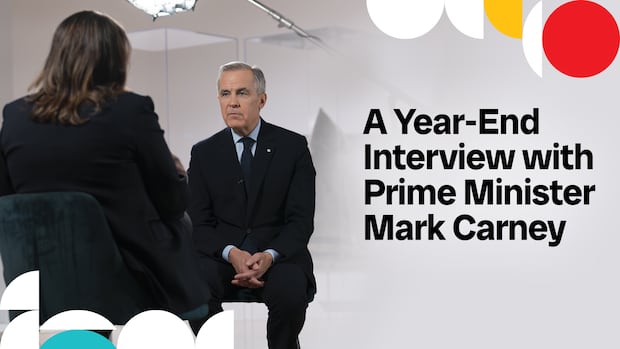
As the year draws to a close, Prime Minister Mark Carney reflects on his entry into politics during a pivotal moment for Canada. In a year-end interview with CBC News chief political correspondent Rosemary Barton, Carney discussed his experiences since assuming leadership of the Liberal Party and the country following Justin Trudeau‘s resignation in 2024. Carney’s ascension culminated in his election victory in April 2025, marking a significant shift in the Canadian political landscape.
In the interview, aired on December 21, 2025, Carney addressed several pressing issues, including Canada’s trade relations, environmental policies, and his approach to leadership.
Environmental Policies Under Scrutiny
Since taking office, Carney has reversed several key environmental initiatives established by his predecessor. On his first day as prime minister, he suspended the consumer carbon tax and later paused the electric vehicle sales mandate. Additionally, he promised to halt the proposed federal oil and gas emissions cap and alleviate Alberta’s obligations under the Clean Electricity Regulations as part of a recent agreement with Premier Danielle Smith.
Carney, previously an advocate for climate action as the UN special envoy on climate action and finance, asserted, “I’m the same person,” emphasizing that his commitment to addressing climate change remains strong. Nevertheless, a report from Environment and Climate Change Canada indicates that Canada is on track to fall significantly short of its 2030 climate goals, with projections estimating a reduction of just 21 percent below 2005 levels. This contrasts sharply with Trudeau’s administration, which aimed for a reduction of 34 percent.
Despite the setbacks, Carney maintained that he is still dedicated to curbing climate change, asserting that effective action holds more importance than regulations alone.
Trade Relations and Challenges Ahead
Carney also discussed the challenges posed by trade relations with the United States, particularly in light of tariffs imposed by President Donald Trump. During his campaign, Carney positioned himself as the candidate best equipped to navigate these complexities. Following his election, he has taken steps to ease tensions, such as retracting a proposed digital services tax and eliminating various retaliatory tariffs on American goods.
In the interview, Carney remarked, “Canada has the best deal” with the U.S. under the Canada-U.S.-Mexico Agreement (CUSMA), highlighting the country’s unique tariff exemptions. He reiterated the necessity of renegotiating aspects of the agreement, stating, “Better is always possible,” echoing a sentiment often expressed by Trudeau.
Efforts to diversify Canada’s export markets have also been a focus, with Carney pointing to ongoing discussions with both India and the United Arab Emirates. He acknowledged the need to address the challenges presented by China, especially following the imposition of tariffs on Canadian canola.
Preparing for Economic Adjustments
Turning to domestic issues, Carney characterized the upcoming budget as a time for “challenges” and “sacrifices.” His government is projected to post a deficit of $78 billion, significantly higher than the $42 billion deficit anticipated under Trudeau. The budget plan includes a reduction of 16,000 positions in the federal civil service over the next three years, as part of a broader strategy to streamline government operations.
Carney expressed a commitment to maintaining support programs for Canadians facing rising living costs, such as dental and childcare initiatives introduced during Trudeau’s tenure.
Political Landscape and Future Prospects
As Carney considers his political future, he finds himself just one seat shy of a majority in the House of Commons, following defections from the Conservative Party. Conservative Leader Pierre Poilievre has criticized Carney for allegedly pursuing a majority through “dirty backroom deals.” Carney countered this accusation, asserting his confidence in commanding the support of the House.
When asked about the biggest challenges ahead, Carney pointed to Canada-U.S. relations and the impending CUSMA review. However, he emphasized the importance of focusing on domestic priorities as well. His government has already introduced legislation to facilitate the approval of major projects deemed vital for Canada’s economic future.
In closing, Carney reflected on his personal experience in office, describing the role of prime minister as both a privilege and a significant responsibility. He acknowledged the demanding nature of the position, stating, “It’s surprising just how real the relentless nature of the job is — it’s obviously 24/7/365.” When asked if he enjoys the role, Carney replied with a definitive, “Yes,” highlighting the importance of the moment and his commitment to serving the Canadian public.











UPEI’s High-Tech Simulation Centre Enhances Future Healthcare Skills

Canadian Astronaut Chris Hadfield Advocates for Eye Health

GPIQ and QYLD: Evaluating Strategies Amid Market Stagnation

Norovirus Outbreak Forces Canada’s Hockey Game Postponement

Fauna Robotics Unveils Sprout: A Humanoid Robot for Home Use

Team Canada Faces Goaltending Concerns Ahead of Olympics

Celebrating the Life of Irena Peritz: A Legacy of Love and Resilience

India, U.S. Announce Urgent Trade Deal to Slash Tariffs Now

American Airlines Pilots Challenge Management After Poor Results

Secwepemc First Nation Seeks Aboriginal Title Over Kamloops Area

Scientists Unearth Ancient Antarctic Ice to Unlock Climate Secrets

Urgent Fire Erupts at Salvation Army on Christmas Evening

Canadian Curler E.J. Harnden Announces Retirement from Competition

Manitoba’s Burger Champion Shines Again Amid Dining Innovations

Fatal Crash on Highway 11 Claims Three Lives, Major Closure Ongoing

Trump and McCormick to Announce $70 Billion Energy Investments

Four Astronauts Return to Earth After International Space Station Mission

TransLink Launches Food Truck Program to Boost Revenue in Vancouver
-
 Politics3 months ago
Secwepemc First Nation Seeks Aboriginal Title Over Kamloops Area
-
 World7 months ago
Scientists Unearth Ancient Antarctic Ice to Unlock Climate Secrets
-
 Top Stories1 month ago
Urgent Fire Erupts at Salvation Army on Christmas Evening
-
 Sports1 month ago
Canadian Curler E.J. Harnden Announces Retirement from Competition
-
 Lifestyle5 months ago
Manitoba’s Burger Champion Shines Again Amid Dining Innovations
-
 Top Stories2 months ago
Fatal Crash on Highway 11 Claims Three Lives, Major Closure Ongoing
-
 Entertainment7 months ago
Trump and McCormick to Announce $70 Billion Energy Investments
-
 Science7 months ago
Four Astronauts Return to Earth After International Space Station Mission
-
 Lifestyle7 months ago
TransLink Launches Food Truck Program to Boost Revenue in Vancouver
-

 Technology5 months ago
Apple Notes Enhances Functionality with Markdown Support in macOS 26
-

 Top Stories1 month ago
Blue Jays Sign Kazuma Okamoto: Impact on Bo Bichette’s Future
-

 Top Stories2 months ago
NHL Teams Inquire About Marc-André Fleury’s Potential Return