
Business
Consultant Proposes Electric Replacement for Howe Island Ferry

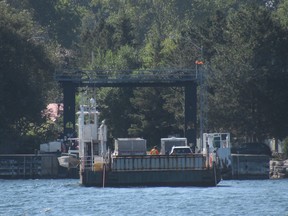
HOWE ISLAND — A consultant from the Ontario Ministry of Transportation has proposed replacing the aging Howe Island ferry with a new, all-electric vessel. In a report issued in March 2024, the consulting firm 3GA emphasized the potential benefits of an electric ferry, particularly in light of federal funding opportunities that could cover one-third of the estimated $12.5 million required for the new boat and terminal renovations.
The report outlined three possible options for the ferry’s future: retaining the current vessel, retrofitting it, or replacing it entirely. Built in 2004, the existing ferry is considered to be in fair condition, with approximately 30 years of service life remaining. Retrofitting the ferry would require nearly $7 million for extensive renovations, which would include modifications to create additional deck space and accommodate three lanes of traffic.
Challenges with Retrofitting
Despite these enhancements, the report noted that the width for vehicles would remain restricted. Operators would need to load vehicles carefully to avoid scenarios where larger vehicles block passenger access. This operational burden could complicate boarding, especially during peak times when many wide vehicles are using the ferry.
In late 2022, Frontenac County reduced the number of traffic lanes on the ferry from three to two, a move that sparked controversy but was deemed necessary for safety compliance. The consultant pointed out that retrofitting would not increase the ferry’s vehicle weight capacity beyond the current 45 tonnes, falling short of the road-legal limit of 63.5 tonnes. The ferry frequently transports agricultural vehicles between Howe Island and the mainland, underscoring the need for a solution that accommodates heavier loads.
In light of these challenges, the consultant recommended that replacing the ferry would be the most effective solution for improving service capacity, ensuring safety, and meeting future demands. A new vessel would not only address current needs but also allow for the existing ferry, the Frontenac Howe Islander, to be repurposed for other routes.
Evaluating Propulsion Options
The report examined three propulsion types for the new ferry: diesel, hybrid diesel-electric, and all-electric. While a new diesel engine would be the simplest option to implement, the report indicated that an electric or hybrid system could be more economically viable in the long run. Despite higher initial capital costs, these systems may qualify for federal funding through emissions reduction grants.
Federal funding could potentially cover over $4.3 million of the total expenditures for both the diesel-electric and all-electric options, making them more financially attractive than a traditional diesel-powered vessel. However, implementing these options would necessitate additional terminal upgrades for vessel charging, which would also be eligible for federal assistance.
The estimated costs for the various ferry options include approximately $8.5 million for a new diesel ferry, with an additional $1.4 million required for terminal upgrades. The hybrid diesel-electric ferry is projected to cost about $9.75 million plus $3.3 million in terminal renovations, while a new electric ferry would require around $9.2 million along with $3.3 million for terminal modifications. The report concluded that both the diesel-electric and electric ferries would have lower maintenance and operational costs.
As discussions continue regarding the ferry’s future, the recommendations from the Ontario Ministry of Transportation consultant will play a crucial role in shaping decisions that impact the residents of Howe Island and their vital transportation links.













Morris Churches Unite for Annual Good Friday Walk With the Cross

Chloe Zhao’s ‘Buffy’ Reboot Cancelled: Sarah Michelle Gellar Speaks Out

Essential Ingredients for Life Found in Ryugu Asteroid Samples

Urgent Rescue: NSR Airlifts Injured Climber from Nanaimo

Riverside Heart Ball Achieves Record $815,000 for Mental Health

Cognizant Launches AI Factory to Enhance Enterprise AI Scalability

Samsung’s Galaxy Watch 9 to Feature Larger Battery Than Before

Toronto’s AIDS Memorial Faces Potential Redesign Amid Community Concerns

Bayern Munich Loses Luis Díaz Red Card Appeal Despite Referee’s Admission

Secwepemc First Nation Seeks Aboriginal Title Over Kamloops Area

Fatal Crash on Highway 11 Claims Three Lives, Major Closure Ongoing

Manitoba’s Burger Champion Shines Again Amid Dining Innovations

Canadian Curler E.J. Harnden Announces Retirement from Competition

Urgent Fire Erupts at Salvation Army on Christmas Evening

Scientists Unearth Ancient Antarctic Ice to Unlock Climate Secrets

Minister Faces Scrutiny Over Delayed Foreign Interference Watchdog Appointment

Trump and McCormick to Announce $70 Billion Energy Investments

Monika Hibbs Unveils Acres Market & Interiors in Major Rebrand
-
 Politics5 months ago
Secwepemc First Nation Seeks Aboriginal Title Over Kamloops Area
-
 Top Stories4 months ago
Fatal Crash on Highway 11 Claims Three Lives, Major Closure Ongoing
-
 Lifestyle7 months ago
Manitoba’s Burger Champion Shines Again Amid Dining Innovations
-
 Sports3 months ago
Canadian Curler E.J. Harnden Announces Retirement from Competition
-
 Top Stories4 months ago
Urgent Fire Erupts at Salvation Army on Christmas Evening
-
 World9 months ago
Scientists Unearth Ancient Antarctic Ice to Unlock Climate Secrets
-
 World5 months ago
Minister Faces Scrutiny Over Delayed Foreign Interference Watchdog Appointment
-
 Entertainment9 months ago
Trump and McCormick to Announce $70 Billion Energy Investments
-
 Lifestyle9 months ago
Monika Hibbs Unveils Acres Market & Interiors in Major Rebrand
-

 Science9 months ago
Four Astronauts Return to Earth After International Space Station Mission
-

 Lifestyle9 months ago
TransLink Launches Food Truck Program to Boost Revenue in Vancouver
-

 World1 month ago
Ranchman’s Cookhouse & Dancehall to Relocate by Early 2027