
Education
Kamloops Residential School Search Identifies New Focus Areas

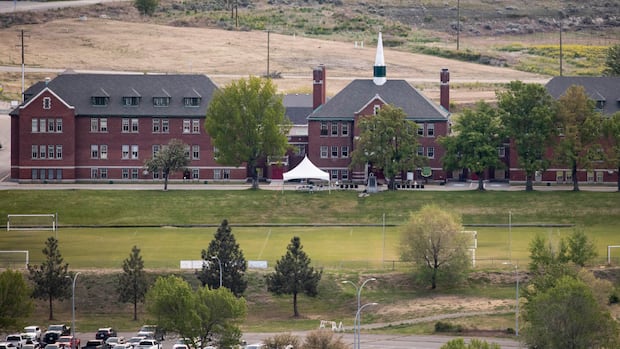
The Tk̓emlúps te Secwépemc First Nation has announced the identification of new areas for investigation at the former Kamloops Indian Residential School. This follows a series of surveys which have ruled out certain sections of the grounds as sites of potential unmarked graves. The ongoing inquiry has now determined which areas “should now be the primary focus” of the search, highlighting the complexity of the investigation.
Almost five years ago, Tk̓emlúps te Secwépemc revealed findings from an initial ground-penetrating radar survey that indicated approximately 200 potential unmarked graves on the grounds. This announcement sparked a nationwide movement, prompting First Nations across Canada to initiate similar searches and raising awareness among non-Indigenous Canadians about the historical injustices faced by Indigenous communities.
The First Nation stated that the investigation has proven to be “more complex” than initially anticipated. “We are making progress and will continue adapting our methodologies and information as it advances,” the Tk̓emlúps te Secwépemc said in a statement.
Investigation Techniques and Challenges
Tk̓emlúps te Secwépemc has employed advanced technologies in their search, utilizing ground-penetrating radar, as well as a LiDAR (Light Detection and Ranging) scanner. This technology involves rapid laser pulses to create three-dimensional representations of the terrain. Additionally, specialized dog teams trained to detect historic human remains have contributed to the investigation.
The findings from these methods have revealed overlaps in several areas, which have now been identified as the focus for further exploration. Although the First Nation did not disclose specific locations, they noted that the surveys have detected “signatures that resemble burials” in certain parts of the grounds while ruling out others.
Accessing historical records from the Catholic Church and government entities has presented challenges, particularly due to bureaucratic restrictions and slow response times. The Catholic Church operated the residential school from 1890 to 1969, and the federal government managed it as a day school until its closure in 1978.
Cultural Sensitivity and Future Steps
Debate continues regarding the exhumation of remains at former residential school sites. Some survivors advocate for leaving remains undisturbed, while others believe that exhumation could aid in providing closure for families. The Tk̓emlúps te Secwépemc have emphasized that should any ancestral remains be discovered, they will seek consensus with the numerous First Nations whose ancestors attended the institution.
“Each nation upholds its own cultural and spiritual protocols for how ancestral remains must be treated,” the statement read. The First Nation acknowledges the challenge of reaching full consensus among all affected groups.
Support services remain available for individuals impacted by their experiences at residential schools or intergenerational trauma. A national Indian Residential School Crisis Line has been established, offering emotional and crisis referral services. Those in need of support can contact the 24-hour national crisis line at 1-866-925-4419.
The former Kamloops Indian Residential School, where those initial findings were reported, has since been designated a national historic site. More than 150,000 First Nations, Métis, and Inuit children were forced to attend residential schools across Canada between the 1870s and 1997, with the National Centre for Truth and Reconciliation estimating that about 4,100 children died in these institutions, although the true number is likely higher.
The Tk̓emlúps te Secwépemc First Nation continues to navigate this sensitive investigation, seeking both truth and reconciliation as they honor the memories of those affected by the residential school system.












Morris Churches Unite for Annual Good Friday Walk With the Cross

Chloe Zhao’s ‘Buffy’ Reboot Cancelled: Sarah Michelle Gellar Speaks Out

Essential Ingredients for Life Found in Ryugu Asteroid Samples

Urgent Rescue: NSR Airlifts Injured Climber from Nanaimo

Riverside Heart Ball Achieves Record $815,000 for Mental Health

Cognizant Launches AI Factory to Enhance Enterprise AI Scalability

Samsung’s Galaxy Watch 9 to Feature Larger Battery Than Before

Toronto’s AIDS Memorial Faces Potential Redesign Amid Community Concerns

Bayern Munich Loses Luis Díaz Red Card Appeal Despite Referee’s Admission

Secwepemc First Nation Seeks Aboriginal Title Over Kamloops Area

Fatal Crash on Highway 11 Claims Three Lives, Major Closure Ongoing

Manitoba’s Burger Champion Shines Again Amid Dining Innovations

Canadian Curler E.J. Harnden Announces Retirement from Competition

Urgent Fire Erupts at Salvation Army on Christmas Evening

Scientists Unearth Ancient Antarctic Ice to Unlock Climate Secrets

Minister Faces Scrutiny Over Delayed Foreign Interference Watchdog Appointment

Trump and McCormick to Announce $70 Billion Energy Investments

Monika Hibbs Unveils Acres Market & Interiors in Major Rebrand
-
 Politics5 months ago
Secwepemc First Nation Seeks Aboriginal Title Over Kamloops Area
-
 Top Stories4 months ago
Fatal Crash on Highway 11 Claims Three Lives, Major Closure Ongoing
-
 Lifestyle7 months ago
Manitoba’s Burger Champion Shines Again Amid Dining Innovations
-
 Sports3 months ago
Canadian Curler E.J. Harnden Announces Retirement from Competition
-
 Top Stories4 months ago
Urgent Fire Erupts at Salvation Army on Christmas Evening
-
 World9 months ago
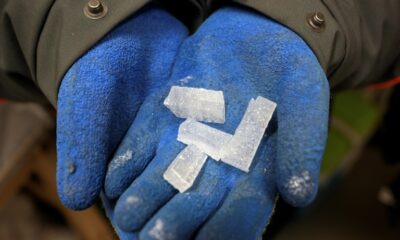
Scientists Unearth Ancient Antarctic Ice to Unlock Climate Secrets
-
 World5 months ago
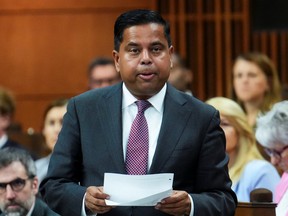
Minister Faces Scrutiny Over Delayed Foreign Interference Watchdog Appointment
-
 Entertainment9 months ago
Trump and McCormick to Announce $70 Billion Energy Investments
-
 Lifestyle9 months ago
Monika Hibbs Unveils Acres Market & Interiors in Major Rebrand
-

 Science9 months ago
Four Astronauts Return to Earth After International Space Station Mission
-

 Lifestyle9 months ago
TransLink Launches Food Truck Program to Boost Revenue in Vancouver
-
 World1 month ago
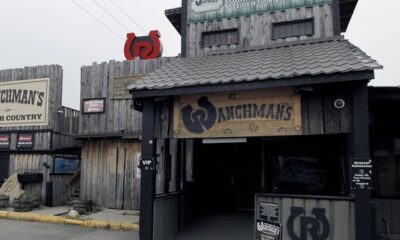
Ranchman’s Cookhouse & Dancehall to Relocate by Early 2027