
Education
Thrift Shop Discovery Sparks Excitement Over Potential Ancient Artifacts

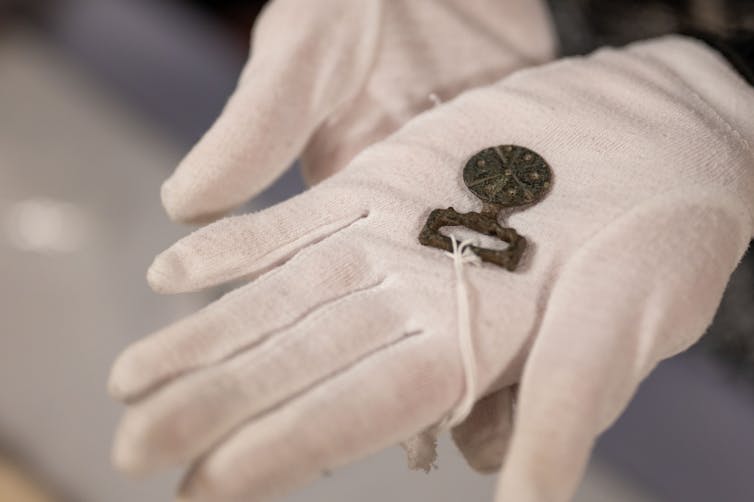
In a surprising turn of events, a thrift shop in Chilliwack, British Columbia, has become the center of an archaeological investigation. Thrifty Boutique contacted the archaeology department at Simon Fraser University (SFU) in spring 2024, seeking expertise to determine the authenticity of several items believed to be ancient artifacts. The shop staff reported that a customer suggested the collection, including eleven rings and two medallions—one possibly a belt buckle—might date back to ancient times, with a price tag of just $30.
Following the store’s inquiry, faculty members, including Babara Hilden, director of the Museum of Archaeology and Ethnology at SFU, conducted an initial analysis of the items. The preliminary assessment indicated that the artifacts likely originated from within the boundaries of the once-mighty Roman Empire. They may date back to late antiquity, around the third to sixth or seventh century, or possibly the medieval period.
The decorative motifs on the objects play a significant role in this estimation. One medallion features a Chi Rho, a symbol that was prominent during late antiquity, while the other resembles artifacts from the Byzantine Period. The contrasting characteristics of these items suggest they were not part of the same collection, indicating the likelihood that they were individually acquired and later donated.
With the potential for these objects to be genuine ancient artifacts, Thrifty Boutique offered to donate them to SFU’s archaeology museum. The decision required careful consideration of the museum’s capacity to preserve these items responsibly. Ultimately, the museum committed to their stewardship, recognizing the educational opportunities they could provide to students. However, the official transfer of the items took over a year, as the faculty grappled with the ethical implications of acquiring artifacts without known provenance.
Acquiring items without clear ownership history poses significant challenges for museums. The Canadian Museums Association Ethics Guidelines emphasize the importance of not participating in the illicit trade of cultural objects. The lack of provenance makes it difficult to ascertain whether these artifacts were obtained legally or through looting, despite existing laws like the Canadian Property Import and Export Act that aim to regulate such practices.
The museum community acknowledges the responsibility to avoid accepting potentially illicit donations. However, with no current information regarding the artifacts’ origins, the museum cannot inform the authorities or facilitate their return to any original source. SFU’s Museum of Archaeology and Ethnology has a long-standing commitment to ethical engagement with communities, including repatriation efforts, and remains dedicated to responsibly addressing this situation should the authenticity of the items be confirmed.
Archaeological forgeries, while not often the subject of public discourse, represent a significant issue within museum collections globally. Historical cases, such as the Glozel hoax in France during the 1920s and the infamous Piltdown Man fossil forgery, illustrate the challenges faced in distinguishing authentic artifacts from forgeries. Although various scientific techniques can aid in verifying authenticity, the intricate skill involved in creating convincing replicas complicates definitive assessments.
Regardless of whether the newly discovered items are genuine artifacts or modern replicas, they will hold a place within the museum. Engaging with these objects allows students to hone their investigative skills as they delve into the processes of museum research. This hands-on approach enhances their understanding of provenance and artifact significance while fostering a deeper appreciation for archaeology.
To further enrich the educational experience, SFU has designed a new archaeology course set to launch in September 2026. This course will focus on ethical considerations and the complexities of provenance research. Students will explore what steps may be necessary should the artifacts be determined to be authentic and potentially eligible for repatriation.
Collaborative opportunities with local museum professionals will also enhance student learning, with mentoring on exhibition development and public engagement. This collaboration aims to prepare aspiring museum and cultural heritage professionals for future careers. Students will benefit from access to advanced technologies, such as X-ray fluorescence for elemental analysis and 3D scanning techniques, to further study the artifacts and their contexts.
Ultimately, the discovery at Thrifty Boutique not only sparks excitement over potential ancient artifacts but also opens a dialogue about ethical stewardship, provenance, and the educational value of hands-on engagement in archaeology. The faculty and students at SFU eagerly anticipate uncovering more about these mysterious objects and their place in history.













Christmas Cheer Breakfast Breaks Record with $2,327 Donation

Daxon Rudolph Delivers Overtime Winner, Raiders Top Oil Kings 4-3

Poets Rally for Hope in Somalia Amid Ongoing Violence

Edmonton Parents Honor Children in Emotional Candlelight Ceremony

Hundreds of Stuffed Animals Tossed at Oil Kings Game for Charity

Urgent Rescue: Seriously Injured Biker Saved After 5.5-Hour Operation

Urgent: Mezuzahs Torn from Doors in North York Housing Complex

Vancouver Councillor Moves to End Use of X.com for Meeting Updates

Two Men Fined $7K for Illegal Moose Hunting in Ontario

Secwepemc First Nation Seeks Aboriginal Title Over Kamloops Area

Scientists Unearth Ancient Antarctic Ice to Unlock Climate Secrets

Trump and McCormick to Announce $70 Billion Energy Investments

Four Astronauts Return to Earth After International Space Station Mission

TransLink Launches Food Truck Program to Boost Revenue in Vancouver

Apple Notes Enhances Functionality with Markdown Support in macOS 26

Manitoba’s Burger Champion Shines Again Amid Dining Innovations

Urgent Update: Fatal Crash on Highway 99 Claims Life of Pitt Meadows Man

Homemade Houseboat ‘Neverlanding’ Captivates Lake Huron Voyagers
-
 Politics1 month ago
Secwepemc First Nation Seeks Aboriginal Title Over Kamloops Area
-
 World5 months ago
Scientists Unearth Ancient Antarctic Ice to Unlock Climate Secrets
-
 Entertainment5 months ago
Trump and McCormick to Announce $70 Billion Energy Investments
-
 Science5 months ago
Four Astronauts Return to Earth After International Space Station Mission
-
 Lifestyle5 months ago
TransLink Launches Food Truck Program to Boost Revenue in Vancouver
-
 Technology3 months ago
Apple Notes Enhances Functionality with Markdown Support in macOS 26
-
 Lifestyle3 months ago
Manitoba’s Burger Champion Shines Again Amid Dining Innovations
-
 Top Stories2 months ago
Urgent Update: Fatal Crash on Highway 99 Claims Life of Pitt Meadows Man
-
 Top Stories1 week ago
Homemade Houseboat ‘Neverlanding’ Captivates Lake Huron Voyagers
-

 Politics4 months ago
Ukrainian Tennis Star Elina Svitolina Faces Death Threats Online
-

 Sports5 months ago
Search Underway for Missing Hunter Amid Hokkaido Bear Emergency
-

 Politics5 months ago
Carney Engages First Nations Leaders at Development Law Summit