
Health
Canadians Face Record Health Care Delays, Manitoba Shows Mixed Results

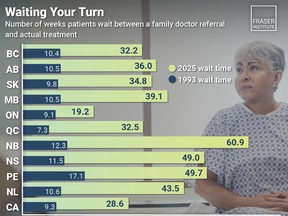
Canadians are facing significant delays in accessing medically necessary health care, with patients waiting an average of more than six months from a family doctor referral to treatment, according to a new report by the Fraser Institute. The study, titled Waiting Your Turn: Wait Times for Health Care in Canada, 2025, reveals that patients waited a median of 28.6 weeks from referral to treatment in 2025. While this marks a slight improvement from the 30.0 weeks recorded in 2024, it remains the second-longest wait time in the report’s 34-year history.
“Remarkably long wait times for medically necessary care have become the defining characteristic of the Canadian health-care experience,” stated Nadeem Esmail, director of health policy studies at the Fraser Institute and co-author of the report. This annual survey, which draws on responses from physicians across 10 provinces and 12 medical specialties, indicates that wait times have increased by 208% since 1993, when the median wait was just 9.3 weeks.
Manitoba’s Performance in the Wait Times Landscape
While Manitoba did not have the shortest overall wait times, it showed relatively better performance in the second stage of care, which encompasses the time between seeing a specialist and receiving treatment. The province recorded a median wait of 15.7 weeks in this phase, ranking among the shorter wait times nationally. Only Ontario (8.5 weeks) and British Columbia (12.4 weeks) reported faster access.
However, like many provinces, Manitobans are still facing delays earlier in the health care process. The national average wait time between referral by a family doctor and a specialist consultation rose slightly to 15.3 weeks in 2025, continuing a long-term upward trend.
Disparities Across Canada
The report highlights stark differences in wait times across the country. Ontario reported the shortest overall median wait at 19.2 weeks, while New Brunswick endured the longest wait at 60.9 weeks. Additionally, Prince Edward Island (49.7 weeks) and Nova Scotia (49.0 weeks) witnessed patients waiting nearly a full year for care. Nationwide, approximately 1.4 million Canadians were waiting for medically necessary procedures in 2025.
Wait times also varied significantly based on the type of care needed. Nationally, patients faced the longest waits for neurosurgery (49.9 weeks) and orthopaedic surgery (48.6 weeks), both of which are often associated with chronic pain and reduced quality of life. In contrast, wait times were considerably shorter for radiation oncology (4.2 weeks) and medical oncology (4.7 weeks).
Even after consulting a specialist, Canadians experienced an average wait of 4.5 weeks longer than what physicians consider clinically reasonable. “Long wait times can result in increased suffering for patients, lost productivity at work, decreased quality of life, and, in the worst cases, disability or death,” remarked Mackenzie Moir, senior policy analyst at the Fraser Institute and co-author of the study.
The report also emphasizes ongoing delays in diagnostic imaging, a crucial step in diagnosis and treatment planning. In 2025, patients waited a median of 8.8 weeks for CT scans, 18.1 weeks for MRI scans, and 5.4 weeks for ultrasounds, with some provinces reporting delays of several months for MRI scans.
This comprehensive study underscores the pressing challenges within Canada’s health care system, calling for urgent attention to address the increasing wait times that affect millions of citizens across the country.













Morris Churches Unite for Annual Good Friday Walk With the Cross

Chloe Zhao’s ‘Buffy’ Reboot Cancelled: Sarah Michelle Gellar Speaks Out

Essential Ingredients for Life Found in Ryugu Asteroid Samples

Urgent Rescue: NSR Airlifts Injured Climber from Nanaimo

Riverside Heart Ball Achieves Record $815,000 for Mental Health

Cognizant Launches AI Factory to Enhance Enterprise AI Scalability

Samsung’s Galaxy Watch 9 to Feature Larger Battery Than Before

Toronto’s AIDS Memorial Faces Potential Redesign Amid Community Concerns

Bayern Munich Loses Luis Díaz Red Card Appeal Despite Referee’s Admission

Secwepemc First Nation Seeks Aboriginal Title Over Kamloops Area

Fatal Crash on Highway 11 Claims Three Lives, Major Closure Ongoing

Manitoba’s Burger Champion Shines Again Amid Dining Innovations

Canadian Curler E.J. Harnden Announces Retirement from Competition

Urgent Fire Erupts at Salvation Army on Christmas Evening

Scientists Unearth Ancient Antarctic Ice to Unlock Climate Secrets

Minister Faces Scrutiny Over Delayed Foreign Interference Watchdog Appointment

Trump and McCormick to Announce $70 Billion Energy Investments

Monika Hibbs Unveils Acres Market & Interiors in Major Rebrand
-
 Politics5 months ago
Secwepemc First Nation Seeks Aboriginal Title Over Kamloops Area
-
 Top Stories4 months ago
Fatal Crash on Highway 11 Claims Three Lives, Major Closure Ongoing
-
 Lifestyle7 months ago
Manitoba’s Burger Champion Shines Again Amid Dining Innovations
-
 Sports3 months ago
Canadian Curler E.J. Harnden Announces Retirement from Competition
-
 Top Stories4 months ago
Urgent Fire Erupts at Salvation Army on Christmas Evening
-
 World9 months ago
Scientists Unearth Ancient Antarctic Ice to Unlock Climate Secrets
-
 World5 months ago
Minister Faces Scrutiny Over Delayed Foreign Interference Watchdog Appointment
-
 Entertainment9 months ago
Trump and McCormick to Announce $70 Billion Energy Investments
-
 Lifestyle9 months ago
Monika Hibbs Unveils Acres Market & Interiors in Major Rebrand
-

 Science9 months ago
Four Astronauts Return to Earth After International Space Station Mission
-

 Lifestyle9 months ago
TransLink Launches Food Truck Program to Boost Revenue in Vancouver
-

 World1 month ago
Ranchman’s Cookhouse & Dancehall to Relocate by Early 2027