
Politics
Alberta Separatism Dominates Conservative Party Convention Discussions

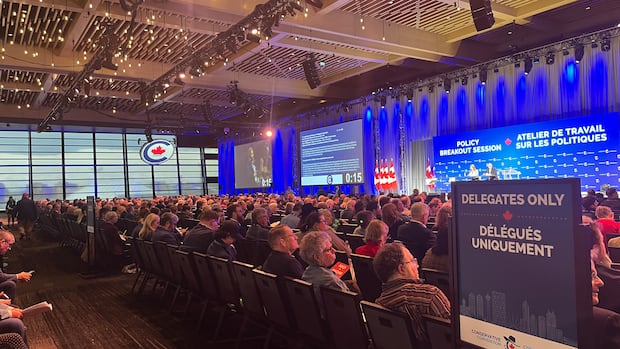
The Conservative Party convention in Calgary has become a focal point for discussions on Alberta separatism, a contentious issue gaining traction among conservative circles in the province. The convention, attended by approximately 2,650 delegates, is overshadowed by a separatist rally hosted by Stay Free Alberta, which attracted over 3,000 supporters just a short distance away at the Big Four building.
This growing sentiment for independence has sparked intense debate among delegates. Many attendees express a desire for a referendum on Alberta’s potential secession from Canada. Daniel Hein, a delegate from Medicine Hat, indicated his support for the initiative, emphasizing the need for a public discussion on the matter. “I want the question, that’s what I want,” he stated. “I’m tired of people saying, you hush.”
Another delegate, Norman Schachar, echoed these sentiments, suggesting that the discussions surrounding Alberta’s future need to be addressed openly. He noted that while many of his Conservative friends are interested in the topic, they are not necessarily ready to take immediate action. “They want to talk about moving, but they aren’t packing their bags,” Schachar said.
The issue has caught the attention of Conservative Leader Pierre Poilievre, who is expected to address separatism during his speech at the convention. This comes amid increasing calls for party leaders, including Alberta Premier Danielle Smith, to take a definitive stand against rising separatist sentiments. Ontario Premier Doug Ford challenged Premier Smith to clarify her position, stating, “This is an opportunity for Premier Smith to stand up and say, ‘Enough is enough.’ Either you’re with Canada or you’re not with Canada.”
Political tensions are further heightened by the response of the Alberta New Democrats, who have called for all United Conservative Party (UCP) members to publicly declare their stance on separatism. Despite this, a UCP caucus spokeswoman noted that while members are free to express their views, there is no confirmation of any MLAs signing the separatist petition.
According to Jeff Rath, legal counsel for Stay Free Alberta, several UCP MLAs have signed the petition, though he declined to disclose their names. The petition requires at least 177,732 signatures from Albertans by May to mandate a referendum on the issue, representing less than six percent of the province’s eligible voters.
Support for separatism is particularly pronounced among conservative activists in rural Alberta, where the sentiment runs high outside major urban centers like Edmonton and Calgary. Some MPs, including David Bexte and Shannon Stubbs, have refrained from taking a public stance on signing the petition, reflecting the complexity and sensitivity surrounding the topic within their constituencies. Stubbs acknowledged the frustrations of her constituents, who feel that they have been marginalized by the federal government. “People are losing hope about the concept that Alberta will ever get a fair deal,” she remarked.
The divide over independence is also evident within the federal Conservative base. A survey conducted by Janet Brown Research indicated that 49 percent of self-identified Conservative voters in Alberta would support a “Yes” vote for separation, while 45 percent would oppose it. More recent polls suggest that general support for separation among all Albertans ranges from 20 percent to the low 30s.
As delegates deliberate over the leadership of Poilievre, the issue of Alberta separatism poses a significant challenge. Some believe that openly denouncing the separatist movement could alienate a substantial portion of the party’s base. Delegate Gord Tulk warned against dismissive attitudes towards those supporting independence, noting that many feel unheard and frustrated. “We cannot have massive federal interference continue even more and more,” he stated, reflecting a growing sentiment among conservatives in the region.
The political landscape in Alberta is evolving rapidly, and as discussions continue at the Conservative convention, the implications of Alberta separatism are likely to resonate far beyond the province’s borders.










Morris Churches Unite for Annual Good Friday Walk With the Cross

Chloe Zhao’s ‘Buffy’ Reboot Cancelled: Sarah Michelle Gellar Speaks Out

Essential Ingredients for Life Found in Ryugu Asteroid Samples

Urgent Rescue: NSR Airlifts Injured Climber from Nanaimo

Riverside Heart Ball Achieves Record $815,000 for Mental Health

Cognizant Launches AI Factory to Enhance Enterprise AI Scalability

Samsung’s Galaxy Watch 9 to Feature Larger Battery Than Before

Toronto’s AIDS Memorial Faces Potential Redesign Amid Community Concerns

Bayern Munich Loses Luis Díaz Red Card Appeal Despite Referee’s Admission

Secwepemc First Nation Seeks Aboriginal Title Over Kamloops Area

Fatal Crash on Highway 11 Claims Three Lives, Major Closure Ongoing

Manitoba’s Burger Champion Shines Again Amid Dining Innovations

Canadian Curler E.J. Harnden Announces Retirement from Competition

Urgent Fire Erupts at Salvation Army on Christmas Evening

Scientists Unearth Ancient Antarctic Ice to Unlock Climate Secrets

Trump and McCormick to Announce $70 Billion Energy Investments

Minister Faces Scrutiny Over Delayed Foreign Interference Watchdog Appointment

Four Astronauts Return to Earth After International Space Station Mission
-
 Politics5 months ago
Secwepemc First Nation Seeks Aboriginal Title Over Kamloops Area
-
 Top Stories4 months ago
Fatal Crash on Highway 11 Claims Three Lives, Major Closure Ongoing
-
 Lifestyle7 months ago
Manitoba’s Burger Champion Shines Again Amid Dining Innovations
-
 Sports3 months ago
Canadian Curler E.J. Harnden Announces Retirement from Competition
-
 Top Stories3 months ago
Urgent Fire Erupts at Salvation Army on Christmas Evening
-
 World9 months ago
Scientists Unearth Ancient Antarctic Ice to Unlock Climate Secrets
-
 Entertainment9 months ago
Trump and McCormick to Announce $70 Billion Energy Investments
-
 World5 months ago
Minister Faces Scrutiny Over Delayed Foreign Interference Watchdog Appointment
-
 Science9 months ago
Four Astronauts Return to Earth After International Space Station Mission
-

 Lifestyle9 months ago
Monika Hibbs Unveils Acres Market & Interiors in Major Rebrand
-

 Lifestyle9 months ago
TransLink Launches Food Truck Program to Boost Revenue in Vancouver
-
 World1 month ago
Ranchman’s Cookhouse & Dancehall to Relocate by Early 2027