
Politics
British Columbia Introduces Bill 5 to Enhance Interprovincial Trade


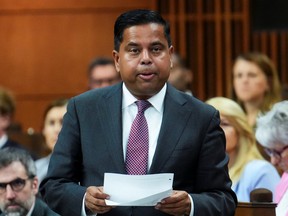
British Columbia has taken a significant step to bolster its economy by introducing the Trade Recognition Act, known as Bill 5, aimed at removing interprovincial trade barriers. The announcement was made on February 18, 2026, by Minister of Jobs and Economic Growth, Ravi Kahlon, who emphasized the importance of addressing challenges posed by unfair tariffs from the United States. This legislative move is expected to enhance the flow of goods and services across Canada, ultimately benefiting consumers and businesses alike.
During a media briefing, Kahlon outlined the necessity of the legislation in light of the ongoing US tariff and trade war, which has created economic uncertainty for Canadian businesses. He stated, “It is critically important to try to address the challenges of unfair tariffs.” The goals of Bill 5 include tracking investments in British Columbia, fostering international partnerships, and streamlining interprovincial trade to ensure efficient distribution of products.
Key Features of Bill 5
The Trade Recognition Act aims to simplify the movement of goods throughout British Columbia and across Canada, reducing both time and costs for businesses. Kahlon highlighted the legislation’s potential to lower prices for consumers by facilitating smoother trade practices. He noted that the framework is foundational for unlocking economic activity and will help address specific challenges related to the interprovincial trade of food and liquor, as well as labor mobility.
Kahlon assured that all safety and environmental standards would remain intact under the new framework. He expressed that removing barriers to trade is essential for fostering competition, which in turn will lead to more affordable products for consumers. “We have to allow for goods at least within Canada to move freely,” he stated.
The introduction of Bill 5 comes on the heels of discussions among provinces regarding interprovincial trade. Notably, Manitoba is also working on similar legislation to facilitate trade. Kahlon pointed out that businesses have often found it easier to export to international markets than to navigate the complexities of selling to other provinces within Canada.
Collaborative Efforts and Future Goals
The provincial government aims to promote interprovincial trade through ongoing collaboration with other jurisdictions. Premier David Eby has actively engaged with other provincial leaders, underscoring the necessity of a cohesive approach to trade during meetings held throughout 2025. A collective communique from the premiers indicated a strong commitment to having agreements in place within the year.
Kahlon also discussed the upcoming discussions regarding the Canada-United States-Mexico Agreement (CUSMA) and the need for provinces to contribute to federal negotiations. He identified “unfair tariffs on our forest products” as a primary concern that will be addressed in the forthcoming meetings. Additionally, he noted an increase in trade with non-US partners, specifically mentioning Vietnam and India as emerging markets interested in investing in British Columbia.
The provincial government is also taking steps to encourage BC crown corporations to prioritize Canadian products, a strategy that has shown positive effects in recent months. Kahlon asserted that the push to buy Canadian is now entering a new phase as negotiations related to CUSMA progress.
In summary, with the introduction of Bill 5, British Columbia is positioning itself to harness the full potential of interprovincial trade, aiming to create a more efficient marketplace that benefits both businesses and consumers. By addressing trade barriers and fostering collaboration with other provinces, the government seeks to strengthen the province’s economic resilience in the face of ongoing international challenges.













Morris Churches Unite for Annual Good Friday Walk With the Cross

Chloe Zhao’s ‘Buffy’ Reboot Cancelled: Sarah Michelle Gellar Speaks Out

Essential Ingredients for Life Found in Ryugu Asteroid Samples

Urgent Rescue: NSR Airlifts Injured Climber from Nanaimo

Riverside Heart Ball Achieves Record $815,000 for Mental Health

Cognizant Launches AI Factory to Enhance Enterprise AI Scalability

Samsung’s Galaxy Watch 9 to Feature Larger Battery Than Before

Toronto’s AIDS Memorial Faces Potential Redesign Amid Community Concerns

Bayern Munich Loses Luis Díaz Red Card Appeal Despite Referee’s Admission

Secwepemc First Nation Seeks Aboriginal Title Over Kamloops Area

Fatal Crash on Highway 11 Claims Three Lives, Major Closure Ongoing

Manitoba’s Burger Champion Shines Again Amid Dining Innovations

Canadian Curler E.J. Harnden Announces Retirement from Competition

Urgent Fire Erupts at Salvation Army on Christmas Evening

Scientists Unearth Ancient Antarctic Ice to Unlock Climate Secrets

Minister Faces Scrutiny Over Delayed Foreign Interference Watchdog Appointment

Trump and McCormick to Announce $70 Billion Energy Investments

Four Astronauts Return to Earth After International Space Station Mission
-
 Politics5 months ago
Secwepemc First Nation Seeks Aboriginal Title Over Kamloops Area
-
 Top Stories4 months ago
Fatal Crash on Highway 11 Claims Three Lives, Major Closure Ongoing
-
 Lifestyle7 months ago
Manitoba’s Burger Champion Shines Again Amid Dining Innovations
-
 Sports3 months ago
Canadian Curler E.J. Harnden Announces Retirement from Competition
-
 Top Stories3 months ago
Urgent Fire Erupts at Salvation Army on Christmas Evening
-
 World9 months ago
Scientists Unearth Ancient Antarctic Ice to Unlock Climate Secrets
-
 World5 months ago
Minister Faces Scrutiny Over Delayed Foreign Interference Watchdog Appointment
-
 Entertainment9 months ago
Trump and McCormick to Announce $70 Billion Energy Investments
-
 Science9 months ago
Four Astronauts Return to Earth After International Space Station Mission
-

 Lifestyle9 months ago
TransLink Launches Food Truck Program to Boost Revenue in Vancouver
-

 Lifestyle9 months ago
Monika Hibbs Unveils Acres Market & Interiors in Major Rebrand
-

 World1 month ago
Ranchman’s Cookhouse & Dancehall to Relocate by Early 2027