
Politics
EU Agrees on €90 Billion Loan to Strengthen Ukraine’s Defense

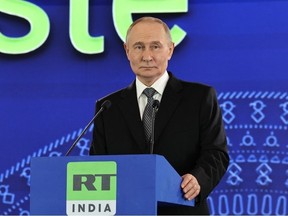
During a recent summit in Brussels, the European Council reached a critical agreement to provide a financial package of €90 billion to support Ukraine in its ongoing conflict against Russian aggression. This decision, announced on December 19, 2025, underscores the EU’s commitment to bolster Ukraine’s defense capabilities and enhance security across Europe.
The backdrop to this agreement includes ongoing tensions stemming from Russia’s invasion of Ukraine, which began in February 2022. Russian President Vladimir Putin has consistently denied responsibility for the conflict, claiming during his year-end press conference that “we do not consider ourselves responsible for the deaths of people, because we did not start this war.” His statements come despite extensive evidence of war crimes committed by Russian forces against Ukrainian civilians.
As the situation intensifies, Donald Tusk, Prime Minister of Poland, has been vocal about the threats posed by Russia not only to Ukraine but also to the security of Europe. Tusk recently asserted that Russian intelligence was involved in a terrorist attack on Poland’s transport infrastructure, stating, “Blowing up the rail track on the Warsaw-Lublin route is an unprecedented act of sabotage targeting directly the security of the Polish state and its civilians.”
The U.S. intelligence community has echoed concerns about Russia’s ambitions, with reports indicating that Putin aims to reclaim territories in Ukraine and Europe that were once part of the Soviet Union. Sources familiar with U.S. intelligence assert that Russia’s actions reflect a broader strategy of hybrid warfare against democracies.
In light of these developments, the European Council convened to strategize on financing Ukraine’s defense. Tusk emphasized the necessity of immediate support, stating, “Now we have a simple choice: either money today, or blood tomorrow.” His remarks highlight the urgency of the situation and the potential repercussions of insufficient financial aid.
The financial agreement reached by the European Council includes provisions for a loan of €90 billion for the years 2026-2027, financed through joint EU borrowing. António Costa, President of the European Council, confirmed the decision, stating that it reaffirms the EU’s steadfast commitment to Ukraine’s independence and territorial integrity. The official statement from the council also noted that the EU will continue to coordinate support alongside its partners.
Despite reaching this significant financial agreement, internal dissent within the EU complicated discussions. Notably, the Council could not agree on using frozen Russian assets to support Ukraine directly. Although the agreement does not include this option, the European Commission has reserved the right to consider using these assets for future financing.
President of the European Commission, Ursula von der Leyen, commented on the importance of the loan, stating, “We gathered today with a clear objective: to address Ukraine’s pressing financing needs. We delivered.” Ukrainian President Volodymyr Zelenskyy also expressed gratitude for the support, noting that the loan represents a significant geopolitical victory for Ukraine and strengthens its position in potential peace negotiations.
Ukrainian officials have characterized the loan as a decisive step towards economic resilience during wartime. Yulia Svyrydenko, Ukraine’s Prime Minister, remarked that economic stability is a vital prerequisite for security, both for Ukraine and Europe.
However, not all voices within Ukraine are satisfied with the outcome. Kira Rudik, a member of the Ukrainian parliament, criticized the EU for not utilizing frozen Russian assets, stating that the failure to find a solution demonstrates a lack of unity among EU states.
Sweden’s Minister for EU Affairs, Jessica Rosencrantz, expressed disappointment that the initial proposal to use Russian assets as collateral for reparations loans did not materialize. She emphasized the necessity of maintaining pressure on Russia while simultaneously strengthening Ukraine’s defenses.
As the European Union navigates these complex challenges, the implications of the loan agreement extend beyond financial assistance. It signals a collective resolve among European leaders to support Ukraine while also addressing the broader security concerns posed by Russia’s aggressive actions.
In conclusion, as the geopolitical landscape evolves, the European Union’s commitment to invest in Ukraine’s defense is crucial for both immediate security needs and long-term stability in the region. The ongoing dialogue around financing and support will likely shape the future of European security architecture amidst the ongoing conflict.









UPEI’s High-Tech Simulation Centre Enhances Future Healthcare Skills

Canadian Astronaut Chris Hadfield Advocates for Eye Health

GPIQ and QYLD: Evaluating Strategies Amid Market Stagnation

Norovirus Outbreak Forces Canada’s Hockey Game Postponement

Fauna Robotics Unveils Sprout: A Humanoid Robot for Home Use

Team Canada Faces Goaltending Concerns Ahead of Olympics

Celebrating the Life of Irena Peritz: A Legacy of Love and Resilience

India, U.S. Announce Urgent Trade Deal to Slash Tariffs Now

American Airlines Pilots Challenge Management After Poor Results

Secwepemc First Nation Seeks Aboriginal Title Over Kamloops Area

Scientists Unearth Ancient Antarctic Ice to Unlock Climate Secrets

Urgent Fire Erupts at Salvation Army on Christmas Evening

Canadian Curler E.J. Harnden Announces Retirement from Competition

Manitoba’s Burger Champion Shines Again Amid Dining Innovations

Fatal Crash on Highway 11 Claims Three Lives, Major Closure Ongoing

Trump and McCormick to Announce $70 Billion Energy Investments

Four Astronauts Return to Earth After International Space Station Mission

TransLink Launches Food Truck Program to Boost Revenue in Vancouver
-
 Politics3 months ago
Secwepemc First Nation Seeks Aboriginal Title Over Kamloops Area
-
 World7 months ago
Scientists Unearth Ancient Antarctic Ice to Unlock Climate Secrets
-
 Top Stories1 month ago
Urgent Fire Erupts at Salvation Army on Christmas Evening
-
 Sports1 month ago
Canadian Curler E.J. Harnden Announces Retirement from Competition
-
 Lifestyle5 months ago
Manitoba’s Burger Champion Shines Again Amid Dining Innovations
-
 Top Stories2 months ago
Fatal Crash on Highway 11 Claims Three Lives, Major Closure Ongoing
-
 Entertainment7 months ago
Trump and McCormick to Announce $70 Billion Energy Investments
-
 Science7 months ago
Four Astronauts Return to Earth After International Space Station Mission
-
 Lifestyle7 months ago
TransLink Launches Food Truck Program to Boost Revenue in Vancouver
-

 Technology5 months ago
Apple Notes Enhances Functionality with Markdown Support in macOS 26
-

 Top Stories1 month ago
Blue Jays Sign Kazuma Okamoto: Impact on Bo Bichette’s Future
-

 Top Stories2 months ago
NHL Teams Inquire About Marc-André Fleury’s Potential Return