
Politics
First Nations Demand Respect for Treaties Amid Alberta Referendum Push

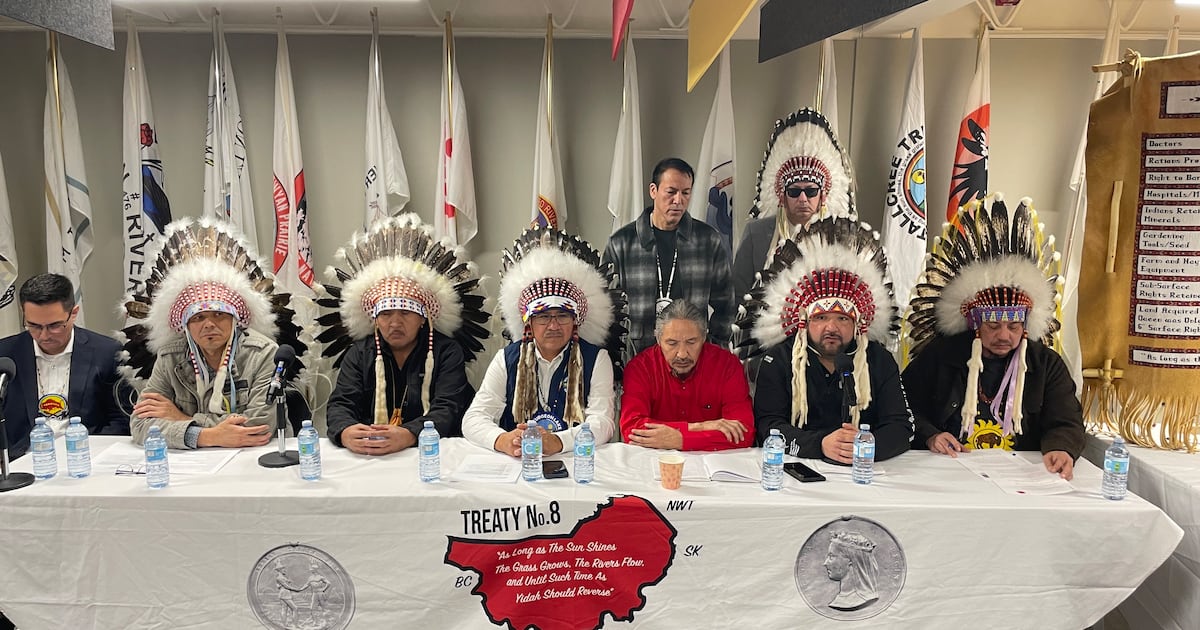
A coalition of First Nations chiefs in Alberta is urging politicians to uphold treaty rights as discussions about the province’s potential separation from Canada intensify. These leaders, representing communities under Treaties 3, 6, 7, and 8, voiced their concerns following the Alberta government’s recent passage of Bill 14, also known as the Justice Statutes Amendment Act 2025. This legislation enables citizen initiatives to bypass the Constitution, allowing for a referendum on independence.
The Alberta Prosperity Project is at the forefront of this movement, having received approval from Elections Alberta for a ballot question that asks, “Do you agree that the province of Alberta shall become a sovereign country and cease to be a province in Canada?” This initiative requires the collection of at least 177,732 signatures by May 2, 2025, to proceed. The push for independence gained momentum after an Alberta judge ruled in early December that a similar question had violated constitutional guidelines.
During a media conference in Edmonton, Sturgeon Lake Cree First Nation Chief Sheldon Sunshine articulated the chiefs’ collective stance, stating they “strongly oppose any petition calling for a separation referendum.” He emphasized that the recent developments concerning Alberta’s independence are serious matters that warrant careful consideration.
The chiefs are also pursuing legal action against the province, claiming that the new law infringes upon their treaty rights. The Sturgeon Lake Cree Nation, Athabasca Chipewyan First Nation, Siksika Nation, Piikani Nation, and the Blood Tribe are among the groups involved in this lawsuit. A spokesperson for the Alberta Justice department acknowledged the importance of treaty rights but refrained from commenting further, citing the ongoing legal proceedings.
In the past week, discussions involving Alberta and the United States have raised eyebrows. U.S. Treasury Secretary Scott Bessent referred to Alberta as “a natural partner,” suggesting the province should consider joining the U.S. This commentary, alongside a report from the Financial Times indicating that leaders of the Alberta Prosperity Project have engaged with U.S. State Department officials multiple times, has drawn criticism from B.C. Premier David Eby, who labeled such discussions as “treason” during a recent meeting of Canadian premiers.
While Mitch Sylvestre, a key figure in the Alberta Prosperity Project, downplayed the notion of wanting to join the U.S., he acknowledged the significance of Bessent’s remarks. “We’ve seen what’s happening south of the border,” Chief Sunshine responded. He urged all Albertans to take these developments seriously, highlighting the implications for the province’s political future.
Provincial leaders, including Premier Danielle Smith and Prime Minister Mark Carney, responded cautiously to the reported meetings in Washington. Smith stated her expectation that the U.S. administration would respect Canadian sovereignty and indicated she would address the matter with her delegate in Washington. Carney echoed her sentiments, emphasizing the importance of maintaining discussions within the framework of Canadian governance.
Smith has expressed that her administration supports “a strong and sovereign Alberta within a united Canada.” However, she acknowledged that polls show approximately one million Albertans feel disillusioned after what she described as a decade of federal government challenges to Alberta’s resource economy. “I’m not going to demonize or marginalize a million of my fellow citizens when they’ve got legitimate grievances,” she said.
The Alberta Prosperity Project’s legal representative, Jeff Rath, defended the actions of the group, asserting that they are private citizens without the authority to negotiate on behalf of the province. “We have not entered into any agreements with the United States regarding anything,” he clarified.
As the chiefs continue to assert their treaty rights, they express concern that the referendum question could foster racial discrimination within Alberta. “Alberta was never a party to treaty and has no jurisdiction over our lands,” stated Trevor Mercredi, Grand Chief of the Treaty 8 First Nations of Alberta. “We’re here to fight and stand strong against this discussion around separation and how it’s impacting our people and our communities.”
Grand Chief Joey Pete of Treaty 6 echoed these sentiments, highlighting the paradox of unity amid ongoing treaty disrespect. “Alberta sovereignty is an illusion. Without treaty, Alberta, as we know it, wouldn’t even exist.”
The situation remains fluid as the provincial government navigates the complexities of independence discussions while addressing the rights and concerns of First Nations communities.










Morris Churches Unite for Annual Good Friday Walk With the Cross

Chloe Zhao’s ‘Buffy’ Reboot Cancelled: Sarah Michelle Gellar Speaks Out

Essential Ingredients for Life Found in Ryugu Asteroid Samples

Urgent Rescue: NSR Airlifts Injured Climber from Nanaimo

Riverside Heart Ball Achieves Record $815,000 for Mental Health

Cognizant Launches AI Factory to Enhance Enterprise AI Scalability

Samsung’s Galaxy Watch 9 to Feature Larger Battery Than Before

Toronto’s AIDS Memorial Faces Potential Redesign Amid Community Concerns

Bayern Munich Loses Luis Díaz Red Card Appeal Despite Referee’s Admission

Secwepemc First Nation Seeks Aboriginal Title Over Kamloops Area

Fatal Crash on Highway 11 Claims Three Lives, Major Closure Ongoing

Manitoba’s Burger Champion Shines Again Amid Dining Innovations

Canadian Curler E.J. Harnden Announces Retirement from Competition

Urgent Fire Erupts at Salvation Army on Christmas Evening

Scientists Unearth Ancient Antarctic Ice to Unlock Climate Secrets

Minister Faces Scrutiny Over Delayed Foreign Interference Watchdog Appointment

Trump and McCormick to Announce $70 Billion Energy Investments

Four Astronauts Return to Earth After International Space Station Mission
-
 Politics5 months ago
Secwepemc First Nation Seeks Aboriginal Title Over Kamloops Area
-
 Top Stories4 months ago
Fatal Crash on Highway 11 Claims Three Lives, Major Closure Ongoing
-
 Lifestyle7 months ago
Manitoba’s Burger Champion Shines Again Amid Dining Innovations
-
 Sports3 months ago
Canadian Curler E.J. Harnden Announces Retirement from Competition
-
 Top Stories3 months ago
Urgent Fire Erupts at Salvation Army on Christmas Evening
-
 World9 months ago
Scientists Unearth Ancient Antarctic Ice to Unlock Climate Secrets
-
 World5 months ago
Minister Faces Scrutiny Over Delayed Foreign Interference Watchdog Appointment
-
 Entertainment9 months ago
Trump and McCormick to Announce $70 Billion Energy Investments
-
 Science9 months ago
Four Astronauts Return to Earth After International Space Station Mission
-

 Lifestyle9 months ago
Monika Hibbs Unveils Acres Market & Interiors in Major Rebrand
-

 Lifestyle9 months ago
TransLink Launches Food Truck Program to Boost Revenue in Vancouver
-

 World1 month ago
Ranchman’s Cookhouse & Dancehall to Relocate by Early 2027