
Politics
Holt Liberals Seek Public Input on Budget Cuts Amid Deficit Crisis

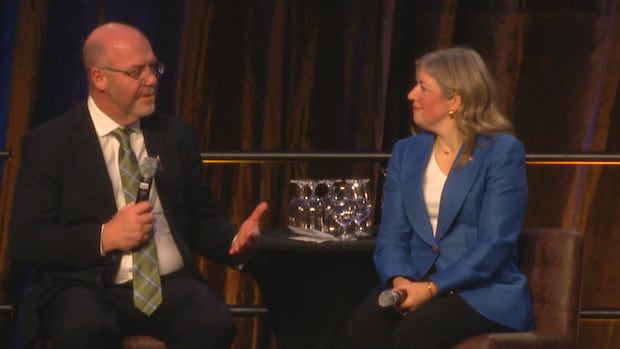
The Holt Liberals are navigating challenging political waters in New Brunswick as they engage the public in discussions concerning potential cuts to government programs. This initiative aims to address a projected budget deficit of $834.7 million for the current fiscal year. Premier Susan Holt has outlined several options in a discussion paper titled “Difficult Decisions,” which includes civil service layoffs, increased fees for government services, and tolls for out-of-province vehicles.
In her recent state of the province address, Holt emphasized the necessity of making tough choices to sustain funding for essential sectors like health care and affordability measures. “We have to stop doing some other things. And they’re going to be things we don’t want to stop doing,” she stated. This candid acknowledgment of the situation reflects the growing urgency for the government to rein in spending.
The current fiscal landscape has led to heightened scrutiny of government expenditures. Holt has actively invited New Brunswickers to provide feedback on which programs they believe should be prioritized for cuts or if they are amenable to increased revenue collection. Past experiences suggest that the public may be resistant to tax hikes, as evidenced by the last Liberal government’s decision to raise the harmonized sales tax from 13 percent to 15 percent.
Among the proposed ideas for reducing expenses are the merging of government agencies, cutting back on maintenance for low-traffic roads, and potentially reallocating hospital beds to long-term care facilities. These changes aim to streamline services while addressing budget constraints. Additionally, the discussion paper suggests the implementation of highway tolls specifically for out-of-province vehicles, a concept that has historically faced political backlash.
In light of the current economic circumstances, there is a palpable concern regarding the impact of budget cuts on critical services. Claire Johnson, the Minister of Education and Early Childhood Development, did not provide assurances that budget constraints would not hinder the government’s commitment to achieving an average $10 per day child-care cost by April, a goal tied to federal funding agreements.
Housing Minister David Hickey indicated that all areas of the budget are up for review, stating, “Everything’s on the table over the next little while.” His comments underscore the extent of the fiscal challenges facing the province. Even issues previously flagged as emergencies, such as housing, are now subject to potential reductions in funding.
In contrast, some ministers have voiced strong opposition to cuts that could adversely affect specific services. Gilles LePage, the Environment and Climate Change Minister, expressed his intent to protect frontline inspectors who monitor compliance with environmental regulations. “If we do that, we put the environment at risk,” he warned, emphasizing the critical nature of these roles in safeguarding public health.
The complexity of the situation is further illustrated by discussions around revenue generation. One suggestion involves taxing the estimated 10 to 30 percent of lobster catches that go unreported, which would likely require increased staffing for effective enforcement. This presents a paradox as the government considers cutting back on resources while needing to enhance oversight in other areas.
New Brunswick’s recent history offers a cautionary tale regarding budgetary decisions. In 2015, the previous Liberal government, led by Brian Gallant, initiated a strategic program review to manage the deficit. The process sparked significant public debate over potential service cuts, including the controversial suggestion of closing hospitals. Ultimately, the government opted for a sales tax increase, a move that was met with public resistance.
While Holt has ruled out a sales tax hike this time, her discussion paper does hint at possible increases in provincial fees to reflect the true cost of certain services. The idea of imposing road tolls remains contentious, as evidenced by the public outcry that followed similar tolling initiatives in the past. In 1999, the tolling of the Moncton-Fredericton highway contributed to the downfall of the Liberal government, a lesson that weighs heavily on current deliberations.
All proposals outlined in the discussion paper are still theoretical, and the Holt Liberals face the challenge of balancing fiscal responsibility with public sentiment. “Our government is not going to do nothing. We are going to get it, we are going to make the cuts we need to, and we are going to invest where we need to,” Holt affirmed in her speech, signaling a commitment to proactive governance. The coming months will reveal which choices the government ultimately makes, as the pressure to address the deficit intensifies.












Morris Churches Unite for Annual Good Friday Walk With the Cross

Chloe Zhao’s ‘Buffy’ Reboot Cancelled: Sarah Michelle Gellar Speaks Out

Essential Ingredients for Life Found in Ryugu Asteroid Samples

Urgent Rescue: NSR Airlifts Injured Climber from Nanaimo

Riverside Heart Ball Achieves Record $815,000 for Mental Health

Cognizant Launches AI Factory to Enhance Enterprise AI Scalability

Samsung’s Galaxy Watch 9 to Feature Larger Battery Than Before

Toronto’s AIDS Memorial Faces Potential Redesign Amid Community Concerns

Bayern Munich Loses Luis Díaz Red Card Appeal Despite Referee’s Admission

Secwepemc First Nation Seeks Aboriginal Title Over Kamloops Area

Fatal Crash on Highway 11 Claims Three Lives, Major Closure Ongoing

Manitoba’s Burger Champion Shines Again Amid Dining Innovations

Canadian Curler E.J. Harnden Announces Retirement from Competition

Urgent Fire Erupts at Salvation Army on Christmas Evening

Scientists Unearth Ancient Antarctic Ice to Unlock Climate Secrets

Trump and McCormick to Announce $70 Billion Energy Investments

Minister Faces Scrutiny Over Delayed Foreign Interference Watchdog Appointment

Four Astronauts Return to Earth After International Space Station Mission
-
 Politics5 months ago
Secwepemc First Nation Seeks Aboriginal Title Over Kamloops Area
-
 Top Stories4 months ago
Fatal Crash on Highway 11 Claims Three Lives, Major Closure Ongoing
-
 Lifestyle7 months ago
Manitoba’s Burger Champion Shines Again Amid Dining Innovations
-
 Sports3 months ago
Canadian Curler E.J. Harnden Announces Retirement from Competition
-
 Top Stories3 months ago
Urgent Fire Erupts at Salvation Army on Christmas Evening
-
 World9 months ago
Scientists Unearth Ancient Antarctic Ice to Unlock Climate Secrets
-
 Entertainment9 months ago
Trump and McCormick to Announce $70 Billion Energy Investments
-
 World5 months ago
Minister Faces Scrutiny Over Delayed Foreign Interference Watchdog Appointment
-
 Science9 months ago
Four Astronauts Return to Earth After International Space Station Mission
-

 Lifestyle9 months ago
Monika Hibbs Unveils Acres Market & Interiors in Major Rebrand
-

 Lifestyle9 months ago
TransLink Launches Food Truck Program to Boost Revenue in Vancouver
-

 World1 month ago
Ranchman’s Cookhouse & Dancehall to Relocate by Early 2027