
Politics
Mark Carney’s Beijing Visit Raises Concerns Over Taiwan’s Security

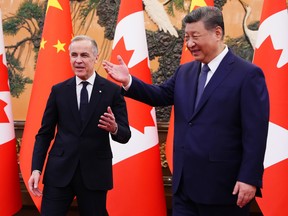
Prime Minister Mark Carney concluded his first official visit to Beijing, where discussions centered around a deal involving Chinese electric vehicles and Canadian canola. While this economic engagement is significant, it also raises strategic questions for Canada, particularly regarding the increasing influence of the People’s Republic of China (PRC) in the Arctic, Indo-Pacific, and particularly in relation to Taiwan.
The PRC has intensified its military presence around Taiwan, conducting military exercises under the guise of the “Justice Mission 2025.” Although these maneuvers have not escalated to the severity of conflicts like the war in Ukraine, they highlight China’s expansionist strategies, which are drawing comparisons to various global crises. The situation in the Taiwan Strait remains a critical point of concern for international peace and stability.
China’s alliance with Russia during the ongoing conflict in Ukraine and its investments in the Arctic through the “Polar Silk Road” initiative are alarming developments. Additionally, China has employed grey-zone tactics aimed at undermining Taiwan’s democracy, including media manipulation, economic coercion, and cyber sabotage. These actions pose a direct threat to the stability of the Taiwan Strait, through which over half of the world’s container traffic transits annually.
The implications of any conflict in this region extend far beyond Taiwan, affecting global markets and economies, including Canada’s. Recent statements from Canada and the G7 nations condemning China’s actions are commendable, but a more proactive stance is necessary. Engaging with Taiwan through routine naval patrols in the Taiwan Strait could serve as a deterrent while also allowing for continued dialogue with China on trade and agriculture.
The issue of Taiwan is not merely a bilateral matter; it is a pressing international security concern. Historical precedents indicate that China has previously weaponized trade in response to political actions. As Canada navigates its relationship with China, it must remain vigilant against potential economic reprisals aimed at defending human rights and maintaining a rules-based international order.
Canada’s past support for Taiwan’s sovereignty has led to retaliatory measures from Beijing, including trade bans on various Taiwanese agricultural products. Such actions serve as a warning of the potential fallout from assertive foreign policies. The Chinese Communist Party has also targeted individual politicians, as seen in the case of Conservative MP Michael Chong, whose family faced intimidation tactics.
As global geopolitics shift, the landscape of international trade is increasingly influenced by national strategies rather than pure globalization. Many multinational corporations are now investing in democratic nations where regulations are clearer and more predictable. Yet, Canada appears to be pursuing a new economic balance with China, even as global markets grapple with rising protectionism.
During his discussions with his PRC counterpart, Prime Minister Carney should ensure that Canada’s position includes firm guardrails supporting a peaceful status quo in the Taiwan Strait. Taiwan is eager to strengthen its partnership with Canada, focusing on establishing reliable and resilient supply chains, which are critical in sectors like critical minerals, liquefied natural gas, and artificial intelligence.
The path forward involves collaboration that prioritizes strong protections for intellectual property and fair trade protocols. By aligning these interests, Canada and Taiwan can open new avenues for innovation and prosperity while addressing the broader challenges posed by an assertive China.












Morris Churches Unite for Annual Good Friday Walk With the Cross

Chloe Zhao’s ‘Buffy’ Reboot Cancelled: Sarah Michelle Gellar Speaks Out

Essential Ingredients for Life Found in Ryugu Asteroid Samples

Urgent Rescue: NSR Airlifts Injured Climber from Nanaimo

Riverside Heart Ball Achieves Record $815,000 for Mental Health

Cognizant Launches AI Factory to Enhance Enterprise AI Scalability

Samsung’s Galaxy Watch 9 to Feature Larger Battery Than Before

Toronto’s AIDS Memorial Faces Potential Redesign Amid Community Concerns

Bayern Munich Loses Luis Díaz Red Card Appeal Despite Referee’s Admission

Secwepemc First Nation Seeks Aboriginal Title Over Kamloops Area

Fatal Crash on Highway 11 Claims Three Lives, Major Closure Ongoing

Manitoba’s Burger Champion Shines Again Amid Dining Innovations

Canadian Curler E.J. Harnden Announces Retirement from Competition

Urgent Fire Erupts at Salvation Army on Christmas Evening

Scientists Unearth Ancient Antarctic Ice to Unlock Climate Secrets

Minister Faces Scrutiny Over Delayed Foreign Interference Watchdog Appointment

Trump and McCormick to Announce $70 Billion Energy Investments

Monika Hibbs Unveils Acres Market & Interiors in Major Rebrand
-
 Politics5 months ago
Secwepemc First Nation Seeks Aboriginal Title Over Kamloops Area
-
 Top Stories4 months ago
Fatal Crash on Highway 11 Claims Three Lives, Major Closure Ongoing
-
 Lifestyle7 months ago
Manitoba’s Burger Champion Shines Again Amid Dining Innovations
-
 Sports3 months ago
Canadian Curler E.J. Harnden Announces Retirement from Competition
-
 Top Stories3 months ago
Urgent Fire Erupts at Salvation Army on Christmas Evening
-
 World9 months ago
Scientists Unearth Ancient Antarctic Ice to Unlock Climate Secrets
-
 World5 months ago
Minister Faces Scrutiny Over Delayed Foreign Interference Watchdog Appointment
-
 Entertainment9 months ago
Trump and McCormick to Announce $70 Billion Energy Investments
-
 Lifestyle9 months ago
Monika Hibbs Unveils Acres Market & Interiors in Major Rebrand
-

 Science9 months ago
Four Astronauts Return to Earth After International Space Station Mission
-
 Lifestyle9 months ago
TransLink Launches Food Truck Program to Boost Revenue in Vancouver
-

 World1 month ago
Ranchman’s Cookhouse & Dancehall to Relocate by Early 2027