
Politics
Russia Strikes Ukraine Near EU Border, Sends Strong Message to West

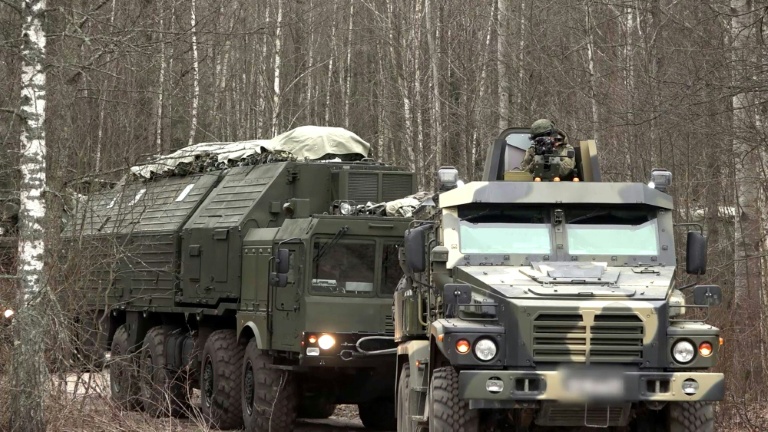
Russia launched a missile strike on Ukraine near the European Union border, utilizing the Oreshnik, a nuclear-capable intermediate-range ballistic missile (IRBM). This attack, which took place overnight from Thursday to Friday, targeted an infrastructure facility in the western region of Lviv. Analysts suggest that the strike aims to intimidate Kyiv’s Western allies and reflects Vladimir Putin’s dissatisfaction with recent foreign policy setbacks.
The assault follows the announcement of a post-war peacekeeping plan for Ukraine by negotiators from Europe and the United States. While Moscow claims the strike was a response to an alleged drone attack on Putin’s residence in December, experts argue it serves as a clear warning to Western leaders and seeks to instill fear among ordinary Europeans. “Vladimir Putin is using this to communicate with the West, because he could undoubtedly achieve the same operational effects without this missile,” stated Cyrille Bret, a Russia expert at the Montaigne Institute in Paris.
Strategic Implications of the Strike
The Oreshnik missile is presented by the Kremlin as a “state-of-the-art” weapon capable of reaching hypersonic speeds, striking targets across Europe, and evading interception. In a call on Friday, the leaders of Britain, France, and Germany condemned the missile launch as “escalatory and unacceptable.” UK Prime Minister Keir Starmer criticized Russia for using “fabricated allegations” to justify the attack.
Lviv’s mayor, Andriy Sadovy, emphasized the seriousness of the strike, labeling it “a new level of threat—not only for Ukraine but also for the security of Europe.” The missile’s target, located approximately 70 kilometers (40 miles) from the EU border, has been interpreted as a deliberate message to European nations. Observers point out that the psychological impact of the attack may outweigh its operational significance. “This should probably be seen as a message to European countries,” said Etienne Marcuz, an associate fellow at the Foundation for Strategic Research.
Political Context and Reactions
The missile strike comes during a period of increasing challenges for Russia, including the recent capture of Venezuelan leader Nicolas Maduro by Washington, the seizure of a Russian-flagged vessel in the North Atlantic, and growing dissent in Iran against Moscow-aligned authorities. Analysts argue that this attack may be Putin’s attempt to reaffirm his authority amidst these setbacks. “It is a psychological weapon—an instrument of Putin’s cognitive war against Ukraine and the West,” commented Mick Ryan, a retired major general from the Australian army.
The use of the Oreshnik missile has raised concerns about Russia’s ability to influence events beyond its borders. “The deployment of the Oreshnik therefore seemed more a PR exercise,” noted Timothy Ash, an emerging market economist focused on Russia. He highlighted that while the missile is effective, its high cost raises questions about its deployment in Ukraine.
Despite claims of its advanced capabilities, Western defense analysts are skeptical. Marcuz noted that the Oreshnik is “most likely NOT a hypersonic missile,” suggesting that Europe possesses means to intercept IRBMs. The missile’s multiple warheads could pose challenges depending on their deployment timing.
In December, Belarusian President Alexander Lukashenko, a close ally of Putin, indicated that the Oreshnik had been stationed in Belarus, which lies along NATO’s eastern flank. As tensions escalate, the implications of this missile strike resonate not only in Ukraine but also across Europe, highlighting the fragile security dynamics in the region.












Morris Churches Unite for Annual Good Friday Walk With the Cross

Chloe Zhao’s ‘Buffy’ Reboot Cancelled: Sarah Michelle Gellar Speaks Out

Essential Ingredients for Life Found in Ryugu Asteroid Samples

Urgent Rescue: NSR Airlifts Injured Climber from Nanaimo

Riverside Heart Ball Achieves Record $815,000 for Mental Health

Cognizant Launches AI Factory to Enhance Enterprise AI Scalability

Samsung’s Galaxy Watch 9 to Feature Larger Battery Than Before

Toronto’s AIDS Memorial Faces Potential Redesign Amid Community Concerns

Bayern Munich Loses Luis Díaz Red Card Appeal Despite Referee’s Admission

Secwepemc First Nation Seeks Aboriginal Title Over Kamloops Area

Fatal Crash on Highway 11 Claims Three Lives, Major Closure Ongoing

Manitoba’s Burger Champion Shines Again Amid Dining Innovations

Canadian Curler E.J. Harnden Announces Retirement from Competition

Urgent Fire Erupts at Salvation Army on Christmas Evening

Scientists Unearth Ancient Antarctic Ice to Unlock Climate Secrets

Minister Faces Scrutiny Over Delayed Foreign Interference Watchdog Appointment

Trump and McCormick to Announce $70 Billion Energy Investments

Monika Hibbs Unveils Acres Market & Interiors in Major Rebrand
-
 Politics5 months ago
Secwepemc First Nation Seeks Aboriginal Title Over Kamloops Area
-
 Top Stories4 months ago
Fatal Crash on Highway 11 Claims Three Lives, Major Closure Ongoing
-
 Lifestyle7 months ago
Manitoba’s Burger Champion Shines Again Amid Dining Innovations
-
 Sports3 months ago
Canadian Curler E.J. Harnden Announces Retirement from Competition
-
 Top Stories4 months ago
Urgent Fire Erupts at Salvation Army on Christmas Evening
-
 World9 months ago
Scientists Unearth Ancient Antarctic Ice to Unlock Climate Secrets
-
 World5 months ago
Minister Faces Scrutiny Over Delayed Foreign Interference Watchdog Appointment
-
 Entertainment9 months ago
Trump and McCormick to Announce $70 Billion Energy Investments
-
 Lifestyle9 months ago
Monika Hibbs Unveils Acres Market & Interiors in Major Rebrand
-

 Science9 months ago
Four Astronauts Return to Earth After International Space Station Mission
-

 Lifestyle9 months ago
TransLink Launches Food Truck Program to Boost Revenue in Vancouver
-

 World1 month ago
Ranchman’s Cookhouse & Dancehall to Relocate by Early 2027