
Politics
Ukraine Peace Talks Stall as Four-Year Conflict Continues

President Donald Trump’s attempts to negotiate peace in Ukraine are facing significant obstacles as discussions remain deadlocked and combat continues to stagnate after four years of conflict. The ongoing war, which escalated with Russia’s invasion on February 24, 2022, shows no signs of resolution, with key demands from Vladimir Putin remaining unmet.
Efforts to broker a deal have reportedly intensified, as U.S. allies express urgency for a resolution before the 250th anniversary of American independence on July 4, 2025. However, senior officials from both NATO and Europe indicate that Putin is unlikely to concede on critical issues that form the basis of Russia’s demands. The situation further complicates as multiple deadlines for negotiations have been missed, leading some U.S. officials to privately acknowledge the lack of progress.
“Russia is fighting for its future,”
Putin stated during a recent ceremony in the Kremlin, underscoring his commitment to Russia’s military objectives. The conflict has drastically diverged from Putin’s initial plan to swiftly overthrow the Ukrainian leadership.
In the wake of stalled U.S.-led diplomacy, which has centered on territorial disputes in eastern Ukraine and control over the Zaporizhzhia nuclear power plant, the prospects for an agreement appear dim. Despite three rounds of trilateral discussions in Abu Dhabi and Geneva this year, no viable solutions have emerged.
Ukraine’s European allies find themselves increasingly sidelined, even as they continue to provide significant financial support for Kyiv’s defense efforts. This has created a dynamic where both Moscow and Washington are engaged in a high-stakes standoff, with U.S. special envoy Steven Witkoff and Trump’s son-in-law Jared Kushner at the forefront of the negotiations. The outcome hinges on whether Russia will abandon its rigid positions or the U.S. will shift its support away from Ukraine.
Trump has expressed dissatisfaction with the slow progression of talks, frequently alternating between criticism of Putin and urging Ukrainian President Volodymyr Zelenskiy to make concessions. Despite considerable military losses and mounting economic pressures on Russia, there is little indication that Putin intends to compromise on his territorial ambitions, particularly regarding the contested Donetsk region.
Ukraine remains resolute, with Zelenskiy emphasizing the need for dialogue. In a recent interview with German broadcaster ARD, he stated,
“My message to Putin is simple: I am ready to meet. We must end the war. Period.”
Ukraine has rejected Russian demands to withdraw from key fortified positions in eastern Donetsk, proposing instead a ceasefire along existing frontlines.
The U.S. has floated the idea of establishing a free economic zone in eastern Ukraine, coupled with security guarantees against future Russian aggression. However, the fate of the nuclear power plant remains contentious, with the U.S. suggesting a potential division of power that Ukraine opposes. Concerns persist among Kyiv’s allies that Putin could accept a ceasefire merely to enable Trump to declare a diplomatic victory, while maintaining a campaign of hybrid warfare to destabilize Ukraine further.
Analysts like Tatiana Stanovaya from the Carnegie Russia Eurasia Center warn that as long as Putin remains in power and financial resources are available for military operations, the conflict is likely to persist. Trump has also shown interest in initiating joint business ventures with Russia, contingent on the cessation of hostilities.
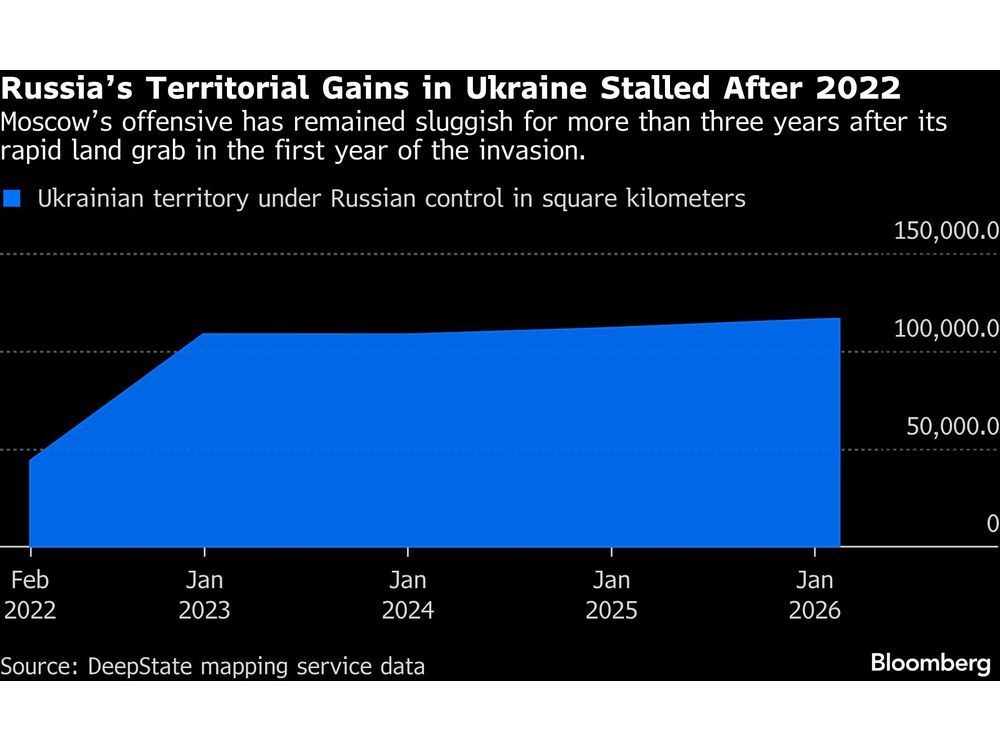
In terms of territorial control, Russian advances have been minimal, capturing less than 1% of Ukraine’s territory in recent years, according to data from DeepState, a conflict mapping service. The frontline has increasingly shifted to drone warfare, complicating traditional military strategies.
Ukrainian military leadership has reported mixed progress. Commander-in-Chief Oleksandr Syrskyi stated that his forces regained approximately 400 square kilometers (about 154 square miles) since January, while Western officials noted a concerning uptick in Russian casualties.
As U.S. officials remain hopeful for a breakthrough in discussions, Witkoff expressed optimism about potential developments in the near future. “It really is a silly war,” he remarked, questioning the rationale behind the ongoing violence over contested territories and the human cost it entails.
With both sides entrenched in their positions, the path to peace appears fraught with challenges, leaving the resolution of this conflict uncertain as it approaches its fourth anniversary.











Morris Churches Unite for Annual Good Friday Walk With the Cross

Chloe Zhao’s ‘Buffy’ Reboot Cancelled: Sarah Michelle Gellar Speaks Out

Essential Ingredients for Life Found in Ryugu Asteroid Samples

Urgent Rescue: NSR Airlifts Injured Climber from Nanaimo

Riverside Heart Ball Achieves Record $815,000 for Mental Health

Cognizant Launches AI Factory to Enhance Enterprise AI Scalability

Samsung’s Galaxy Watch 9 to Feature Larger Battery Than Before

Toronto’s AIDS Memorial Faces Potential Redesign Amid Community Concerns

Bayern Munich Loses Luis Díaz Red Card Appeal Despite Referee’s Admission

Secwepemc First Nation Seeks Aboriginal Title Over Kamloops Area

Fatal Crash on Highway 11 Claims Three Lives, Major Closure Ongoing

Manitoba’s Burger Champion Shines Again Amid Dining Innovations

Canadian Curler E.J. Harnden Announces Retirement from Competition

Urgent Fire Erupts at Salvation Army on Christmas Evening

Scientists Unearth Ancient Antarctic Ice to Unlock Climate Secrets

Minister Faces Scrutiny Over Delayed Foreign Interference Watchdog Appointment

Trump and McCormick to Announce $70 Billion Energy Investments

Monika Hibbs Unveils Acres Market & Interiors in Major Rebrand
-
 Politics5 months ago
Secwepemc First Nation Seeks Aboriginal Title Over Kamloops Area
-
 Top Stories4 months ago
Fatal Crash on Highway 11 Claims Three Lives, Major Closure Ongoing
-
 Lifestyle7 months ago
Manitoba’s Burger Champion Shines Again Amid Dining Innovations
-
 Sports3 months ago
Canadian Curler E.J. Harnden Announces Retirement from Competition
-
 Top Stories4 months ago
Urgent Fire Erupts at Salvation Army on Christmas Evening
-
 World9 months ago
Scientists Unearth Ancient Antarctic Ice to Unlock Climate Secrets
-
 World5 months ago
Minister Faces Scrutiny Over Delayed Foreign Interference Watchdog Appointment
-
 Entertainment9 months ago
Trump and McCormick to Announce $70 Billion Energy Investments
-
 Lifestyle9 months ago
Monika Hibbs Unveils Acres Market & Interiors in Major Rebrand
-

 Science9 months ago
Four Astronauts Return to Earth After International Space Station Mission
-

 Lifestyle9 months ago
TransLink Launches Food Truck Program to Boost Revenue in Vancouver
-

 World1 month ago
Ranchman’s Cookhouse & Dancehall to Relocate by Early 2027