
Science
Astronomers Aim to Capture Historic Video of Black Hole Motion

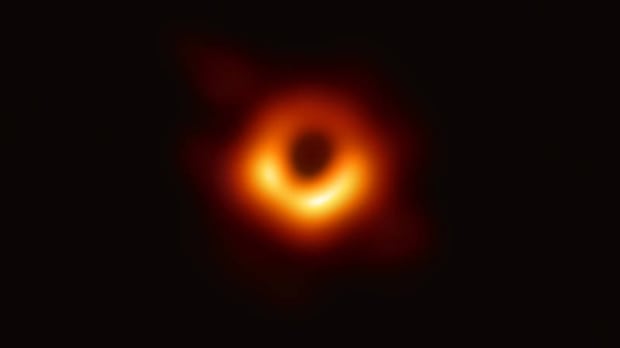
Astronomers are on the brink of a groundbreaking achievement as they work to capture the first-ever video of a black hole. This endeavor aims to provide insights into the behavior of these enigmatic cosmic entities, which have long fascinated and puzzled scientists. The project follows the historic release of the first image of a black hole in April 2019, showcasing the supermassive black hole at the center of the galaxy Messier 87 (M87), located about 50 million light-years from Earth.
The team, which includes astrophysicist Sera Markoff, is utilizing the Event Horizon Telescope (EHT), a network of eight radio telescopes functioning as a single instrument. The EHT links facilities from locations as distant as Antarctica, Spain, and Chile. According to Markoff, who is the Plumian professor of astronomy at the University of Cambridge, the current goal is to track the motion of the black hole in M87, capturing images at a much higher frequency than before.
New Techniques for Capturing Black Hole Dynamics
Previously, astronomers captured only a single snapshot of the black hole once a year, missing much of its dynamic behavior. With the new approach, images will be taken every three to four days from March through April 2024. This frequency allows researchers to create what Vincent Fish, operations data manager for the EHT, describes as “a time-lapse movie” of the black hole in motion. The black hole in M87 is particularly suitable for this observation due to its slower evolution compared to other black holes.
Fish noted that while black holes themselves do not change significantly on human timescales, the hot gas swirling around them does. This turbulent disk of material shifts and churns rapidly, providing a rich field for study. The black hole’s changes unfold over days to weeks, making it a prime candidate for dynamic observation.
Exploring Fundamental Questions About Black Holes
As the team prepares to process vast amounts of data, which could reach petabytes, they hope to answer fundamental questions about black holes. Markoff emphasized the extreme conditions surrounding these entities, where matter moves at close to the speed of light. This environment raises significant scientific inquiries regarding the fundamental physics of black holes.
Several critical questions await resolution: What is the direction of the black hole’s spin? How does it interact with surrounding matter? Why does some material fall into the black hole while other material is expelled outward in powerful jets of plasma? Understanding these processes is crucial, as they influence not only the black holes themselves but also the formation and evolution of their host galaxies.
Markoff explained that jets emitted from M87 inject vast amounts of energy into surrounding gas, a process known as galactic “feedback.” This feedback can regulate star formation by heating gas and preventing it from cooling sufficiently. In this manner, black holes play a vital role in shaping the universe as we know it.
In addition to M87, there is another potential candidate for observation, known as Sagittarius A*, located at the center of our Milky Way galaxy. However, its rapid fluctuations may complicate efforts to capture stable images. Fish noted that the rapid changes observed in Sagittarius A* could make it difficult to study comprehensively.
As the team moves forward, the anticipation builds around what the video of the black hole will reveal. Markoff reflected on the broader implications of their work, stating, “When we think about ourselves living at this time and place in the universe, we’re asking ourselves, ‘How did we get here? Why does the universe look the way it does?’ We know black holes played a big role.”
With the EHT continuing its work, the upcoming months promise to deliver unprecedented insights into one of the universe’s most mysterious phenomena.












Morris Churches Unite for Annual Good Friday Walk With the Cross

Chloe Zhao’s ‘Buffy’ Reboot Cancelled: Sarah Michelle Gellar Speaks Out

Essential Ingredients for Life Found in Ryugu Asteroid Samples

Urgent Rescue: NSR Airlifts Injured Climber from Nanaimo

Riverside Heart Ball Achieves Record $815,000 for Mental Health

Cognizant Launches AI Factory to Enhance Enterprise AI Scalability

Samsung’s Galaxy Watch 9 to Feature Larger Battery Than Before

Toronto’s AIDS Memorial Faces Potential Redesign Amid Community Concerns

Bayern Munich Loses Luis Díaz Red Card Appeal Despite Referee’s Admission

Secwepemc First Nation Seeks Aboriginal Title Over Kamloops Area

Fatal Crash on Highway 11 Claims Three Lives, Major Closure Ongoing

Manitoba’s Burger Champion Shines Again Amid Dining Innovations

Canadian Curler E.J. Harnden Announces Retirement from Competition

Urgent Fire Erupts at Salvation Army on Christmas Evening

Scientists Unearth Ancient Antarctic Ice to Unlock Climate Secrets

Minister Faces Scrutiny Over Delayed Foreign Interference Watchdog Appointment

Trump and McCormick to Announce $70 Billion Energy Investments

Monika Hibbs Unveils Acres Market & Interiors in Major Rebrand
-
 Politics5 months ago
Secwepemc First Nation Seeks Aboriginal Title Over Kamloops Area
-
 Top Stories4 months ago
Fatal Crash on Highway 11 Claims Three Lives, Major Closure Ongoing
-
 Lifestyle7 months ago
Manitoba’s Burger Champion Shines Again Amid Dining Innovations
-
 Sports3 months ago
Canadian Curler E.J. Harnden Announces Retirement from Competition
-
 Top Stories4 months ago
Urgent Fire Erupts at Salvation Army on Christmas Evening
-
 World9 months ago
Scientists Unearth Ancient Antarctic Ice to Unlock Climate Secrets
-
 World5 months ago
Minister Faces Scrutiny Over Delayed Foreign Interference Watchdog Appointment
-
 Entertainment9 months ago
Trump and McCormick to Announce $70 Billion Energy Investments
-
 Lifestyle9 months ago
Monika Hibbs Unveils Acres Market & Interiors in Major Rebrand
-

 Science9 months ago
Four Astronauts Return to Earth After International Space Station Mission
-

 Lifestyle9 months ago
TransLink Launches Food Truck Program to Boost Revenue in Vancouver
-

 World1 month ago
Ranchman’s Cookhouse & Dancehall to Relocate by Early 2027