
Science
Astronomers Pinpoint Brightest Fast Radio Burst to Nearby Galaxy

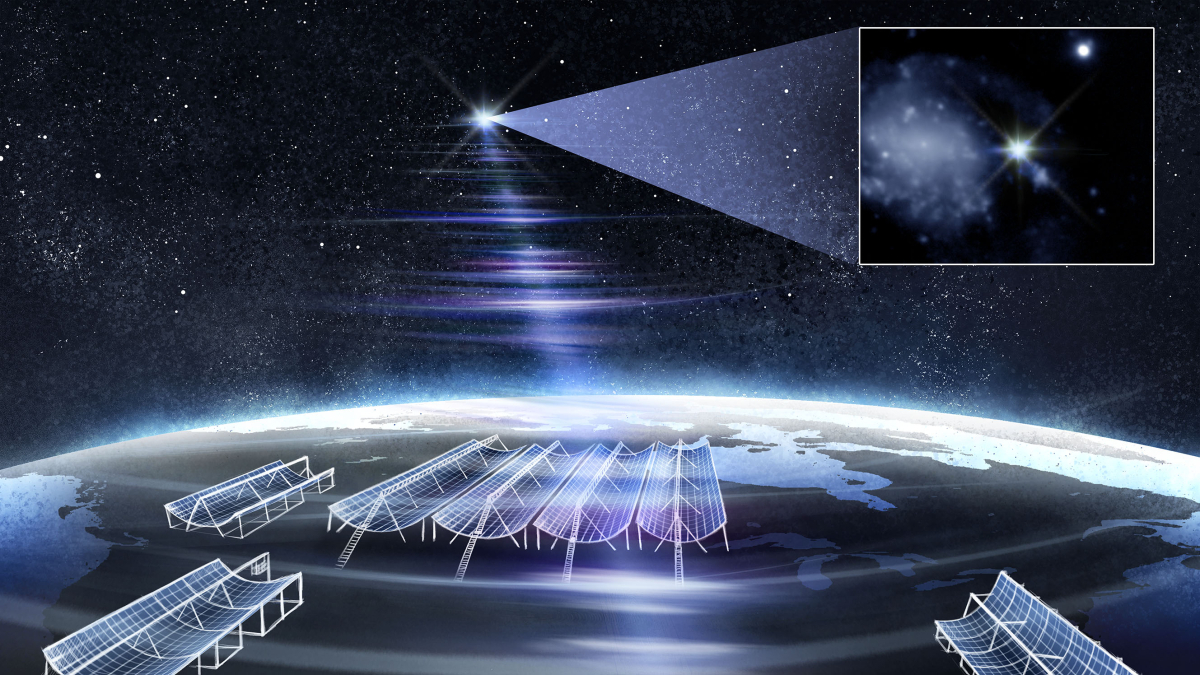
A team of international astronomers, including researchers from McGill University, has successfully pinpointed one of the brightest fast radio bursts (FRBs) ever detected to a specific location in a nearby galaxy. This notable discovery offers new insights into FRBs, which have long puzzled astrophysicists. Fast radio bursts are powerful, millisecond-long flashes of radio waves originating from space, and while their causes are suspected to be extreme cosmic events, the exact origins have remained elusive.
For years, the Canadian CHIME/FRB radio telescope has been instrumental in detecting these rare astrophysical events. In March 2023, it captured a particularly bright FRB, designated FRB 20250316A and playfully named “RBFLOAT” for Radio Brightest FLash Of All Time. This event marked a significant milestone for researchers, as it allowed them to identify its origin using only the CHIME/FRB, renowned for being the most prolific FRB discovery instrument to date.
Unprecedented Resolution in Localization
Leading the study, Amanda Cook, a postdoctoral researcher at McGill, emphasized the importance of the discovery, stating, “This result marks a turning point: instead of just detecting these mysterious flashes, we can now see exactly where they’re coming from.” This capability opens opportunities to investigate whether FRBs are caused by dying stars, exotic magnetic objects, or yet undiscovered phenomena.
To trace RBFLOAT’s origin, researchers utilized CHIME’s newly completed “outrigger” telescopes, which extend across North America from British Columbia to California. This array allowed for unprecedented spatial resolution, pinpointing the burst to an area just 45 light-years across, smaller than the average star cluster, in the outskirts of a galaxy approximately 130 million light-years away. Cook described the precision achieved as “like spotting a quarter from 100 kilometres away.”
This high-resolution capability revealed the host galaxy, NGC 4141, and matched the burst with a faint infrared signal captured by the James Webb Space Telescope (JWST). Researchers were surprised to find a mysterious source of near-infrared light precisely at the location of RBFLOAT, prompting questions about whether the source could be a red giant star or a fading light echo from the burst itself.
New Insights and Ongoing Mysteries
The advanced capabilities of JWST have enabled the resolution of individual stars surrounding an FRB for the first time, which could help identify the types of stellar environments that produce such powerful bursts. Peter Blanchard, a research associate at Harvard and lead author of a related study, highlighted the significance of this research, noting, “This opens the door to identifying the kinds of stellar environments that could give rise to such powerful bursts.”
Despite being the brightest FRB detected by CHIME, researchers have not observed repeated bursts from the source, even after hundreds of hours of observation over more than six years. This absence contradicts the prevailing theory that all FRBs eventually repeat. Mawson Sammons, a postdoctoral researcher at McGill, indicated that this FRB appears energetically distinct from known repeaters, prompting a re-evaluation of some explosive models that had previously fallen out of favor.
The findings are detailed in two studies published in The Astrophysical Journal Letters. The first focuses on the original radio discovery and localization of the burst, while the second examines JWST’s near-infrared images of the originating location. Together, these studies enhance our understanding of FRBs, transitioning them from cosmic curiosities to valuable tools for probing the universe.
As Sammons concluded, “This marks the beginning of a new era where we can routinely localize even single, non-repeating bursts to pinpoint precision. That’s a significant advancement for understanding what’s behind them.”
The research received support from the Trottier Space Institute at McGill University, the Gordon and Betty Moore Foundation, the Canada Foundation for Innovation, and the Natural Sciences and Engineering Research Council of Canada, among other international partners.












Morris Churches Unite for Annual Good Friday Walk With the Cross

Chloe Zhao’s ‘Buffy’ Reboot Cancelled: Sarah Michelle Gellar Speaks Out

Essential Ingredients for Life Found in Ryugu Asteroid Samples

Urgent Rescue: NSR Airlifts Injured Climber from Nanaimo

Riverside Heart Ball Achieves Record $815,000 for Mental Health

Cognizant Launches AI Factory to Enhance Enterprise AI Scalability

Samsung’s Galaxy Watch 9 to Feature Larger Battery Than Before

Toronto’s AIDS Memorial Faces Potential Redesign Amid Community Concerns

Bayern Munich Loses Luis Díaz Red Card Appeal Despite Referee’s Admission

Secwepemc First Nation Seeks Aboriginal Title Over Kamloops Area

Fatal Crash on Highway 11 Claims Three Lives, Major Closure Ongoing

Manitoba’s Burger Champion Shines Again Amid Dining Innovations

Canadian Curler E.J. Harnden Announces Retirement from Competition

Urgent Fire Erupts at Salvation Army on Christmas Evening

Scientists Unearth Ancient Antarctic Ice to Unlock Climate Secrets

Minister Faces Scrutiny Over Delayed Foreign Interference Watchdog Appointment

Trump and McCormick to Announce $70 Billion Energy Investments

Monika Hibbs Unveils Acres Market & Interiors in Major Rebrand
-
 Politics5 months ago
Secwepemc First Nation Seeks Aboriginal Title Over Kamloops Area
-
 Top Stories4 months ago
Fatal Crash on Highway 11 Claims Three Lives, Major Closure Ongoing
-
 Lifestyle7 months ago
Manitoba’s Burger Champion Shines Again Amid Dining Innovations
-
 Sports4 months ago
Canadian Curler E.J. Harnden Announces Retirement from Competition
-
 Top Stories4 months ago
Urgent Fire Erupts at Salvation Army on Christmas Evening
-
 World9 months ago
Scientists Unearth Ancient Antarctic Ice to Unlock Climate Secrets
-
 World5 months ago
Minister Faces Scrutiny Over Delayed Foreign Interference Watchdog Appointment
-
 Entertainment9 months ago
Trump and McCormick to Announce $70 Billion Energy Investments
-
 Lifestyle9 months ago
Monika Hibbs Unveils Acres Market & Interiors in Major Rebrand
-

 Science9 months ago
Four Astronauts Return to Earth After International Space Station Mission
-

 Lifestyle9 months ago
TransLink Launches Food Truck Program to Boost Revenue in Vancouver
-

 World2 months ago
Ranchman’s Cookhouse & Dancehall to Relocate by Early 2027