
Science
B.C. Anesthesiologist Explores Anesthesia in Zero Gravity

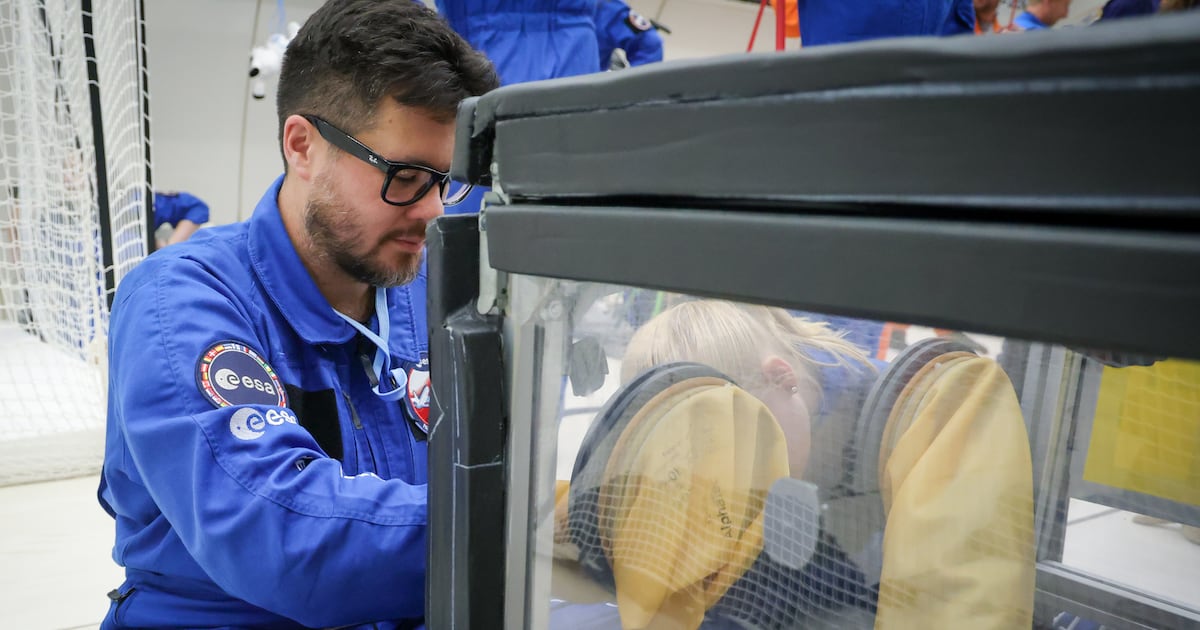
Anesthesiologist Dr. Matthew Turnock and his research team recently conducted groundbreaking studies on how anesthetic drugs behave in microgravity conditions. This unique project, funded by the Canadian Space Agency, involved the team experiencing genuine zero gravity aboard an Airbus A310 in France, aiming to understand the implications of administering anesthetics in space.
The research arose from concerns regarding the complexities of anesthesia in a zero-gravity environment. “In space, giving an anesthetic is challenging because of the space and volume requirements,” Turnock explained. “If there’s an accidental circuit disconnection, the entire crew of a spacecraft could be anesthetized, which would be a really bad thing.”
To simulate the conditions of a patient in space, Turnock and his team developed a model of a spinal canal using computed tomography (CT) images of a real person. They filled the model with simulated spinal fluid to investigate how anesthetic agents might behave without the influence of gravity. “There’s a chance the medication could float up to the brain. Sometimes we see that here on Earth. We call it a high spinal,” he noted.
The team experienced microgravity by flying in an aircraft that performed parabolic maneuvers, allowing them to experience approximately 25 seconds of weightlessness at the peak of each climb. “And it’s not simulated, it’s real zero gravity, exactly how an astronaut would feel in space,” Turnock said, reflecting on the exhilarating experience.
During these weightless periods, they tested their hypothesis that the lack of gravity would prevent the spread of medication. “If we remove gravity, we hypothesized that the medication actually wouldn’t spread at all, which is what we found,” Turnock stated. Surprisingly, the results indicated that the medication did not spread sufficiently to be effective, leading the team to consider ways to enhance the distribution of anesthetics in microgravity.
The research has opened up new avenues for exploration, prompting further inquiries into how to improve anesthetic efficacy in space. Turnock emphasized that the findings raise critical questions that necessitate additional investigation. The team, which included Dr. Alex Suen, Dr. Siobhan Wagner, and Adrian Tabari, aims to continue their research to develop safer and more effective anesthetic protocols for future space missions.
As humanity prepares for extended space travel, understanding the behavior of medications in microgravity will be essential. With projects like these, researchers are laying the groundwork for safe medical practices that could one day support astronauts on long-duration missions to the Moon and beyond.













Morris Churches Unite for Annual Good Friday Walk With the Cross

Chloe Zhao’s ‘Buffy’ Reboot Cancelled: Sarah Michelle Gellar Speaks Out

Essential Ingredients for Life Found in Ryugu Asteroid Samples

Urgent Rescue: NSR Airlifts Injured Climber from Nanaimo

Riverside Heart Ball Achieves Record $815,000 for Mental Health

Cognizant Launches AI Factory to Enhance Enterprise AI Scalability

Samsung’s Galaxy Watch 9 to Feature Larger Battery Than Before

Toronto’s AIDS Memorial Faces Potential Redesign Amid Community Concerns

Bayern Munich Loses Luis Díaz Red Card Appeal Despite Referee’s Admission

Secwepemc First Nation Seeks Aboriginal Title Over Kamloops Area

Fatal Crash on Highway 11 Claims Three Lives, Major Closure Ongoing

Manitoba’s Burger Champion Shines Again Amid Dining Innovations

Canadian Curler E.J. Harnden Announces Retirement from Competition

Urgent Fire Erupts at Salvation Army on Christmas Evening

Scientists Unearth Ancient Antarctic Ice to Unlock Climate Secrets

Minister Faces Scrutiny Over Delayed Foreign Interference Watchdog Appointment

Trump and McCormick to Announce $70 Billion Energy Investments

Monika Hibbs Unveils Acres Market & Interiors in Major Rebrand
-
 Politics5 months ago
Secwepemc First Nation Seeks Aboriginal Title Over Kamloops Area
-
 Top Stories4 months ago
Fatal Crash on Highway 11 Claims Three Lives, Major Closure Ongoing
-
 Lifestyle7 months ago
Manitoba’s Burger Champion Shines Again Amid Dining Innovations
-
 Sports3 months ago
Canadian Curler E.J. Harnden Announces Retirement from Competition
-
 Top Stories4 months ago
Urgent Fire Erupts at Salvation Army on Christmas Evening
-
 World9 months ago
Scientists Unearth Ancient Antarctic Ice to Unlock Climate Secrets
-
 World5 months ago
Minister Faces Scrutiny Over Delayed Foreign Interference Watchdog Appointment
-
 Entertainment9 months ago
Trump and McCormick to Announce $70 Billion Energy Investments
-
 Lifestyle9 months ago
Monika Hibbs Unveils Acres Market & Interiors in Major Rebrand
-
 Science9 months ago
Four Astronauts Return to Earth After International Space Station Mission
-

 Lifestyle9 months ago
TransLink Launches Food Truck Program to Boost Revenue in Vancouver
-

 World1 month ago
Ranchman’s Cookhouse & Dancehall to Relocate by Early 2027