
Science
Discover Cancer’s Beehive Cluster: A Guide to Night Sky Observation

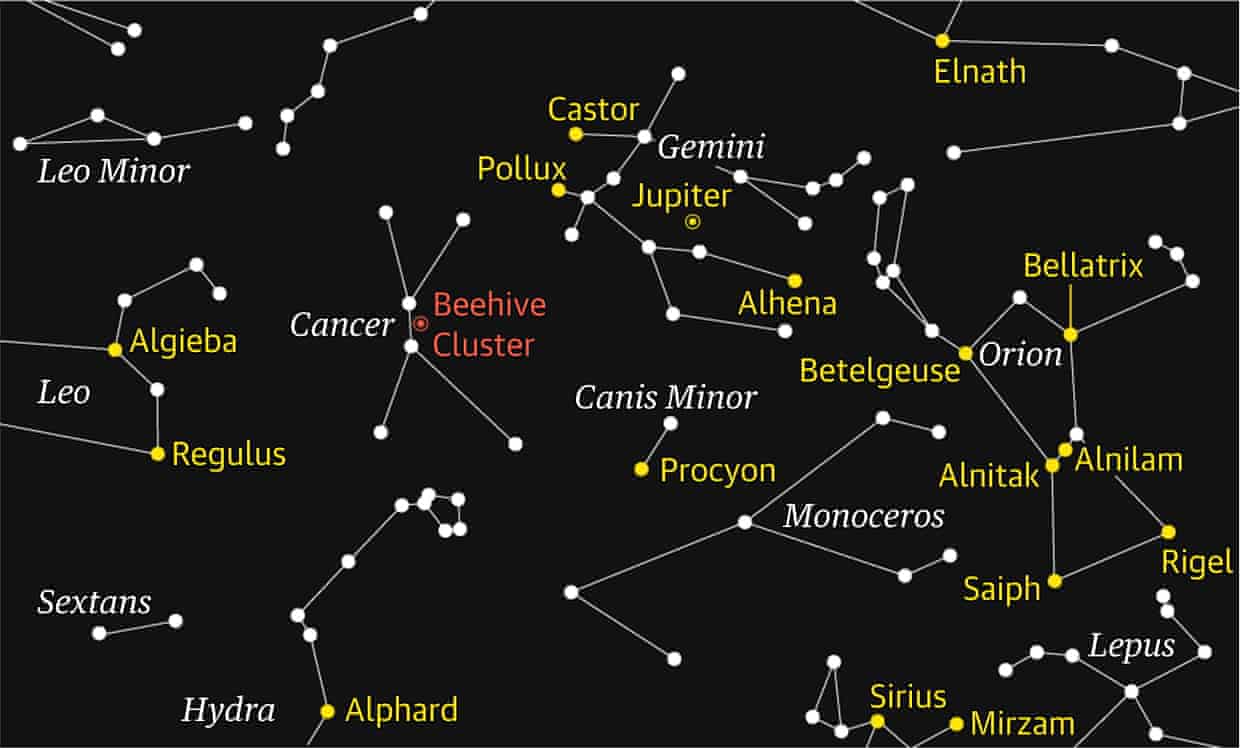
The constellation of Cancer is prominently positioned in the southern sky during late evening hours, providing an opportunity for stargazers to observe its noteworthy feature, the Beehive Cluster, also known as M44. While Cancer lacks bright stars that make it easy to spot, patience is rewarded when one successfully identifies this intriguing cluster.
To locate Cancer, look for it situated halfway between the constellations of Gemini and Leo. A sky chart depicting the view from London at 22:00 UK time on March 9, 2024 can assist in your search. The Beehive Cluster resides at the center of Cancer and is faintly visible to the naked eye, provided one is in a dark sky location.
Finding a place away from streetlights is crucial, as light pollution can obscure the view. Stargazers should allow their eyes approximately 20 minutes to adjust to the darkness. Begin by locating the two bright stars, Castor and Pollux, which mark the heads of the twins in Gemini. From there, look eastward towards Leo, identifiable by its characteristic sickle shape resembling a backward question mark. Midway between these two constellations, M44 will appear as a faint patch of light.
The Beehive Cluster spans an area of sky approximately three times the apparent diameter of the full Moon, making it a significant sight for amateur astronomers. Its historical significance is noteworthy, as it has been recognized since ancient times. Observers in the southern hemisphere will see Cancer positioned lower in the northwestern sky.
For those intrigued by celestial observations, taking the time to find the Beehive Cluster in Cancer can be a rewarding experience. Embrace the beauty of the night sky as you embark on this stargazing adventure.













Morris Churches Unite for Annual Good Friday Walk With the Cross

Chloe Zhao’s ‘Buffy’ Reboot Cancelled: Sarah Michelle Gellar Speaks Out

Essential Ingredients for Life Found in Ryugu Asteroid Samples

Urgent Rescue: NSR Airlifts Injured Climber from Nanaimo

Riverside Heart Ball Achieves Record $815,000 for Mental Health

Cognizant Launches AI Factory to Enhance Enterprise AI Scalability

Samsung’s Galaxy Watch 9 to Feature Larger Battery Than Before

Toronto’s AIDS Memorial Faces Potential Redesign Amid Community Concerns

Bayern Munich Loses Luis Díaz Red Card Appeal Despite Referee’s Admission

Secwepemc First Nation Seeks Aboriginal Title Over Kamloops Area

Fatal Crash on Highway 11 Claims Three Lives, Major Closure Ongoing

Manitoba’s Burger Champion Shines Again Amid Dining Innovations

Canadian Curler E.J. Harnden Announces Retirement from Competition

Urgent Fire Erupts at Salvation Army on Christmas Evening

Scientists Unearth Ancient Antarctic Ice to Unlock Climate Secrets

Minister Faces Scrutiny Over Delayed Foreign Interference Watchdog Appointment

Trump and McCormick to Announce $70 Billion Energy Investments

Monika Hibbs Unveils Acres Market & Interiors in Major Rebrand
-
 Politics5 months ago
Secwepemc First Nation Seeks Aboriginal Title Over Kamloops Area
-
 Top Stories4 months ago
Fatal Crash on Highway 11 Claims Three Lives, Major Closure Ongoing
-
 Lifestyle7 months ago
Manitoba’s Burger Champion Shines Again Amid Dining Innovations
-
 Sports4 months ago
Canadian Curler E.J. Harnden Announces Retirement from Competition
-
 Top Stories4 months ago
Urgent Fire Erupts at Salvation Army on Christmas Evening
-
 World9 months ago
Scientists Unearth Ancient Antarctic Ice to Unlock Climate Secrets
-
 World5 months ago
Minister Faces Scrutiny Over Delayed Foreign Interference Watchdog Appointment
-
 Entertainment9 months ago
Trump and McCormick to Announce $70 Billion Energy Investments
-
 Lifestyle9 months ago
Monika Hibbs Unveils Acres Market & Interiors in Major Rebrand
-

 Science9 months ago
Four Astronauts Return to Earth After International Space Station Mission
-

 Lifestyle9 months ago
TransLink Launches Food Truck Program to Boost Revenue in Vancouver
-

 World2 months ago
Ranchman’s Cookhouse & Dancehall to Relocate by Early 2027