
Science
NASA Delays Artemis II Launch to March Due to Hydrogen Leaks

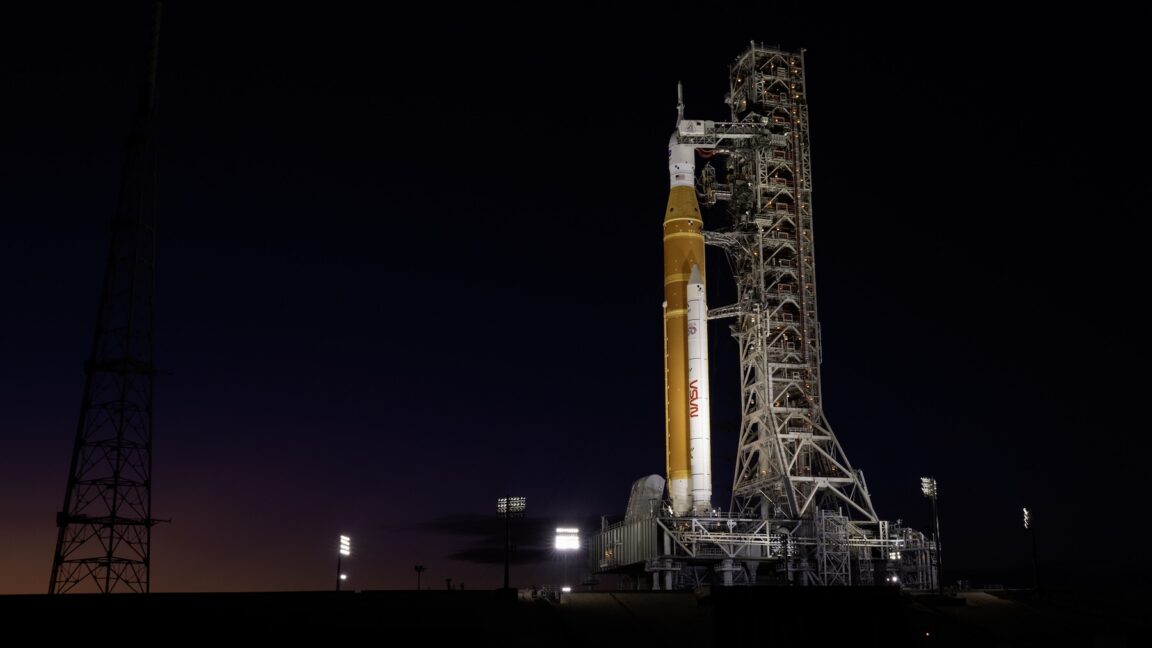
The launch of NASA’s Artemis II mission, marking the first crewed flight to the Moon in over 53 years, has been postponed until March following the discovery of hydrogen leaks during a recent fueling test. The leaks were detected in the connection between the rocket and its launch platform at the Kennedy Space Center in Florida during the Wet Dress Rehearsal (WDR) conducted on February 5 and 6, 2024.
NASA reported that engineers encountered several challenges during the two-day test but met many planned objectives. In a statement, the agency confirmed, “To allow teams to review data and conduct a second Wet Dress Rehearsal, NASA now will target March as the earliest possible launch opportunity for the flight test.” This delay comes as the agency continues to address persistent hydrogen leak issues that previously hindered the uncrewed Artemis I test flight in 2022.
The Artemis II mission is poised to send four astronauts aboard NASA’s Orion spacecraft on a trajectory around the far side of the Moon, the first crewed lunar flight since 1972. This mission is critical for paving the way for future expeditions aimed at landing humans at the Moon’s south pole. NASA had initially hoped to launch Artemis II as early as February 8, 2024, but the hydrogen leaks have necessitated a reassessment of the timeline.
NASA has a limited number of launch windows each month, dictated by the Moon’s position in its orbit, which is essential for ensuring a safe return trajectory for the Orion spacecraft. The first potential launch date next month is set for March 6, with a two-hour window opening at 20:29 EST (01:26 UTC on March 7).
The crew for Artemis II includes commander Reid Wiseman, pilot Victor Glover, mission specialist Christina Koch, and Canadian astronaut Jeremy Hansen. Since January 21, they have been in medical quarantine, a standard procedure for astronauts preparing for space missions. Following the postponement, they will return to their home base in Houston to continue training.
During the countdown rehearsal, the launch team began fueling operations later than planned due to cold temperatures at the Florida spaceport. Hydrogen leaks were detected shortly after loading the super-cold fuel into the Space Launch System (SLS) rocket’s core stage. This issue arose in the same location that caused delays during the Artemis I launch campaign.
Liquid hydrogen and liquid oxygen are transferred from ground storage tanks into the SLS core stage via Tail Service Mast Umbilicals (TSMUs). These connections are critical for propellant flow and must disconnect at liftoff. Hydrogen is a highly efficient rocket fuel, but its handling poses significant challenges due to its extremely low storage temperature of minus 423 degrees Fahrenheit (minus 253 degrees Celsius), which can affect the seals in the fueling lines.
NASA engineers have acknowledged that a small amount of hydrogen will escape from seals, but they have established a safe threshold of 4 percent concentration of hydrogen gas around the fueling connector. During the recent countdown test, hydrogen levels surpassed this limit multiple times, prompting corrective measures.
NASA attempted to mitigate the leaks by halting the flow of liquid hydrogen to allow the seals to reseat and adjusting the propellant flow. Ultimately, the SLS rocket was successfully loaded with more than 750,000 gallons of propellant. However, the countdown was terminated due to a spike in the liquid hydrogen leak rate before the rocket switched to internal power, leading to the decision to delay the launch.
NASA Administrator Jared Isaacman emphasized the importance of safety, stating, “As always, safety remains our top priority, for our astronauts, our workforce, our systems, and the public. We will only launch when we believe we are as ready to undertake this historic mission.”
At present, NASA has not announced a date for the next Wet Dress Rehearsal or whether the rocket will be returned to its assembly building for further repairs. A press briefing is scheduled for later today to provide additional details on the test’s results and the upcoming timeline for Artemis II.










Morris Churches Unite for Annual Good Friday Walk With the Cross

Chloe Zhao’s ‘Buffy’ Reboot Cancelled: Sarah Michelle Gellar Speaks Out

Essential Ingredients for Life Found in Ryugu Asteroid Samples

Urgent Rescue: NSR Airlifts Injured Climber from Nanaimo

Riverside Heart Ball Achieves Record $815,000 for Mental Health

Cognizant Launches AI Factory to Enhance Enterprise AI Scalability

Samsung’s Galaxy Watch 9 to Feature Larger Battery Than Before

Toronto’s AIDS Memorial Faces Potential Redesign Amid Community Concerns

Bayern Munich Loses Luis Díaz Red Card Appeal Despite Referee’s Admission

Secwepemc First Nation Seeks Aboriginal Title Over Kamloops Area

Fatal Crash on Highway 11 Claims Three Lives, Major Closure Ongoing

Manitoba’s Burger Champion Shines Again Amid Dining Innovations

Canadian Curler E.J. Harnden Announces Retirement from Competition

Urgent Fire Erupts at Salvation Army on Christmas Evening

Scientists Unearth Ancient Antarctic Ice to Unlock Climate Secrets

Minister Faces Scrutiny Over Delayed Foreign Interference Watchdog Appointment

Trump and McCormick to Announce $70 Billion Energy Investments

Monika Hibbs Unveils Acres Market & Interiors in Major Rebrand
-
 Politics5 months ago
Secwepemc First Nation Seeks Aboriginal Title Over Kamloops Area
-
 Top Stories4 months ago
Fatal Crash on Highway 11 Claims Three Lives, Major Closure Ongoing
-
 Lifestyle7 months ago
Manitoba’s Burger Champion Shines Again Amid Dining Innovations
-
 Sports3 months ago
Canadian Curler E.J. Harnden Announces Retirement from Competition
-
 Top Stories4 months ago
Urgent Fire Erupts at Salvation Army on Christmas Evening
-
 World9 months ago
Scientists Unearth Ancient Antarctic Ice to Unlock Climate Secrets
-
 World5 months ago
Minister Faces Scrutiny Over Delayed Foreign Interference Watchdog Appointment
-
 Entertainment9 months ago
Trump and McCormick to Announce $70 Billion Energy Investments
-
 Lifestyle9 months ago
Monika Hibbs Unveils Acres Market & Interiors in Major Rebrand
-
 Science9 months ago
Four Astronauts Return to Earth After International Space Station Mission
-

 Lifestyle9 months ago
TransLink Launches Food Truck Program to Boost Revenue in Vancouver
-

 World1 month ago
Ranchman’s Cookhouse & Dancehall to Relocate by Early 2027