
Science
Ontario Artist Provokes Thought with Speculative Plaques on Canada’s Future

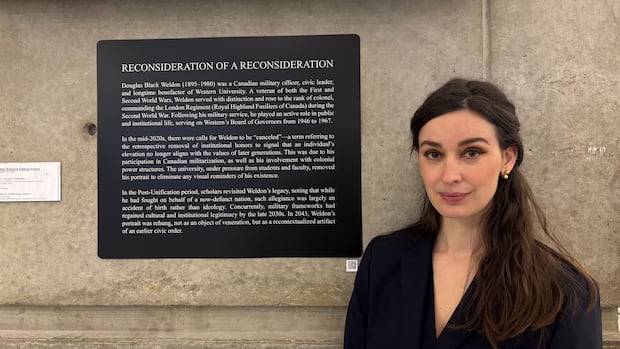
A provocative art installation in Ontario invites viewers to contemplate a hypothetical scenario in which Canada has joined the United States as its 51st state. The exhibit, created by Ontario artist Dara Vandor, features 20 fictional historical plaques placed throughout Western University’s Weldon library in London, Ontario. This series, titled *Pax Americana*, aims to challenge the audience’s perceptions of national identity and historical narrative.
The concept originated in 2025, following comments from former President Donald Trump suggesting the annexation of Canada. Vandor wanted to address the gravity of such notions, stating, “I wanted people to feel it. I wanted them to think about the actual reality, not just the strawberries.” The plaques are crafted from a durable material known as dura black, designed to withstand the elements and provide a sense of permanence to the imagined history they present.
Exploring Historical Narratives
Each plaque is written as if the annexation has already occurred, prompting viewers to consider how history is recorded and who shapes its narrative. Vandor expressed concern that Canadians were trivializing the implications of such discussions. She noted, “After an initial shock, Canadians started to worry about really small things, like where they would buy strawberries from in California, and if they were allowed to go to Disney World anymore.” She believes these concerns overshadow the significant threat of losing national identity and values.
Initially, Vandor planned to create just one plaque in her Toronto neighbourhood. However, the idea expanded rapidly, leading to the installation of multiple plaques that explore various themes related to this speculative future. The seemingly official nature of the plaques, engraved and permanent, encourages contemplation on the malleability of history. “History is written by the victors,” she remarked, emphasizing the subjective nature of how events are recorded.
Engaging with Speculative Art
The project has garnered attention from academics, including Frank Schumacher, a professor of history and director of international relations at Western University. He described the installation as a blend of “eerie realism and playful imagination,” noting that it provides students with a unique way to engage with political and social issues. Schumacher explained that while students often focus on finding concrete answers to contemporary problems, speculative art allows for exploration of ideas that may not fit traditional scholarly frameworks.
The plaques have elicited diverse responses, ranging from curiosity to criticism. Some viewers questioned the legitimacy of the installations, while others accused Vandor of promoting a hidden political agenda. Vandor welcomed this range of reactions, stating, “If it provokes an emotion, I’m happy.” For her, the plaques are not intended to serve as predictions or directives but rather as invitations for reflection.
Schumacher concurs, highlighting that the artwork allows viewers to draw their own conclusions. “They can see it, they can agree with it. They can reject it,” he said. This open-ended approach encourages critical thinking about national identity and the potential implications of geopolitical changes.
Vandor acknowledges the discomfort that her work might evoke but argues that such feelings can lead to productive conversations. “Maybe it should normalize the fact that our neighbours might not always be peaceful,” she said. By confronting this unease, she hopes to inspire constructive dialogue about the importance of national sovereignty and the complexities of international relations.
The *Pax Americana* exhibit ultimately serves as a thought-provoking commentary on the fragile nature of national identity and the narratives that shape our understanding of history. Through Vandor’s artistic vision, viewers are encouraged to reflect on the future of Canada and its relationship with the United States, a conversation that remains relevant in today’s sociopolitical climate.








Morris Churches Unite for Annual Good Friday Walk With the Cross

Chloe Zhao’s ‘Buffy’ Reboot Cancelled: Sarah Michelle Gellar Speaks Out

Essential Ingredients for Life Found in Ryugu Asteroid Samples

Urgent Rescue: NSR Airlifts Injured Climber from Nanaimo

Riverside Heart Ball Achieves Record $815,000 for Mental Health

Cognizant Launches AI Factory to Enhance Enterprise AI Scalability

Samsung’s Galaxy Watch 9 to Feature Larger Battery Than Before

Toronto’s AIDS Memorial Faces Potential Redesign Amid Community Concerns

Bayern Munich Loses Luis Díaz Red Card Appeal Despite Referee’s Admission

Secwepemc First Nation Seeks Aboriginal Title Over Kamloops Area

Fatal Crash on Highway 11 Claims Three Lives, Major Closure Ongoing

Manitoba’s Burger Champion Shines Again Amid Dining Innovations

Canadian Curler E.J. Harnden Announces Retirement from Competition

Urgent Fire Erupts at Salvation Army on Christmas Evening

Scientists Unearth Ancient Antarctic Ice to Unlock Climate Secrets

Minister Faces Scrutiny Over Delayed Foreign Interference Watchdog Appointment

Trump and McCormick to Announce $70 Billion Energy Investments

Four Astronauts Return to Earth After International Space Station Mission
-
 Politics5 months ago
Secwepemc First Nation Seeks Aboriginal Title Over Kamloops Area
-
 Top Stories4 months ago
Fatal Crash on Highway 11 Claims Three Lives, Major Closure Ongoing
-
 Lifestyle7 months ago
Manitoba’s Burger Champion Shines Again Amid Dining Innovations
-
 Sports3 months ago
Canadian Curler E.J. Harnden Announces Retirement from Competition
-
 Top Stories3 months ago
Urgent Fire Erupts at Salvation Army on Christmas Evening
-
 World9 months ago
Scientists Unearth Ancient Antarctic Ice to Unlock Climate Secrets
-
 World5 months ago
Minister Faces Scrutiny Over Delayed Foreign Interference Watchdog Appointment
-
 Entertainment9 months ago
Trump and McCormick to Announce $70 Billion Energy Investments
-
 Science9 months ago
Four Astronauts Return to Earth After International Space Station Mission
-

 Lifestyle9 months ago
Monika Hibbs Unveils Acres Market & Interiors in Major Rebrand
-

 Lifestyle9 months ago
TransLink Launches Food Truck Program to Boost Revenue in Vancouver
-
 World1 month ago
Ranchman’s Cookhouse & Dancehall to Relocate by Early 2027