
Science
Researcher and Pet Chicken Explore Cultural Impact of Pets

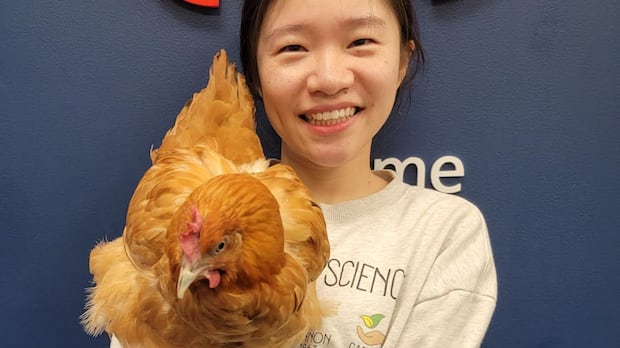
Dr. Sonia Kong, an assistant professor at the University of Northern British Columbia (UNBC), has found a unique source of emotional support in her pet chicken, named Saturday. This 11-month-old chicken, with her bright yellow feathers and gentle demeanor, is not just a companion; she plays a role in Kong’s research on the effects of pets on social and emotional development in teenagers across different cultures.
Alongside her colleague, Tracy Wong from the Chinese University of Hong Kong, Kong is investigating how relationships with pets can vary significantly around the world. Their objective is to understand how these relationships contribute to healthy development among adolescents from diverse cultural backgrounds.
Cultural Perspectives on Pets
Kong’s interest in pets stems from her childhood experiences with chickens and ducks, which inspired her to adopt Saturday from a farm near Prince George. She describes Saturday as a sensitive creature, particularly during her laying periods, and highlights the deep bond they share. “Doing research is not always exciting,” Kong notes, explaining that Saturday often sits beside her while she works, providing comfort during long hours of study.
Realizing the intelligence of chickens has been a revelation for Kong. “She can understand my emotions,” she reflects. “When I was sad, she just lay there, trying to figure out what was going on.” This emotional connection emphasizes the value of pets in personal development.
In many Western cultures, pets are cherished companions, while in other parts of the world, they are often valued for practical purposes such as protection or food. Kong explains, “We want to see whether there are cultural differences and how spending time with pets may influence adolescents in different cultural backgrounds.” Her research aims to uncover these nuances.
Research Methodology and Goals
To collect data, Kong and Wong have developed an online survey targeting adolescents, asking them about their feelings and thoughts regarding pets. They have already begun gathering responses in Hong Kong and are actively seeking more participants in Canada. This cross-cultural study intends to shed light on how the role of pets influences emotional and social growth in young people.
The cultural differences surrounding pet ownership were also highlighted by Kong’s personal experience. When her parents learned she had a pet chicken, they humorously questioned whether she would eat it, underscoring the varying cultural values attached to animals. “It’s like, ‘I will not! She’s a pet,'” she recalls with a laugh.
The findings from this research could provide valuable insights into the emotional significance of pets across cultures, potentially influencing how pets are perceived and integrated into family and social structures worldwide. Kong’s study is a testament to the evolving relationship between humans and their animal companions, revealing that even a chicken can offer profound support and companionship.













Morris Churches Unite for Annual Good Friday Walk With the Cross

Chloe Zhao’s ‘Buffy’ Reboot Cancelled: Sarah Michelle Gellar Speaks Out

Essential Ingredients for Life Found in Ryugu Asteroid Samples

Urgent Rescue: NSR Airlifts Injured Climber from Nanaimo

Riverside Heart Ball Achieves Record $815,000 for Mental Health

Cognizant Launches AI Factory to Enhance Enterprise AI Scalability

Samsung’s Galaxy Watch 9 to Feature Larger Battery Than Before

Toronto’s AIDS Memorial Faces Potential Redesign Amid Community Concerns

Bayern Munich Loses Luis Díaz Red Card Appeal Despite Referee’s Admission

Secwepemc First Nation Seeks Aboriginal Title Over Kamloops Area

Fatal Crash on Highway 11 Claims Three Lives, Major Closure Ongoing

Manitoba’s Burger Champion Shines Again Amid Dining Innovations

Canadian Curler E.J. Harnden Announces Retirement from Competition

Urgent Fire Erupts at Salvation Army on Christmas Evening

Scientists Unearth Ancient Antarctic Ice to Unlock Climate Secrets

Trump and McCormick to Announce $70 Billion Energy Investments

Minister Faces Scrutiny Over Delayed Foreign Interference Watchdog Appointment

Four Astronauts Return to Earth After International Space Station Mission
-
 Politics5 months ago
Secwepemc First Nation Seeks Aboriginal Title Over Kamloops Area
-
 Top Stories4 months ago
Fatal Crash on Highway 11 Claims Three Lives, Major Closure Ongoing
-
 Lifestyle7 months ago
Manitoba’s Burger Champion Shines Again Amid Dining Innovations
-
 Sports3 months ago
Canadian Curler E.J. Harnden Announces Retirement from Competition
-
 Top Stories3 months ago
Urgent Fire Erupts at Salvation Army on Christmas Evening
-
 World9 months ago
Scientists Unearth Ancient Antarctic Ice to Unlock Climate Secrets
-
 Entertainment9 months ago
Trump and McCormick to Announce $70 Billion Energy Investments
-
 World5 months ago
Minister Faces Scrutiny Over Delayed Foreign Interference Watchdog Appointment
-
 Science9 months ago
Four Astronauts Return to Earth After International Space Station Mission
-

 Lifestyle9 months ago
Monika Hibbs Unveils Acres Market & Interiors in Major Rebrand
-

 Lifestyle9 months ago
TransLink Launches Food Truck Program to Boost Revenue in Vancouver
-

 World1 month ago
Ranchman’s Cookhouse & Dancehall to Relocate by Early 2027