
Science
Salish Perspectives on the Cosmos Explored by Indigenous Scholar

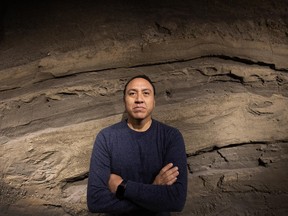
Shandin Pete, an assistant professor at the University of British Columbia, is on a mission to revive and share the astronomical knowledge of his Salish ancestors. Drawing from personal experiences and cultural heritage, he explores how Indigenous stories illuminate the night sky. His work aims to reconnect his community with their celestial traditions, emphasizing the significance of understanding the cosmos through a Salish lens.
Pete’s curiosity about the night sky began in childhood, when he often gazed upward, seeking answers from his grandfather about the Salish name for the Milky Way. While his grandfather could not recall the name, the experience inspired Pete to delve deeper into the cultural narratives surrounding the stars.
In his role at the university, Pete focuses on recovering knowledge that has been fragmented due to colonialism and cultural suppression. “Our creation stories are still told today, and known in our communities, but what was lost was connection to places that were not terrestrial: the patterns in the sky, and how those stories connected to our constellations,” he stated. His research involves interviewing elders, conducting archival research, and analyzing anthropology notes to reconstruct Salish narratives related to the cosmos.
Reviving Indigenous Celestial Knowledge
The international community largely overlooks how Indigenous peoples perceive celestial formations, including known asterisms—smaller star patterns within the 88 internationally recognized constellations. The International Astronomical Union, established in the early 20th century, has primarily focused on a Eurocentric view of the stars, often neglecting Indigenous interpretations.
To truly understand the Salish perspective of the night sky, one must shift their viewpoint. “What we see when we look up away from earth is another reality that mirrors what is happening on earth,” Pete explained. He emphasized that in Salish cosmology, the starry nights reflect events and stories from the terrestrial world, with celestial formations embodying critical moments of transformation.
For example, one of the first asterisms Pete connected to Salish storytelling is the group of stars commonly known as Orion. He described how the belt of Orion represents the center of a canoe, with the right shoulder and opposing foot symbolizing the ends of the vessel. “Once you start understanding the story, you lose the form of Orion and see the canoe so clearly,” Pete remarked.
His research has led to several enlightening moments, where archival documentation aligns with Indigenous storytelling and scientific understanding. “There was a passage in one anthropologist’s notes, written down by one of my ancestors years ago, that described three stars that always rise in the same place, between where the sun and the moon rise,” he recalled. After consulting trained astronomers, Pete was able to connect this cryptic note to the canoe story, revealing the significance of lunar standstills and their connection to the solstices.
Empowering Future Generations
Restoring and revitalizing Indigenous astronomical knowledge carries profound implications for community identity and cultural pride. According to Pete, “It’s important for my community, and in particular it’s important for the young people to have demonstrated how intelligent our communities were, and how well they functioned before the advent of technology.”
Pete will present some of his findings and celestial stories during a talk titled Salish Skies: Indigenous Sky Stories on December 13, 2023, at the H.R. MacMillan Space Centre in Vancouver. The event will commence at 15:00, with doors opening at 14:30. Tickets are priced at $26.20 and are available through Eventbrite.
Through his work, Shandin Pete not only aims to recover lost knowledge but also to inspire a new generation to appreciate and engage with their cultural heritage. By looking to the stars, he invites others to explore a rich tapestry of stories that have been passed down through generations, offering a unique and valuable perspective on the cosmos.










K2 Secures $250 Million to Scale Production of Advanced Satellites

Ottawa Children’s Hospital Urges Doctors to Prioritize Flu Care

Chilco River Holdings Partners with Solutions Group for Growth

Mastering Car Seat Safety: Expert Tips for New Parents

Vicky Mboko Named Among ITF’s Breakthrough Players of 2025

Sault College Board to Determine Successor for Retired President

Salish Perspectives on the Cosmos Explored by Indigenous Scholar

Canadians Face Record Health Care Delays, Manitoba Shows Mixed Results

Vancouver Whitecaps and City Sign MOU for New Stadium Development

Secwepemc First Nation Seeks Aboriginal Title Over Kamloops Area

Scientists Unearth Ancient Antarctic Ice to Unlock Climate Secrets

Trump and McCormick to Announce $70 Billion Energy Investments

TransLink Launches Food Truck Program to Boost Revenue in Vancouver

Four Astronauts Return to Earth After International Space Station Mission

Manitoba’s Burger Champion Shines Again Amid Dining Innovations

Apple Notes Enhances Functionality with Markdown Support in macOS 26

Urgent Update: Fatal Crash on Highway 99 Claims Life of Pitt Meadows Man

Homemade Houseboat ‘Neverlanding’ Captivates Lake Huron Voyagers
-
 Politics1 month ago
Secwepemc First Nation Seeks Aboriginal Title Over Kamloops Area
-
 World5 months ago
Scientists Unearth Ancient Antarctic Ice to Unlock Climate Secrets
-
 Entertainment5 months ago
Trump and McCormick to Announce $70 Billion Energy Investments
-
 Lifestyle5 months ago
TransLink Launches Food Truck Program to Boost Revenue in Vancouver
-
 Science5 months ago
Four Astronauts Return to Earth After International Space Station Mission
-
 Lifestyle3 months ago
Manitoba’s Burger Champion Shines Again Amid Dining Innovations
-
 Technology4 months ago
Apple Notes Enhances Functionality with Markdown Support in macOS 26
-
 Top Stories2 months ago
Urgent Update: Fatal Crash on Highway 99 Claims Life of Pitt Meadows Man
-
 Top Stories2 weeks ago
Homemade Houseboat ‘Neverlanding’ Captivates Lake Huron Voyagers
-

 Politics4 months ago
Ukrainian Tennis Star Elina Svitolina Faces Death Threats Online
-
 Sports5 months ago
Search Underway for Missing Hunter Amid Hokkaido Bear Emergency
-

 Politics5 months ago
Carney Engages First Nations Leaders at Development Law Summit