
Science
Solar Storm Ignites Stunning Northern Lights Across North America

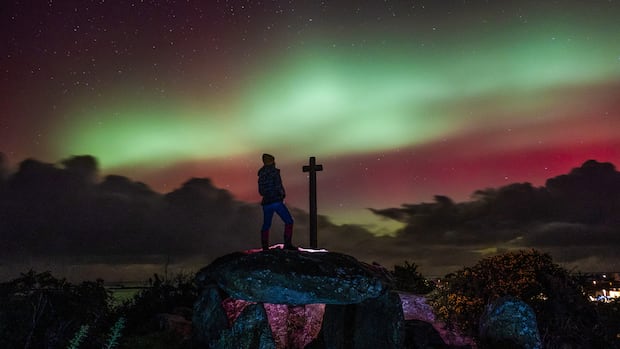
A significant solar storm on March 25, 2024, resulted in a spectacular display of the northern lights, or aurora borealis, illuminating skies across Canada, the United States, and parts of Europe. This natural phenomenon captivated thousands, as vibrant hues of green, pink, and purple danced across the night sky.
The solar storm was triggered by a coronal mass ejection (CME), a massive burst of solar wind and magnetic fields rising above the solar corona or being released into space. According to the National Oceanic and Atmospheric Administration (NOAA), this particular storm was one of the strongest observed in recent years, leading to heightened geomagnetic activity.
Captivating Displays Across the Northern Hemisphere
Regions in northern Canada and Alaska experienced the most intense displays, with residents in cities such as Yellowknife and Fairbanks reporting particularly vivid sightings. In the contiguous United States, states like Minnesota, Wisconsin, and Michigan also witnessed the breathtaking spectacle. The lights were visible as far south as New York and parts of New England, surprising many who had never seen the aurora before.
The phenomenon attracted not only local observers but also tourists, with many traveling specifically to catch a glimpse of the aurora. Social media platforms were flooded with stunning photographs and videos, showcasing the ethereal beauty of the lights. Reports indicate that this solar event led to a surge in tourism in areas known for aurora viewing, as enthusiasts sought the best vantage points.
Scientific Insights and Predictions
NASA scientists had anticipated the solar storm based on data from the Solar Dynamics Observatory, which monitors solar activity. The agency noted that the CME was expected to produce a G4-class geomagnetic storm, indicating potential for significant auroral activity. The NOAA’s Space Weather Prediction Center confirmed that the storm exceeded expectations, reaching a G5 classification, the highest level on the scale.
Astronomers and space weather experts emphasize the importance of monitoring solar activity. Such storms can impact satellite communications, power grids, and even airline operations. The recent event serves as a reminder of the intricate connection between solar activity and life on Earth, highlighting the need for continued research in this area.
The northern lights are not only a marvel to behold but also a subject of scientific study. As our understanding of solar phenomena improves, so does our ability to predict and mitigate the effects of solar storms on technology and infrastructure.
The stunning displays of the aurora borealis provided a unique opportunity for people across multiple regions to connect with nature and witness one of Earth’s most awe-inspiring sights. As the excitement from this event fades, the scientific community will continue to analyze the data collected, enhancing our understanding of solar storms and their impacts on our planet.












Morris Churches Unite for Annual Good Friday Walk With the Cross

Chloe Zhao’s ‘Buffy’ Reboot Cancelled: Sarah Michelle Gellar Speaks Out

Essential Ingredients for Life Found in Ryugu Asteroid Samples

Urgent Rescue: NSR Airlifts Injured Climber from Nanaimo

Riverside Heart Ball Achieves Record $815,000 for Mental Health

Cognizant Launches AI Factory to Enhance Enterprise AI Scalability

Samsung’s Galaxy Watch 9 to Feature Larger Battery Than Before

Toronto’s AIDS Memorial Faces Potential Redesign Amid Community Concerns

Bayern Munich Loses Luis Díaz Red Card Appeal Despite Referee’s Admission

Secwepemc First Nation Seeks Aboriginal Title Over Kamloops Area

Fatal Crash on Highway 11 Claims Three Lives, Major Closure Ongoing

Manitoba’s Burger Champion Shines Again Amid Dining Innovations

Canadian Curler E.J. Harnden Announces Retirement from Competition

Urgent Fire Erupts at Salvation Army on Christmas Evening

Scientists Unearth Ancient Antarctic Ice to Unlock Climate Secrets

Minister Faces Scrutiny Over Delayed Foreign Interference Watchdog Appointment

Trump and McCormick to Announce $70 Billion Energy Investments

Monika Hibbs Unveils Acres Market & Interiors in Major Rebrand
-
 Politics5 months ago
Secwepemc First Nation Seeks Aboriginal Title Over Kamloops Area
-
 Top Stories4 months ago
Fatal Crash on Highway 11 Claims Three Lives, Major Closure Ongoing
-
 Lifestyle7 months ago
Manitoba’s Burger Champion Shines Again Amid Dining Innovations
-
 Sports3 months ago
Canadian Curler E.J. Harnden Announces Retirement from Competition
-
 Top Stories4 months ago
Urgent Fire Erupts at Salvation Army on Christmas Evening
-
 World9 months ago
Scientists Unearth Ancient Antarctic Ice to Unlock Climate Secrets
-
 World5 months ago
Minister Faces Scrutiny Over Delayed Foreign Interference Watchdog Appointment
-
 Entertainment9 months ago
Trump and McCormick to Announce $70 Billion Energy Investments
-
 Lifestyle9 months ago
Monika Hibbs Unveils Acres Market & Interiors in Major Rebrand
-
 Science9 months ago
Four Astronauts Return to Earth After International Space Station Mission
-

 Lifestyle9 months ago
TransLink Launches Food Truck Program to Boost Revenue in Vancouver
-

 World1 month ago
Ranchman’s Cookhouse & Dancehall to Relocate by Early 2027