
Science
UBC Team Advances Zinc-Ion Batteries for Safer Energy Storage

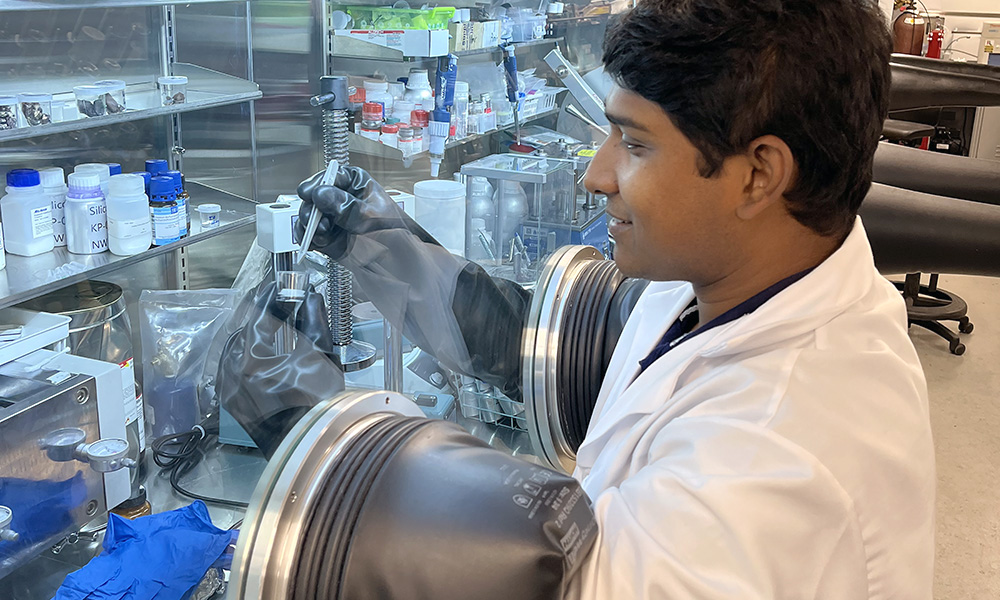
A team of researchers at the University of British Columbia (UBC) has made significant strides in enhancing the safety and longevity of zinc-ion batteries. Under the leadership of doctoral student Musanna Galib, the team discovered a method to control the growth of harmful metallic crystals, known as dendrites, which can compromise battery performance and safety.
This breakthrough addresses longstanding safety concerns related to battery technology, especially in light of previous incidents involving electric vehicles and consumer electronics. While such events have become less frequent, the quest for safer battery systems remains a critical focus for researchers globally.
Research Highlights and Implications
The UBC research team conducted their studies in the Battery Research Centre at UBC Okanagan while utilizing labs at UBC Vancouver. Galib explains that dendrites are microscopic, needle-like structures that can form on battery electrodes during charging. If left unchecked, these structures can breach the battery’s protective coating, resulting in short circuits and potential fires.
“In zinc batteries, dendrites are a major obstacle to developing safe and rechargeable alternatives to lithium-ion technology, as they limit the lifespan and reliability of the battery,” says Galib.
Lead researcher Dr. Jian Liu, an associate professor at the School of Engineering, emphasized the advantages of zinc batteries over their lithium-ion counterparts. While lithium-ion batteries currently dominate the market due to their high energy density, zinc batteries offer a safer, more cost-effective, and environmentally friendly option. “Zinc is abundant and inexpensive, and the water-based electrolytes in zinc-ion batteries make them non-flammable,” Dr. Liu explains.
The team’s findings, recently published on the cover of ACS Applied Materials & Interfaces, demonstrate that applying a thin film coating can generate internal mechanical stresses that deter dendrite growth. This innovative approach acts as a protective barrier, suppressing the initiation and growth of dendrites at the atomic level.
Methodology and Future Directions
Using high-speed in situ optical microscopy, Galib and the research team observed zinc dendrites in real time. Their observations revealed that coated zinc surfaces maintained a smoother profile and produced less hydrogen gas, even under high current densities. “Residual stresses from the coatings made it harder for sharp dendrites to form, leading to more stable cycling and fewer safety risks,” Galib noted.
While the experimental synthesis and electrochemical testing were primarily conducted at UBC Okanagan, computational modeling was carried out at UBC Vancouver under the supervision of Dr. Mauricio Ponga. This collaborative effort highlights the importance of cross-campus research in addressing complex scientific challenges.
Dr. Liu remarked on the significance of this project, stating, “The collaboration between the two campuses was essential. It combined state-of-the-art simulations and experiments to uncover the coating’s stress-driven protection mechanism.” He added that understanding dendrite behavior can pave the way for the development of safer, high-performance batteries suitable for electric vehicles, wearable technology, and renewable energy systems.
As the demand for energy storage solutions continues to grow, the findings from this research could play a pivotal role in advancing the safety and efficiency of future energy technologies. The UBC team’s work exemplifies the potential for innovative research to shift the landscape of battery technology, making it not only more sustainable but also more secure for consumers.










Urgent: One Arrested After Downtown Prince George Apartment Fire

Filipino BC Urged for Immediate Transparency on Festival Funds

Saskatchewan Rejects NDP Bill to Limit Notwithstanding Clause Use

Calgary-Banff Hydrogen Rail Proposal Submitted for Urgent Fast-Tracking

FBI Arrests Suspect in 2016 Washington Pipe Bomb Case

Trevor Halford Takes Helm as Interim Leader of BC Conservatives

Marie Helene Juliette Assman: A Life Remembered, 1934-2025

Dave Chappelle Faces Hecklers During Edmonton Debut Performance

New Study Highlights Mental Health Benefits of Remote Work

Secwepemc First Nation Seeks Aboriginal Title Over Kamloops Area

Scientists Unearth Ancient Antarctic Ice to Unlock Climate Secrets

Trump and McCormick to Announce $70 Billion Energy Investments

Four Astronauts Return to Earth After International Space Station Mission

TransLink Launches Food Truck Program to Boost Revenue in Vancouver

Apple Notes Enhances Functionality with Markdown Support in macOS 26

Manitoba’s Burger Champion Shines Again Amid Dining Innovations

Urgent Update: Fatal Crash on Highway 99 Claims Life of Pitt Meadows Man

Ukrainian Tennis Star Elina Svitolina Faces Death Threats Online
-
 Politics4 weeks ago
Secwepemc First Nation Seeks Aboriginal Title Over Kamloops Area
-
 World5 months ago
Scientists Unearth Ancient Antarctic Ice to Unlock Climate Secrets
-
 Entertainment5 months ago
Trump and McCormick to Announce $70 Billion Energy Investments
-
 Science5 months ago
Four Astronauts Return to Earth After International Space Station Mission
-
 Lifestyle5 months ago
TransLink Launches Food Truck Program to Boost Revenue in Vancouver
-
 Technology3 months ago
Apple Notes Enhances Functionality with Markdown Support in macOS 26
-
 Lifestyle3 months ago
Manitoba’s Burger Champion Shines Again Amid Dining Innovations
-
 Top Stories2 months ago
Urgent Update: Fatal Crash on Highway 99 Claims Life of Pitt Meadows Man
-
 Politics4 months ago
Ukrainian Tennis Star Elina Svitolina Faces Death Threats Online
-

 Sports5 months ago
Search Underway for Missing Hunter Amid Hokkaido Bear Emergency
-

 Politics5 months ago
Carney Engages First Nations Leaders at Development Law Summit
-

 Technology5 months ago
Frosthaven Launches Early Access on July 31, 2025