
Science
Understanding Space-Time: The Complex Fabric of Reality

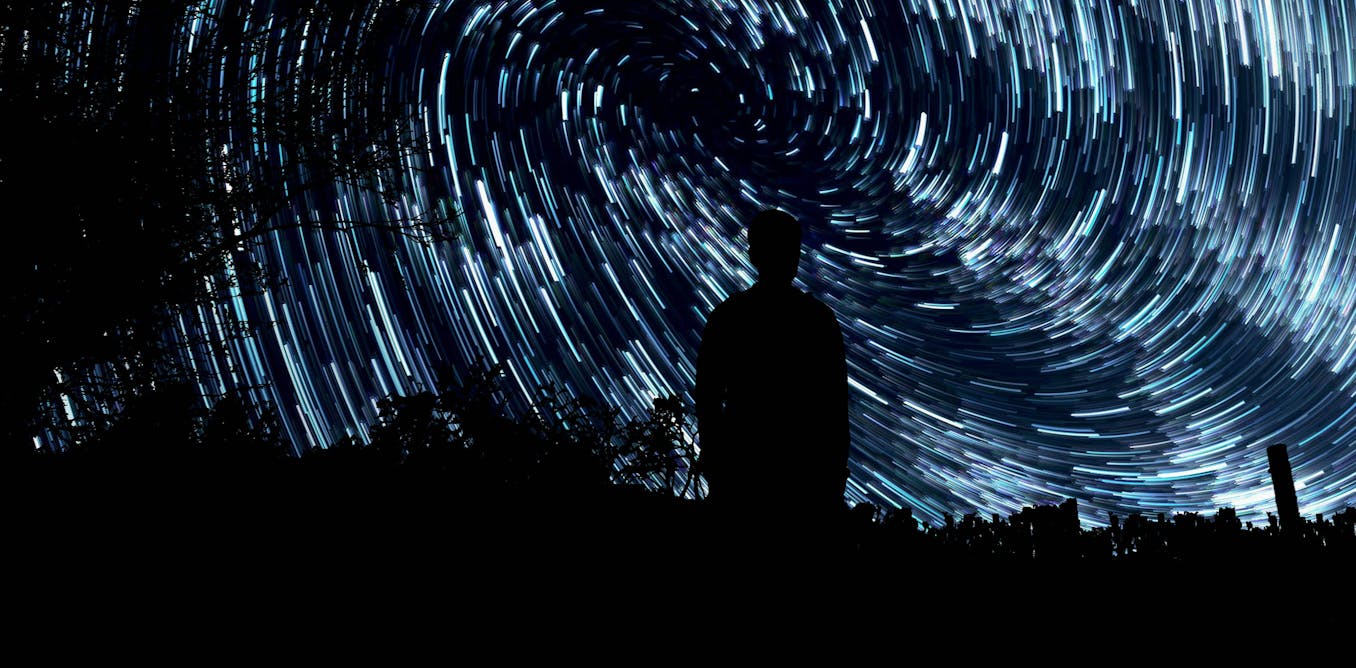
Space-time, a concept deeply rooted in Albert Einstein’s theory of relativity, has fundamentally altered our understanding of reality. Often referred to as the “fabric of reality,” it represents the intricate relationship between space and time. This framework is frequently depicted as a fixed, four-dimensional “block universe,” which encompasses all events—past, present, and future. Alternatively, space-time can be viewed as a dynamic field that responds to gravitational forces. These interpretations raise essential questions about the nature of space-time: Is it a structural entity, a substance, or merely a metaphor?
The Philosophical Implications of Space-Time
The inquiry into space-time is not merely philosophical; it significantly influences our comprehension of modern physics. These discussions impact various concepts, including general relativity, time travel, multiverses, and the origins of the universe. The language surrounding space-time is often vague and metaphorical, leading to confusion. Ludwig Wittgenstein, an influential philosopher, cautioned that philosophical dilemmas arise when “language goes on holiday.” In physics, this phenomenon is evident as common terms like “time,” “exist,” and “timeless” are redefined without addressing their everyday meanings.
One prominent view in the philosophy of physics is known as eternalism, which posits that time does not flow or pass in the conventional sense. Instead, all events across time coexist within the four-dimensional block universe. In this framework, the entire history of the universe is perceived as existing simultaneously, rendering change and becoming illusory. This perspective raises further questions about the actual implications of space-time’s existence.
Existence vs. Occurrence
Understanding the distinction between existence and occurrence is crucial. For instance, consider an elephant in a room. You would assert, “This elephant exists.” It is a tangible, three-dimensional object. Conversely, envision a fleeting, three-dimensional elephant briefly appearing and disappearing. This “occurring elephant” does not truly exist in the conventional sense; it simply happens.
Applying this analogy to space-time invites deeper contemplation. What does it mean for four-dimensional space-time to exist similarly to the elephant? Does it endure over time, possess its own moments of “now,” or is it merely a descriptive framework encapsulating all events? Eternalism complicates this distinction by treating all moments in time as equally real, which challenges our understanding of existence itself.
If we accept that every event in the universe’s history exists within the block universe, we must consider when this block itself exists. If it is indeed timeless and static, introducing another layer of time could contradict its fundamental nature. This complexity suggests a possible five-dimensional framework, incorporating two time dimensions alongside three spatial dimensions. While this idea diverges from established physics, it highlights the challenges of coherently discussing space-time’s existence.
Space-Time in Popular Culture and Science
The confusion surrounding space-time significantly influences our portrayal of time in fiction and popular science. For example, in the 1984 film The Terminator, time is depicted as fixed, allowing for time travel while maintaining an unchangeable timeline. Conversely, Avengers: Endgame (2019) presents a more flexible timeline, where characters can alter past events, suggesting a block universe that can both exist and change.
Regardless of the narrative, these scenarios presuppose that both past and future are accessible, yet they do not address the implications of such existence or the fundamental differences between space-time and a mere map of events. When physicists assert that space-time “exists,” they often operate within a framework that blurs the line between existence and occurrence.
Understanding the complexities of space-time is more than a technical debate; it shapes our perception of reality. While the mathematical foundation of relativity remains sound, how we interpret these principles is critical. This understanding plays a vital role in reconciling general relativity with quantum theory, a challenge that spans both philosophical and scientific discussions.
Ultimately, defining space-time influences our conception of the universe we inhabit, revealing deeper questions about the nature of existence itself. Daryl Janzen, the author of this analysis, has no affiliations that would benefit from this discourse, ensuring an objective examination of a topic that continues to provoke thought and inquiry.







Maple Leafs Triumph Over Canes, Face Goaltending Crisis

Kishwaukee College to Celebrate Fall Graduates on December 13

Renewed Fighting in Eastern Congo Undermines Peace Agreement

Calgary Faces Domestic Violence Crisis: Urgent Action Required

Discover 3 Festive Recipes from Dan Pelosi’s New Cookbook

Radiothon Launches to Equip Victoria Hospital Expansion

Netflix Confirms $72B Acquisition of Warner Bros. Discovery

Acute Care Alberta Extends $34M Contract Amid Procurement Probes

Ambassador Bridge Fees Surge $2 by January 2026

Secwepemc First Nation Seeks Aboriginal Title Over Kamloops Area

Scientists Unearth Ancient Antarctic Ice to Unlock Climate Secrets

Trump and McCormick to Announce $70 Billion Energy Investments

Four Astronauts Return to Earth After International Space Station Mission

TransLink Launches Food Truck Program to Boost Revenue in Vancouver

Apple Notes Enhances Functionality with Markdown Support in macOS 26

Manitoba’s Burger Champion Shines Again Amid Dining Innovations

Urgent Update: Fatal Crash on Highway 99 Claims Life of Pitt Meadows Man

Ukrainian Tennis Star Elina Svitolina Faces Death Threats Online
-
 Politics4 weeks ago
Secwepemc First Nation Seeks Aboriginal Title Over Kamloops Area
-
 World5 months ago
Scientists Unearth Ancient Antarctic Ice to Unlock Climate Secrets
-
 Entertainment5 months ago
Trump and McCormick to Announce $70 Billion Energy Investments
-
 Science5 months ago
Four Astronauts Return to Earth After International Space Station Mission
-
 Lifestyle5 months ago
TransLink Launches Food Truck Program to Boost Revenue in Vancouver
-
 Technology3 months ago
Apple Notes Enhances Functionality with Markdown Support in macOS 26
-
 Lifestyle3 months ago
Manitoba’s Burger Champion Shines Again Amid Dining Innovations
-
 Top Stories2 months ago
Urgent Update: Fatal Crash on Highway 99 Claims Life of Pitt Meadows Man
-
 Politics4 months ago
Ukrainian Tennis Star Elina Svitolina Faces Death Threats Online
-

 Sports5 months ago
Search Underway for Missing Hunter Amid Hokkaido Bear Emergency
-

 Politics5 months ago
Carney Engages First Nations Leaders at Development Law Summit
-
 Technology5 months ago
Frosthaven Launches Early Access on July 31, 2025