
Technology
Ford Faces $19.5 Billion Writedown, Shifts Focus to Gas Models

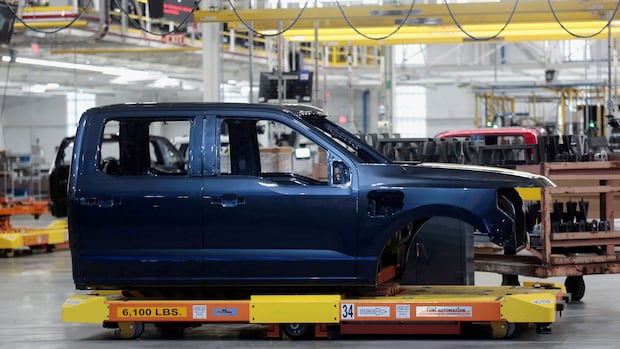
Ford Motor Company announced on Monday that it will incur a significant writedown of $19.5 billion and discontinue several electric vehicle (EV) models. This decision marks a notable shift in the auto industry as companies grapple with changing demand for battery-powered vehicles, influenced by recent policy changes under the Trump administration.
In light of these developments, Ford plans to replace the fully electric F-150 Lightning with a new extended-range electric model that will incorporate a gas-powered engine to recharge the battery. The company will also halt production of the next-generation electric truck, known as the T3, along with several planned electric commercial vans. In an interview with Reuters, Ford CEO Jim Farley stated, “When the market really changed over the last couple of months, that was really the impetus for us to make the call.”
The Michigan-based automaker is adjusting its strategy to focus on gas and hybrid models. Although this transition may lead to some layoffs at a jointly owned battery plant in Kentucky, Ford anticipates hiring thousands of new workers in the future. The company aims for its global mix of hybrids, extended-range EVs, and pure EVs to reach 50 percent by 2030, an increase from 17 percent today.
Financial Implications and Future Outlook
Ford plans to manage the $19.5 billion writedown over several years, with the bulk of it occurring in the fourth quarter and extending into 2027. Approximately $8.5 billion is associated with the cancellation of planned EV models, while about $6 billion relates to the dissolution of a battery joint venture with South Korea’s SK On. The remaining $5 billion is classified as “program-related expenses.”
Despite these challenges, Ford has raised its guidance for adjusted earnings before interest and taxes in 2025 to around $7 billion, up from a prior estimate of $6 billion to $6.5 billion. Following the announcement, Ford shares rose by approximately 1 percent in after-hours trading.
The move by Ford reflects a broader trend within the automotive sector, as manufacturers reassess their EV strategies in response to declining demand. U.S. sales of electric vehicles dropped by about 40 percent in November, following the expiration of a consumer tax credit on September 30, 2023. This credit, valued at $7,500, had been a key incentive for buyers for over 15 years. The Trump administration’s policies, which relaxed fuel economy regulations and halted fines for non-compliance, have further reshaped the market landscape.
Broader Industry Impact
The challenges facing Ford are not isolated; other major automakers are also scaling back their EV initiatives. General Motors recently reported a $1.6 billion charge as it modified its EV production plans, indicating potential for future financial adjustments. Similarly, Stellantis has revised its EV roadmap, eliminating a planned electric Ram pickup truck and pivoting toward hybrid models.
Ford’s decision to shift focus away from large EVs comes after the F-150 Lightning was initially celebrated upon its launch in 2022, receiving widespread attention, including a song by comedian Jimmy Fallon. Despite producing 25,583 units through November 2023, sales have not met expectations, reflecting a 10 percent decline from the previous year.
The upcoming T3 truck was intended to be a flagship model for Ford’s next generation of EVs, with plans for its production to take place at a new facility in Tennessee. Instead, Ford is now redirecting its efforts to gas-powered variants, which are set to start production in 2029.
In the meantime, Ford is developing more affordable EV options, with plans to price a new midsize electric truck around $30,000, aimed for release in 2027. This initiative, spearheaded by a dedicated team in California, signifies a shift towards more cost-effective solutions in the EV market.
As the automotive landscape continues to evolve, Ford’s strategic pivot highlights the challenges traditional manufacturers face in adapting to shifting consumer preferences and regulatory environments. The company’s commitment to profitability in its EV business by 2029 will be closely monitored by industry analysts as it navigates this complex transition.











Saskatoon Shoppers Embrace Experience Gifts This Christmas

British Comedy “O Christmas Tea” Returns to Surrey Stage with Festive Fun

AI-Native VC Launches $50M Fund to Revolutionize Startups

Montreal Children’s Hospital Eliminates Surgical Waitlists for Kids

Treasury Wine Estates Updates Investors on Strategic Growth Plans

Reece Howden Claims Historic 19th Ski Cross Gold in Arosa

Bearspaw First Nation Education Trust Empowers Young Students

Thousands Protest Fico’s Government Over Whistleblower Office Closure

Eastern Charlotte Mayor John Craig Reflects on 2025 Progress

Secwepemc First Nation Seeks Aboriginal Title Over Kamloops Area

Scientists Unearth Ancient Antarctic Ice to Unlock Climate Secrets

Trump and McCormick to Announce $70 Billion Energy Investments

TransLink Launches Food Truck Program to Boost Revenue in Vancouver

Four Astronauts Return to Earth After International Space Station Mission

Manitoba’s Burger Champion Shines Again Amid Dining Innovations

Apple Notes Enhances Functionality with Markdown Support in macOS 26

Urgent Update: Fatal Crash on Highway 99 Claims Life of Pitt Meadows Man

Homemade Houseboat ‘Neverlanding’ Captivates Lake Huron Voyagers
-
 Politics1 month ago
Secwepemc First Nation Seeks Aboriginal Title Over Kamloops Area
-
 World5 months ago
Scientists Unearth Ancient Antarctic Ice to Unlock Climate Secrets
-
 Entertainment5 months ago
Trump and McCormick to Announce $70 Billion Energy Investments
-
 Lifestyle5 months ago
TransLink Launches Food Truck Program to Boost Revenue in Vancouver
-
 Science5 months ago
Four Astronauts Return to Earth After International Space Station Mission
-
 Lifestyle3 months ago
Manitoba’s Burger Champion Shines Again Amid Dining Innovations
-
 Technology4 months ago
Apple Notes Enhances Functionality with Markdown Support in macOS 26
-
 Top Stories2 months ago
Urgent Update: Fatal Crash on Highway 99 Claims Life of Pitt Meadows Man
-
 Top Stories3 weeks ago
Homemade Houseboat ‘Neverlanding’ Captivates Lake Huron Voyagers
-

 Politics4 months ago
Ukrainian Tennis Star Elina Svitolina Faces Death Threats Online
-

 Politics5 months ago
Carney Engages First Nations Leaders at Development Law Summit
-

 Sports5 months ago
Search Underway for Missing Hunter Amid Hokkaido Bear Emergency