
Top Stories
Argentine Stocks Plunge 8% as Earnings Growth Stalls Under Milei

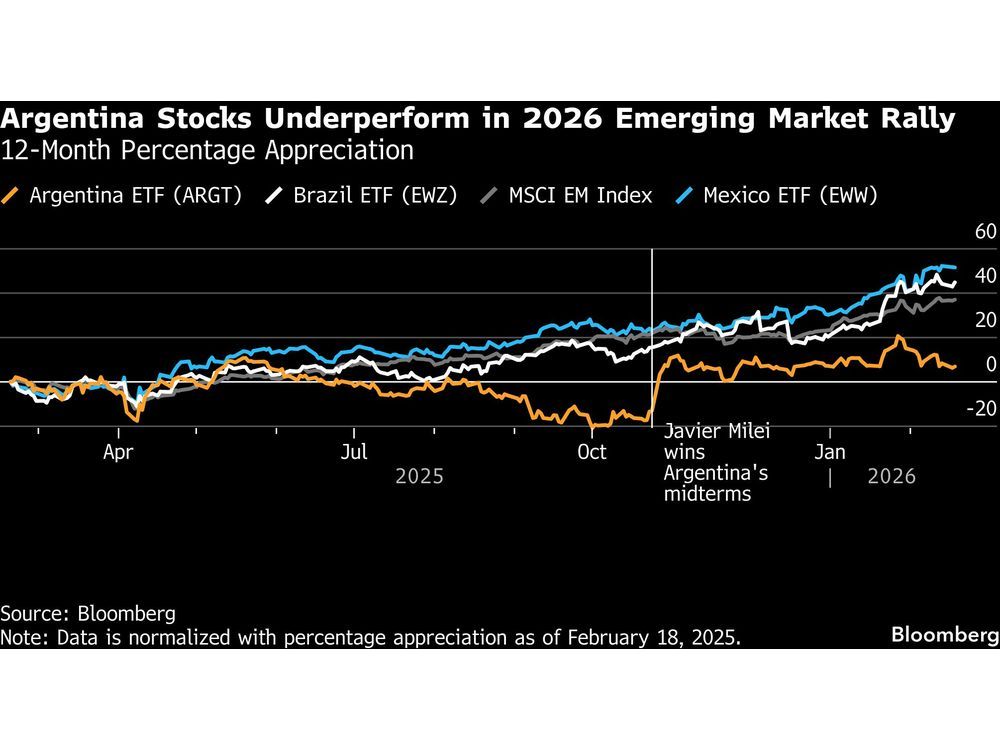
UPDATE: Argentine stocks are facing a significant downturn, plunging 8% this year as corporate earnings fail to meet expectations under President Javier Milei. This disappointing performance stands in stark contrast to a remarkable 20% rally in the MSCI Latin America index, marking its best start since 1994.
Investors initially cheered Milei’s election victories, but optimism has faded as concerns about weak corporate earnings take center stage. The benchmark Merval index has flattened out, raising alarms about the sustainability of economic recovery amidst reports of stagnating profits.
According to analysts, while Milei’s administration has made strides in cutting fiscal spending and curbing inflation, these achievements have not yet translated into robust growth or earnings recovery. “Stocks need clear evidence of a second phase—sustained economic growth, earnings recovery, and greater regulatory predictability,” stated Carolina Volman, head of equity and corporate research at One618.
Even renowned investor Stanley Druckenmiller has exited his position in a leading Argentina exchange-traded fund, reallocating capital to Brazil as concerns mount. “The market rallied very aggressively after the midterms, and valuations became a little too punchy,” noted Ola El-Shawarby, an emerging-markets portfolio manager at VanEck.
Corporate earnings have struggled, with major players such as Grupo Financiero Galicia and YPF reporting losses due to financial volatility and declining commodity prices. The loan delinquency rate in Argentina has surged to its highest level in 15 years, highlighting the ongoing challenges facing the finance sector.
As fourth-quarter earnings begin to trickle in, attention shifts to the economy’s projected growth. The latest estimates indicate that Argentina’s economy will expand by only 2% in 2026, significantly down from an earlier prediction of 3.2%. This revised outlook raises serious concerns for investors looking for solid returns in the equity market.
“Recent data have cast doubt on Argentina’s outlook for 2026,” warns Jimena Zuniga, a Latin America geoeconomics analyst. “We expect limited upside potential for equities, which may not weigh heavily on bonds, but could rattle the political environment if the slowdown continues.”
The Argentine government is actively proposing tax incentives aimed at attracting foreign investment to stimulate growth. Additionally, Milei’s signature labor reform bill, which seeks to ease restrictive hiring and firing laws, is on the verge of Congressional approval.
Despite the challenges, emerging markets have seen over $50 billion in inflows this year, the strongest showing in years. However, much of this capital has favored larger markets like Brazil and Mexico, leaving Argentina’s equity market struggling to keep pace. Analysts note that Argentina’s exclusion from major benchmarks exacerbates these difficulties.
Although there was a surge of $630 million in net inflows into the MSCI Argentina ETF in 2024, the momentum quickly faded, with approximately $200 million flowing out in 2025. The potential for reclassification by MSCI hinges on the long-term removal of capital controls and improved access for foreign investors.
As the situation unfolds, investors are left to grapple with uncertainty and a cautious outlook. “We remain positive on local equities,” asserts Ezequiel Fernández, head of corporate research at Balanz, “but it may require a bit more patience than we had previously expected.”
The implications of these developments are profound, impacting not just the stock market but the broader economic landscape in Argentina. Investors and policymakers alike are watching closely as the country navigates this turbulent financial terrain.













Morris Churches Unite for Annual Good Friday Walk With the Cross

Chloe Zhao’s ‘Buffy’ Reboot Cancelled: Sarah Michelle Gellar Speaks Out

Essential Ingredients for Life Found in Ryugu Asteroid Samples

Urgent Rescue: NSR Airlifts Injured Climber from Nanaimo

Riverside Heart Ball Achieves Record $815,000 for Mental Health

Cognizant Launches AI Factory to Enhance Enterprise AI Scalability

Samsung’s Galaxy Watch 9 to Feature Larger Battery Than Before

Toronto’s AIDS Memorial Faces Potential Redesign Amid Community Concerns

Bayern Munich Loses Luis Díaz Red Card Appeal Despite Referee’s Admission

Secwepemc First Nation Seeks Aboriginal Title Over Kamloops Area

Fatal Crash on Highway 11 Claims Three Lives, Major Closure Ongoing

Manitoba’s Burger Champion Shines Again Amid Dining Innovations

Canadian Curler E.J. Harnden Announces Retirement from Competition

Urgent Fire Erupts at Salvation Army on Christmas Evening

Scientists Unearth Ancient Antarctic Ice to Unlock Climate Secrets

Minister Faces Scrutiny Over Delayed Foreign Interference Watchdog Appointment

Trump and McCormick to Announce $70 Billion Energy Investments

Monika Hibbs Unveils Acres Market & Interiors in Major Rebrand
-
 Politics5 months ago
Secwepemc First Nation Seeks Aboriginal Title Over Kamloops Area
-
 Top Stories4 months ago
Fatal Crash on Highway 11 Claims Three Lives, Major Closure Ongoing
-
 Lifestyle7 months ago
Manitoba’s Burger Champion Shines Again Amid Dining Innovations
-
 Sports3 months ago
Canadian Curler E.J. Harnden Announces Retirement from Competition
-
 Top Stories4 months ago
Urgent Fire Erupts at Salvation Army on Christmas Evening
-
 World9 months ago
Scientists Unearth Ancient Antarctic Ice to Unlock Climate Secrets
-
 World5 months ago
Minister Faces Scrutiny Over Delayed Foreign Interference Watchdog Appointment
-
 Entertainment9 months ago
Trump and McCormick to Announce $70 Billion Energy Investments
-
 Lifestyle9 months ago
Monika Hibbs Unveils Acres Market & Interiors in Major Rebrand
-

 Science9 months ago
Four Astronauts Return to Earth After International Space Station Mission
-

 Lifestyle9 months ago
TransLink Launches Food Truck Program to Boost Revenue in Vancouver
-

 World1 month ago
Ranchman’s Cookhouse & Dancehall to Relocate by Early 2027