
Top Stories
Hyundai’s Chung Warns of Tough Year Ahead for Auto Industry

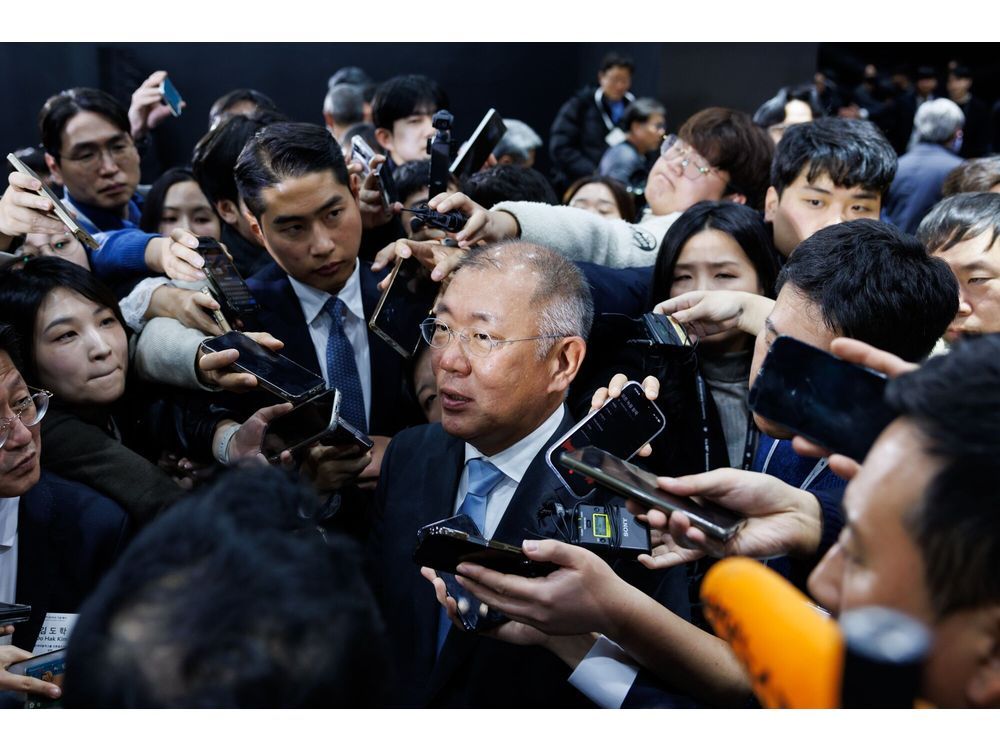
UPDATE: Hyundai Motor Co. Executive Chair Chung Euisun has issued a stark warning about a challenging year ahead for the global auto industry, emphasizing the urgent need for the South Korean carmaker to enhance its artificial intelligence (AI) capabilities. In his New Year address, Chung pointed out that escalating global trade tensions and fierce competition could significantly hamper profitability in the sector.
Chung’s remarks come as geopolitical conflicts threaten to disrupt operations in various regions, potentially leading to a suspension of business activities. “This will be the year when the crisis factors we have long worried about become reality,” he stated, underscoring the gravity of the situation.
The largest South Korean automaker has faced major financial impacts from US President Donald Trump’s tariff policies, which impose a hefty 15% levy on Korean-made vehicles. In fact, this single policy has cost Hyundai approximately 1.8 trillion won ($1.2 billion) in the third quarter alone.
Adding to these challenges, a recent immigration raid on a Hyundai-LG Energy Solution Ltd. plant in the US has delayed construction timelines by at least two to three months, further complicating the company’s recovery efforts.
Chung also highlighted that Hyundai is lagging behind its rivals in the AI race, calling for collaboration with multiple partners to enhance its technological capabilities. “If we look coldly at reality, leading global companies have already secured a dominant position in this field through investments worth hundreds of trillions of won,” he remarked. “The capabilities we have right now are not yet sufficient.”
To combat this, Hyundai has been proactive in its focus on AI and robotics, launching the Robotics Lab in 2019 and acquiring Boston Dynamics Inc. two years later. The company plans to invest a staggering 125 trillion won in South Korea over the next five years to bolster its AI, robotics, and other emerging technologies.
“As the focus shifts toward physical AI, the value of our moving entities, such as automobiles and robots, and our manufacturing process data will become increasingly rare,” Chung explained. “This is a powerful weapon unique to us that Big Tech companies can’t easily imitate.”
In a bid to advance its autonomous driving capabilities, Motional, a joint venture with parts-maker Aptiv Plc, is gearing up to launch fully driverless Ioniq 5 robotaxis in Las Vegas by the end of this year, according to Vice Chair Chang Jaehoon.
With the automotive landscape shifting rapidly, all eyes will be on Hyundai as it navigates these turbulent waters. The implications of Chung’s warnings resonate not just within Hyundai but throughout the global auto sector, signaling potential challenges for manufacturers worldwide in the coming months.
Stay tuned for updates as we follow this developing story closely.












Morris Churches Unite for Annual Good Friday Walk With the Cross

Chloe Zhao’s ‘Buffy’ Reboot Cancelled: Sarah Michelle Gellar Speaks Out

Essential Ingredients for Life Found in Ryugu Asteroid Samples

Urgent Rescue: NSR Airlifts Injured Climber from Nanaimo

Riverside Heart Ball Achieves Record $815,000 for Mental Health

Cognizant Launches AI Factory to Enhance Enterprise AI Scalability

Samsung’s Galaxy Watch 9 to Feature Larger Battery Than Before

Toronto’s AIDS Memorial Faces Potential Redesign Amid Community Concerns

Bayern Munich Loses Luis Díaz Red Card Appeal Despite Referee’s Admission

Secwepemc First Nation Seeks Aboriginal Title Over Kamloops Area

Fatal Crash on Highway 11 Claims Three Lives, Major Closure Ongoing

Manitoba’s Burger Champion Shines Again Amid Dining Innovations

Canadian Curler E.J. Harnden Announces Retirement from Competition

Urgent Fire Erupts at Salvation Army on Christmas Evening

Scientists Unearth Ancient Antarctic Ice to Unlock Climate Secrets

Minister Faces Scrutiny Over Delayed Foreign Interference Watchdog Appointment

Trump and McCormick to Announce $70 Billion Energy Investments

Monika Hibbs Unveils Acres Market & Interiors in Major Rebrand
-
 Politics5 months ago
Secwepemc First Nation Seeks Aboriginal Title Over Kamloops Area
-
 Top Stories4 months ago
Fatal Crash on Highway 11 Claims Three Lives, Major Closure Ongoing
-
 Lifestyle7 months ago
Manitoba’s Burger Champion Shines Again Amid Dining Innovations
-
 Sports3 months ago
Canadian Curler E.J. Harnden Announces Retirement from Competition
-
 Top Stories4 months ago
Urgent Fire Erupts at Salvation Army on Christmas Evening
-
 World9 months ago
Scientists Unearth Ancient Antarctic Ice to Unlock Climate Secrets
-
 World5 months ago
Minister Faces Scrutiny Over Delayed Foreign Interference Watchdog Appointment
-
 Entertainment9 months ago
Trump and McCormick to Announce $70 Billion Energy Investments
-
 Lifestyle9 months ago
Monika Hibbs Unveils Acres Market & Interiors in Major Rebrand
-
 Science9 months ago
Four Astronauts Return to Earth After International Space Station Mission
-

 Lifestyle9 months ago
TransLink Launches Food Truck Program to Boost Revenue in Vancouver
-

 World1 month ago
Ranchman’s Cookhouse & Dancehall to Relocate by Early 2027