
Top Stories
Indigenous Sentencing Court Launch Set for Fort St. John

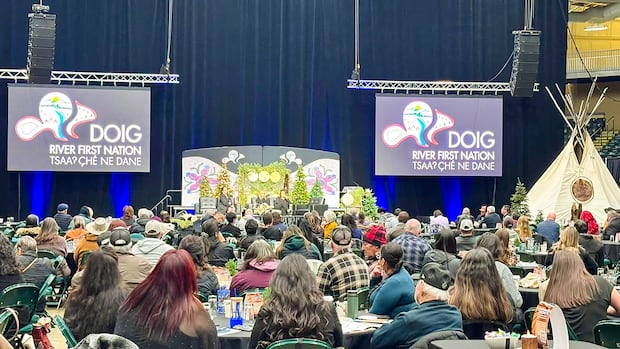
UPDATE: A groundbreaking Indigenous sentencing court is set to be established in Fort St. John, British Columbia, a move praised by First Nation leaders and attorneys as crucial for community health. This initiative was a central topic at the Walking the Path of Justice conference held last week in Dawson Creek, where a coalition of leaders, elders, and legal professionals convened to address the urgent need for reform in the region’s justice system.
Statistics reveal a troubling reality: Indigenous individuals make up a staggering 36 percent of the provincial custody population, despite accounting for only 6 percent of B.C.’s adult demographic. Trevor Makadahay, outgoing chief of Doig River First Nation, asserts that the justice system is failing Indigenous communities, attributing this to deep-rooted trauma. He expressed, “It just doesn’t work for our people,” underscoring the need for a more culturally relevant approach to sentencing.
The proposed Indigenous court aims to tackle these disparities by providing a restorative justice model. Makadahay emphasizes that this court will connect offenders with elders and cultural counseling, paving the way for healing through land-based practices. “Our traditional knowledge… needs to be incorporated into the court system,” he stated. This shift is expected to alleviate pressure on the conventional court system while fostering better integration into society for Indigenous individuals.
Legal experts like Graham Kay, who has contributed to the establishment of six Indigenous courts across B.C., highlight the unique approach these courts take. They focus on offenses with potential sentences of two years or less, ranging from probation breaches to first-time aggravated assaults. Kay notes that traditional courts often leave individuals to navigate their rehabilitation alone, whereas Indigenous courts ensure ongoing support from elders and justice partners throughout the sentencing process. “More often than not, we’re seeing that they’re not coming back before the judicial system,” he added, emphasizing the effectiveness of this model.
The call for an Indigenous court in Fort St. John also aligns with the broader initiatives responding to the Truth and Reconciliation Commission’s calls to action. Kay asserts, “Indigenous courts are one step toward reconciliation.” The first Indigenous court opened in New Westminster in 2006, with the latest being established in Lillooet in 2023. Leaders believe that the new court will play a pivotal role in fostering healthier communities across northeastern B.C.
As discussions continue regarding the implementation of this court, the urgency for reform remains palpable. “It’s important for all the nations to get together and figure this out together,” Makadahay said, emphasizing collective effort in addressing the systemic issues at hand.
Community members and advocates are closely watching this developing story, with hopes that the establishment of the Indigenous court will mark a transformative moment for justice in Fort St. John and beyond. The next steps involve finalizing the court’s structure and engaging with the community to ensure it meets their needs effectively.
Stay tuned for further updates as this significant initiative unfolds, promising a new path toward justice for Indigenous peoples in British Columbia.









Morris Churches Unite for Annual Good Friday Walk With the Cross

Chloe Zhao’s ‘Buffy’ Reboot Cancelled: Sarah Michelle Gellar Speaks Out

Essential Ingredients for Life Found in Ryugu Asteroid Samples

Urgent Rescue: NSR Airlifts Injured Climber from Nanaimo

Riverside Heart Ball Achieves Record $815,000 for Mental Health

Cognizant Launches AI Factory to Enhance Enterprise AI Scalability

Samsung’s Galaxy Watch 9 to Feature Larger Battery Than Before

Toronto’s AIDS Memorial Faces Potential Redesign Amid Community Concerns

Bayern Munich Loses Luis Díaz Red Card Appeal Despite Referee’s Admission

Secwepemc First Nation Seeks Aboriginal Title Over Kamloops Area

Fatal Crash on Highway 11 Claims Three Lives, Major Closure Ongoing

Manitoba’s Burger Champion Shines Again Amid Dining Innovations

Canadian Curler E.J. Harnden Announces Retirement from Competition

Urgent Fire Erupts at Salvation Army on Christmas Evening

Scientists Unearth Ancient Antarctic Ice to Unlock Climate Secrets

Minister Faces Scrutiny Over Delayed Foreign Interference Watchdog Appointment

Trump and McCormick to Announce $70 Billion Energy Investments

Monika Hibbs Unveils Acres Market & Interiors in Major Rebrand
-
 Politics5 months ago
Secwepemc First Nation Seeks Aboriginal Title Over Kamloops Area
-
 Top Stories4 months ago
Fatal Crash on Highway 11 Claims Three Lives, Major Closure Ongoing
-
 Lifestyle7 months ago
Manitoba’s Burger Champion Shines Again Amid Dining Innovations
-
 Sports3 months ago
Canadian Curler E.J. Harnden Announces Retirement from Competition
-
 Top Stories4 months ago
Urgent Fire Erupts at Salvation Army on Christmas Evening
-
 World9 months ago
Scientists Unearth Ancient Antarctic Ice to Unlock Climate Secrets
-
 World5 months ago
Minister Faces Scrutiny Over Delayed Foreign Interference Watchdog Appointment
-
 Entertainment9 months ago
Trump and McCormick to Announce $70 Billion Energy Investments
-
 Lifestyle9 months ago
Monika Hibbs Unveils Acres Market & Interiors in Major Rebrand
-

 Science9 months ago
Four Astronauts Return to Earth After International Space Station Mission
-
 Lifestyle9 months ago
TransLink Launches Food Truck Program to Boost Revenue in Vancouver
-
 World1 month ago
Ranchman’s Cookhouse & Dancehall to Relocate by Early 2027