
World
China Conducts Military Drills Near Taiwan, Heightening Tensions

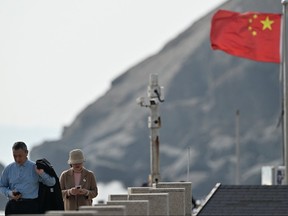
TAIPEI, Taiwan — On December 5, 2023, China’s People’s Liberation Army (PLA) continued large-scale military exercises around Taiwan, marking the second day of operations under the banner of “Justice Mission 2025.” These drills, which included live-fire demonstrations, aim to showcase China’s capability to deter external support for Taiwan, a territory it claims as its own.
Taiwanese officials reported that some of the live rounds fired by the PLA landed closer to the island than in previous exercises. This escalation has heightened tensions in the Taiwan Strait, with significant implications for both military and civilian life. The Taiwan Civil Aviation Administration announced that seven temporary “dangerous zones” were established around the strait, leading to disruptions at Taiwan’s four international airports. On Tuesday afternoon alone, over 150 flights faced revised schedules, delays, or cancellations.
According to Xinhua, China’s official news agency, the military drills serve as a clear message that Beijing is prepared to counter any actions that seek to separate Taiwan from China. The commentary criticized Taiwan’s ruling Democratic Progressive Party (DPP) for its perceived alignment with U.S. interests, suggesting that such actions bind Taiwan to a path of “catastrophic secessionism.”
The PLA’s Eastern Theater Command deployed various military assets, including destroyers, frigates, fighter jets, and bombers, in operations conducted around the island. These maneuvers included long-range live-fire drills in both northern and southern waters. Command spokesperson Li Xi stated that these exercises achieved the “desired effects” of showcasing military readiness.
In a briefing, Hsieh Jih-sheng, deputy chief of the general staff for intelligence at Taiwan’s Defense Ministry, confirmed the detection of 27 rockets in the waters near Taiwan, some of which fell within its 24-nautical-mile (44-kilometer) territorial line. He emphasized that the landing points of these rounds were notably closer to Taiwan compared to past drills, reinforcing the message that China intends to demonstrate its military capabilities.
Taiwanese President Lai Ching-te responded to the situation by advocating for a responsible approach, emphasizing the importance of avoiding conflict while condemning the military exercises. Taiwan’s Defense Ministry reported that between December 4 and December 5, it tracked 130 aircraft, including fighters and bombers, as well as 14 military ships around the island. The ministry’s monitoring efforts also detected a Chinese military balloon.
The exercises disrupted civilian life significantly, with a total of 941 flights affected due to the ongoing drills. Hsieh noted that the increasing scale of the PLA’s operations aims to influence public morale in Taiwan, potentially undermining trust in the Taiwanese military and government.
China has consistently expressed its intention to reclaim Taiwan, emphasizing that it may resort to military force if necessary. In a statement, Zhang Xiaogang, spokesperson for the Chinese Defense Ministry, labeled the drills as a stern warning to “Taiwan independence” supporters and external powers, without specifying any countries. He criticized Lai’s administration for its alignment with foreign interests, claiming that this relationship provokes instability in the Taiwan Strait.
Tensions have also escalated between China and Japan, particularly following comments from Japanese Prime Minister Sanae Takaichi, who indicated that Japan’s military could intervene if China takes action against Taiwan. Chinese Foreign Minister Wang Yi rebuked both Japan and Taiwan’s pro-independence efforts, highlighting historical grievances stemming from Japan’s military actions in China prior to World War II.
These military drills are part of broader geopolitical dynamics that have intensified over the years. China regularly sends warplanes and naval vessels toward Taiwan, and last week, imposed sanctions on 20 defense-related U.S. companies following a significant arms sale to Taiwan valued at over $10 billion. Under U.S. law, Washington is required to assist in Taiwan’s defense, a point that continues to strain relations with Beijing.
The situation remains fluid, with the PLA utilizing social media to disseminate provocative imagery and rhetoric during the drills. Taiwanese fishermen have also been affected, as military exercises have hindered their ability to operate, leading to economic losses and prompting local associations to issue regular updates regarding the locations of Chinese exercises.
As tensions rise in the Taiwan Strait, the international community continues to closely monitor the evolving situation, which underscores the complex interplay of military capabilities, historical animosities, and international relations in the region.










Morris Churches Unite for Annual Good Friday Walk With the Cross

Chloe Zhao’s ‘Buffy’ Reboot Cancelled: Sarah Michelle Gellar Speaks Out

Essential Ingredients for Life Found in Ryugu Asteroid Samples

Urgent Rescue: NSR Airlifts Injured Climber from Nanaimo

Riverside Heart Ball Achieves Record $815,000 for Mental Health

Cognizant Launches AI Factory to Enhance Enterprise AI Scalability

Samsung’s Galaxy Watch 9 to Feature Larger Battery Than Before

Toronto’s AIDS Memorial Faces Potential Redesign Amid Community Concerns

Bayern Munich Loses Luis Díaz Red Card Appeal Despite Referee’s Admission

Secwepemc First Nation Seeks Aboriginal Title Over Kamloops Area

Fatal Crash on Highway 11 Claims Three Lives, Major Closure Ongoing

Manitoba’s Burger Champion Shines Again Amid Dining Innovations

Canadian Curler E.J. Harnden Announces Retirement from Competition

Urgent Fire Erupts at Salvation Army on Christmas Evening

Scientists Unearth Ancient Antarctic Ice to Unlock Climate Secrets

Minister Faces Scrutiny Over Delayed Foreign Interference Watchdog Appointment

Trump and McCormick to Announce $70 Billion Energy Investments

Monika Hibbs Unveils Acres Market & Interiors in Major Rebrand
-
 Politics5 months ago
Secwepemc First Nation Seeks Aboriginal Title Over Kamloops Area
-
 Top Stories4 months ago
Fatal Crash on Highway 11 Claims Three Lives, Major Closure Ongoing
-
 Lifestyle7 months ago
Manitoba’s Burger Champion Shines Again Amid Dining Innovations
-
 Sports3 months ago
Canadian Curler E.J. Harnden Announces Retirement from Competition
-
 Top Stories4 months ago
Urgent Fire Erupts at Salvation Army on Christmas Evening
-
 World9 months ago
Scientists Unearth Ancient Antarctic Ice to Unlock Climate Secrets
-
 World5 months ago
Minister Faces Scrutiny Over Delayed Foreign Interference Watchdog Appointment
-
 Entertainment9 months ago
Trump and McCormick to Announce $70 Billion Energy Investments
-
 Lifestyle9 months ago
Monika Hibbs Unveils Acres Market & Interiors in Major Rebrand
-

 Science9 months ago
Four Astronauts Return to Earth After International Space Station Mission
-

 Lifestyle9 months ago
TransLink Launches Food Truck Program to Boost Revenue in Vancouver
-

 World1 month ago
Ranchman’s Cookhouse & Dancehall to Relocate by Early 2027