
World
Colombian Drug Ring Ties Venezuelan Military to Cocaine Smuggling

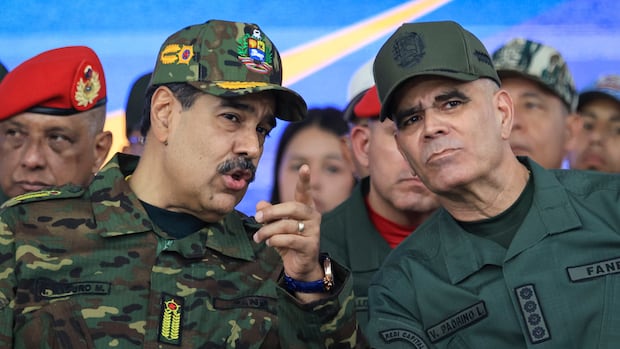
A recent investigation has revealed significant connections between a Colombian drug trafficking organization and high-ranking officials within the Venezuelan military. Wiretaps obtained during a two-year probe by the Colombian Federal Police captured conversations detailing plans to smuggle cocaine from Venezuela to Libya, implicating military personnel in facilitating these operations.
The intercepted conversations, reported by CBC News, featured key figures in the drug trade, including a broker known as Luis Ernesto Galvis Martinez, alias Luisito, and his client, Luis Fernando Martinez, alias Julio. These discussions outlined a scheme to transport 32 kilograms of cocaine concealed within two electrical generators. The shipment was intended for a vessel docked at the Guarano International Port in Venezuela, with assurances from Luisito that military officials would ensure safe passage for the cargo.
In the wiretaps, Luisito indicated his connections within the United Socialist Party of Venezuela (PSUV), suggesting that a relative of his had influence in the military. He stated, “Someone has to be the guarantee,” emphasizing that military officers would not interfere with the transaction. The conversations revealed a chilling confidence in the military’s role in the drug trade, with Luisito claiming that the officers were responsible for overseeing the shipments and had established a system to ensure their operations ran smoothly.
The investigation, which culminated in 2016, was initiated by the U.S. Drug Enforcement Administration (DEA). According to the former Colombian anti-narcotics agent involved in the case, the wiretaps provide compelling evidence of the existence of the so-called Cartel of the Suns, a term referring to high-ranking military officers. “These conversations help us understand that, effectively, the ‘Cartel of the Suns’ exists,” the agent noted.
Despite the serious allegations, the Venezuelan government has denied any involvement in drug trafficking activities. No military officials were captured on the wiretaps, and the government maintains that it does not engage in the drug trade.
Luisito’s conversations highlighted the operational details of the smuggling plan. He mentioned the use of fake Venezuelan identification cards and a local company to facilitate the movement of cocaine packed in a container. The plan included transporting the cargo by sea from Venezuela to Brazil before it would reach its final destination in Libya. The broker expressed no concern regarding the military’s involvement, stating that “there’s no more DEA… they are the ones who are doing this with the famous Suns.”
The former agent further elaborated on the military’s control over the Guarano International Port, explaining that each shift operated its own side business, charging fees to allow containers to pass. “They have been doing this for a long time,” the agent said, adding that the military’s focus was predominantly on monetary gain rather than adherence to law enforcement.
Luisito also referenced a previous successful shipment where he moved 50 kilograms of cocaine hidden in a charcoal shipment to Portugal. His confidence in the connections he claimed to have within the Venezuelan military underscored the pervasive influence of drug trafficking networks in the region.
The U.S. has taken a keen interest in this case, particularly following the indictment of Venezuelan President Nicolás Maduro and his wife, Cilia Flores, on charges of conspiracy to commit narco-terrorism and cocaine importation. This indictment describes the Cartel of the Suns as a system of patronage where elites enrich themselves through drug trafficking.
As the investigation unfolds, the implications of these findings continue to resonate, revealing a complex web of corruption linking drug cartels and military officials in Venezuela. The wiretaps have not only exposed the operations of a significant drug trafficking organization but have also raised urgent questions about the integrity of military institutions in Venezuela.
Luisito and Julio were eventually charged and convicted as authorities worked to dismantle the network facilitating the cocaine trade from Colombia through Venezuela. The revelations from the wiretaps serve as a stark reminder of the challenges faced in combating drug trafficking in the region, particularly when state institutions are allegedly complicit in such activities.









Morris Churches Unite for Annual Good Friday Walk With the Cross

Chloe Zhao’s ‘Buffy’ Reboot Cancelled: Sarah Michelle Gellar Speaks Out

Essential Ingredients for Life Found in Ryugu Asteroid Samples

Urgent Rescue: NSR Airlifts Injured Climber from Nanaimo

Riverside Heart Ball Achieves Record $815,000 for Mental Health

Cognizant Launches AI Factory to Enhance Enterprise AI Scalability

Samsung’s Galaxy Watch 9 to Feature Larger Battery Than Before

Toronto’s AIDS Memorial Faces Potential Redesign Amid Community Concerns

Bayern Munich Loses Luis Díaz Red Card Appeal Despite Referee’s Admission

Secwepemc First Nation Seeks Aboriginal Title Over Kamloops Area

Fatal Crash on Highway 11 Claims Three Lives, Major Closure Ongoing

Manitoba’s Burger Champion Shines Again Amid Dining Innovations

Canadian Curler E.J. Harnden Announces Retirement from Competition

Urgent Fire Erupts at Salvation Army on Christmas Evening

Scientists Unearth Ancient Antarctic Ice to Unlock Climate Secrets

Minister Faces Scrutiny Over Delayed Foreign Interference Watchdog Appointment

Trump and McCormick to Announce $70 Billion Energy Investments

Monika Hibbs Unveils Acres Market & Interiors in Major Rebrand
-
 Politics5 months ago
Secwepemc First Nation Seeks Aboriginal Title Over Kamloops Area
-
 Top Stories4 months ago
Fatal Crash on Highway 11 Claims Three Lives, Major Closure Ongoing
-
 Lifestyle7 months ago
Manitoba’s Burger Champion Shines Again Amid Dining Innovations
-
 Sports3 months ago
Canadian Curler E.J. Harnden Announces Retirement from Competition
-
 Top Stories4 months ago
Urgent Fire Erupts at Salvation Army on Christmas Evening
-
 World9 months ago
Scientists Unearth Ancient Antarctic Ice to Unlock Climate Secrets
-
 World5 months ago
Minister Faces Scrutiny Over Delayed Foreign Interference Watchdog Appointment
-
 Entertainment9 months ago
Trump and McCormick to Announce $70 Billion Energy Investments
-
 Lifestyle9 months ago
Monika Hibbs Unveils Acres Market & Interiors in Major Rebrand
-
 Science9 months ago
Four Astronauts Return to Earth After International Space Station Mission
-
 Lifestyle9 months ago
TransLink Launches Food Truck Program to Boost Revenue in Vancouver
-
 World1 month ago
Ranchman’s Cookhouse & Dancehall to Relocate by Early 2027