
World
Discover the Comfort and Perks of American Airlines’ Premium Economy


American Airlines’ premium economy class has emerged as a popular choice for travelers seeking enhanced comfort during their flights. This service, available on long-haul and select transcontinental routes, provides passengers with a bridge between standard economy and business class, offering an upgraded experience that has proven lucrative for the airline.
Overview of American Airlines Premium Economy
Launched in March 2016, American Airlines was the first U.S. airline to introduce premium economy, a move that has since influenced competitors such as Delta Air Lines and United Airlines. This cabin is accessible on all widebody aircraft, including the Boeing 777 and Boeing 787, as well as the new Airbus A321XLRs. The premium economy cabin, positioned between the Main Cabin Extra and Flagship business class, features a range of seating configurations designed to optimize passenger comfort.
American Airlines primarily utilizes Collins Aerospace MiQ seats for its premium economy, although the Boeing 787-9 aircraft coded as “78P” incorporate the Safran Z535i model, and the A321XLR utilizes Recaro R5. The seating arrangements vary significantly: the Boeing 777 offers eight-abreast seating in premium economy, while the Boeing 787 has a seven-abreast configuration. The A321XLR’s premium economy is designed with four-abreast seating, allowing for more personal space.
The premium economy section on the Boeing 777-200ER hosts 24 seats, while the 777-300ER will be updated to include 44 seats in this class. The Boeing 787-8 features 28 premium economy seats, and the 787-9 has 21 seats in that category. The A321XLRs, part of American’s expanding fleet, provide 12 premium economy seats.
Benefits of Flying Premium Economy
Traveling in premium economy comes with several advantages, starting with priority boarding and dedicated security lanes. Passengers enjoy a more streamlined airport experience, as they are included in Boarding Group 4, which allows them to board before most economy passengers. While premium economy does not grant access to American Airlines’ lounges, eligible travelers may access them through AAdvantage status or partnerships with other carriers.
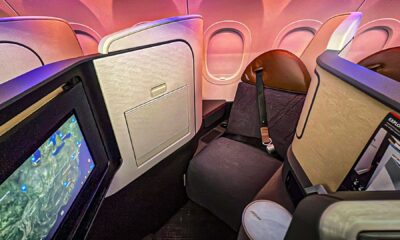
Onboard, premium economy offers a more spacious cabin with additional legroom, measuring 38 inches compared to standard economy. The seats are wider as well, with the Boeing 777 offering 18.5 inches in width, and the A321XLR providing up to 21 inches. Passengers also benefit from enhanced service, including plated meals served on ceramic dishes and larger portions.
The cabin generally accommodates between 12 to 32 seats, making it the smallest cabin on American Airlines aircraft (excluding first class). This smaller size typically results in more attentive service from flight attendants, who prioritize the needs of premium economy travelers.
Additionally, premium economy passengers receive complimentary amenities such as an amenity kit featuring skincare products and enhanced bedding, setting the class apart from the standard economy offerings. In terms of entertainment, premium economy seats on the A321XLR and select Boeing 787-9 aircraft come equipped with 13.3-inch 4K screens, while other models feature 11.5-inch screens.
Ultimately, whether the premium economy experience is worth the cost can depend on individual preferences and budget. For many passengers, the added comfort on long-haul flights justifies the premium over economy class. As airlines continue to enhance their offerings, premium economy represents a compelling alternative for those looking to travel with greater comfort without the higher price tag of business class.
American Airlines, along with its competitors, continues to expand and upgrade premium economy options, reflecting a growing demand for this mid-range travel experience.









Morris Churches Unite for Annual Good Friday Walk With the Cross

Chloe Zhao’s ‘Buffy’ Reboot Cancelled: Sarah Michelle Gellar Speaks Out

Essential Ingredients for Life Found in Ryugu Asteroid Samples

Urgent Rescue: NSR Airlifts Injured Climber from Nanaimo

Riverside Heart Ball Achieves Record $815,000 for Mental Health

Cognizant Launches AI Factory to Enhance Enterprise AI Scalability

Samsung’s Galaxy Watch 9 to Feature Larger Battery Than Before

Toronto’s AIDS Memorial Faces Potential Redesign Amid Community Concerns

Bayern Munich Loses Luis Díaz Red Card Appeal Despite Referee’s Admission

Secwepemc First Nation Seeks Aboriginal Title Over Kamloops Area

Fatal Crash on Highway 11 Claims Three Lives, Major Closure Ongoing

Manitoba’s Burger Champion Shines Again Amid Dining Innovations

Canadian Curler E.J. Harnden Announces Retirement from Competition

Urgent Fire Erupts at Salvation Army on Christmas Evening

Scientists Unearth Ancient Antarctic Ice to Unlock Climate Secrets

Minister Faces Scrutiny Over Delayed Foreign Interference Watchdog Appointment

Trump and McCormick to Announce $70 Billion Energy Investments

Monika Hibbs Unveils Acres Market & Interiors in Major Rebrand
-
 Politics5 months ago
Secwepemc First Nation Seeks Aboriginal Title Over Kamloops Area
-
 Top Stories4 months ago
Fatal Crash on Highway 11 Claims Three Lives, Major Closure Ongoing
-
 Lifestyle7 months ago
Manitoba’s Burger Champion Shines Again Amid Dining Innovations
-
 Sports4 months ago
Canadian Curler E.J. Harnden Announces Retirement from Competition
-
 Top Stories4 months ago
Urgent Fire Erupts at Salvation Army on Christmas Evening
-
 World9 months ago
Scientists Unearth Ancient Antarctic Ice to Unlock Climate Secrets
-
 World5 months ago
Minister Faces Scrutiny Over Delayed Foreign Interference Watchdog Appointment
-
 Entertainment9 months ago
Trump and McCormick to Announce $70 Billion Energy Investments
-
 Lifestyle9 months ago
Monika Hibbs Unveils Acres Market & Interiors in Major Rebrand
-

 Science9 months ago
Four Astronauts Return to Earth After International Space Station Mission
-

 Lifestyle9 months ago
TransLink Launches Food Truck Program to Boost Revenue in Vancouver
-

 World2 months ago
Ranchman’s Cookhouse & Dancehall to Relocate by Early 2027