
World
Housing Minister Unveils Agency Without Homebuilding Targets

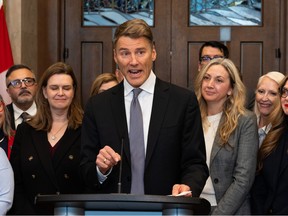
The Canadian government has introduced legislation to establish a new affordable housing agency, but it will not set specific targets for the number of homes to be constructed. Housing Minister Gregor Robertson announced the formation of Build Canada Homes during a press conference on Parliament Hill, emphasizing that while $13 billion has been allocated in Budget 2025 for affordable housing, the agency does not have top-line goals for homebuilding.
“There aren’t top-line targets set for the number of homes to build,” said Robertson. The new agency, which aims to primarily focus on non-market housing, was first introduced in September and has begun signing agreements with cities across Canada. So far, it has established over ten partnerships, facilitating the use of public land and flexible financing options from the federal government.
Robertson highlighted the agency’s progress, stating, “We’ve advanced six major affordable housing projects on public lands that will create over 4,000 homes.” He noted that these partnerships with local governments aim to streamline processes by reducing bureaucracy, waiving fees, and expediting approvals.
In December, the Parliamentary Budget Officer (PBO) released a report estimating that the new agency’s initiatives could directly fund 26,000 housing units over the next five years. The government has argued that this estimate does not account for additional units resulting from collaborations with private developers or the impact of its $51-billion infrastructure fund.
Despite these projections, the PBO also indicated that federal spending on housing programs is expected to decline significantly, decreasing from $9.8 billion in 2025-26 to $4.3 billion by 2028-29. This drop is attributed to the expiration of funding for existing programs and cuts outlined in the latest budget.
Jenny Kwan, the NDP housing critic, expressed concern over Canada’s diminishing non-profit housing stock, which currently makes up only about 4.5 percent of the total housing market—far below the G7 average of approximately 20 percent. The Canada Mortgage and Housing Corporation (CMHC) estimates that to return to housing affordability levels seen in 2019, Canada must double its homebuilding rate to between 430,000 and 480,000 units annually over the next decade.
A recent report from the Toronto-Dominion Bank indicated that Canada is currently building at an annualized rate of 264,000 units. The report also noted significant regional disparities, particularly with construction in Ontario experiencing a substantial decline.
In a call for action, Conservative housing critic Scott Aitchison suggested that eliminating the Goods and Services Tax (GST) or the Harmonized Sales Tax (HST) on new homes priced under $1.3 million would stimulate housing development. “No one makes more money on a house than all levels of government,” he stated. “The best way to get homes built in this country is to get government out of the way.”
While the federal government has initiated rebates for first-time homebuyers as a response, Aitchison pointed out that this demographic does not represent a significant enough portion of the market to significantly impact overall housing construction.
During an appearance on the Herle Burly podcast in October, Robertson addressed the hesitation to remove taxes from home construction. “It’s a big large, sweeping change to make,” he explained, adding that the finance department is exploring various models related to the GST/HST. “We can’t roll the dice with some of these bigger moves.”
The federal government has also sought to incentivize municipalities to reduce regulations and development charges through the Housing Accelerator Fund. Since its launch in March 2023, the program has committed $4.37 billion in federal funding, resulting in local governments issuing 160,585 residential building permits, according to the CMHC.
Despite these efforts, Robertson recently reduced funding from the Housing Accelerator Fund for the City of Toronto, citing the local council’s failure to implement citywide zoning for sixplexes, a move intended to enhance housing density.
Mike Moffat, an economist and founding director of the Missing Middle Initiative, acknowledged some successes of the Housing Accelerator Program but criticized its enforcement. “I think it was a good idea,” he said, “but it wasn’t implemented nearly as well as it could have been.”
As the government navigates the complexities of the housing crisis, the establishment of Build Canada Homes marks a significant step. However, the absence of specific targets raises questions about the efficacy and accountability of the new agency in addressing Canada’s pressing housing needs.













Morris Churches Unite for Annual Good Friday Walk With the Cross

Chloe Zhao’s ‘Buffy’ Reboot Cancelled: Sarah Michelle Gellar Speaks Out

Essential Ingredients for Life Found in Ryugu Asteroid Samples

Urgent Rescue: NSR Airlifts Injured Climber from Nanaimo

Riverside Heart Ball Achieves Record $815,000 for Mental Health

Cognizant Launches AI Factory to Enhance Enterprise AI Scalability

Samsung’s Galaxy Watch 9 to Feature Larger Battery Than Before

Toronto’s AIDS Memorial Faces Potential Redesign Amid Community Concerns

Bayern Munich Loses Luis Díaz Red Card Appeal Despite Referee’s Admission

Secwepemc First Nation Seeks Aboriginal Title Over Kamloops Area

Fatal Crash on Highway 11 Claims Three Lives, Major Closure Ongoing

Manitoba’s Burger Champion Shines Again Amid Dining Innovations

Canadian Curler E.J. Harnden Announces Retirement from Competition

Urgent Fire Erupts at Salvation Army on Christmas Evening

Scientists Unearth Ancient Antarctic Ice to Unlock Climate Secrets

Minister Faces Scrutiny Over Delayed Foreign Interference Watchdog Appointment

Trump and McCormick to Announce $70 Billion Energy Investments

Monika Hibbs Unveils Acres Market & Interiors in Major Rebrand
-
 Politics5 months ago
Secwepemc First Nation Seeks Aboriginal Title Over Kamloops Area
-
 Top Stories4 months ago
Fatal Crash on Highway 11 Claims Three Lives, Major Closure Ongoing
-
 Lifestyle7 months ago
Manitoba’s Burger Champion Shines Again Amid Dining Innovations
-
 Sports4 months ago
Canadian Curler E.J. Harnden Announces Retirement from Competition
-
 Top Stories4 months ago
Urgent Fire Erupts at Salvation Army on Christmas Evening
-
 World9 months ago
Scientists Unearth Ancient Antarctic Ice to Unlock Climate Secrets
-
 World5 months ago
Minister Faces Scrutiny Over Delayed Foreign Interference Watchdog Appointment
-
 Entertainment9 months ago
Trump and McCormick to Announce $70 Billion Energy Investments
-
 Lifestyle9 months ago
Monika Hibbs Unveils Acres Market & Interiors in Major Rebrand
-

 Science9 months ago
Four Astronauts Return to Earth After International Space Station Mission
-

 Lifestyle9 months ago
TransLink Launches Food Truck Program to Boost Revenue in Vancouver
-

 World2 months ago
Ranchman’s Cookhouse & Dancehall to Relocate by Early 2027