
World
Hundreds of Thousands Mourn Slain Bangladeshi Activist Hadi

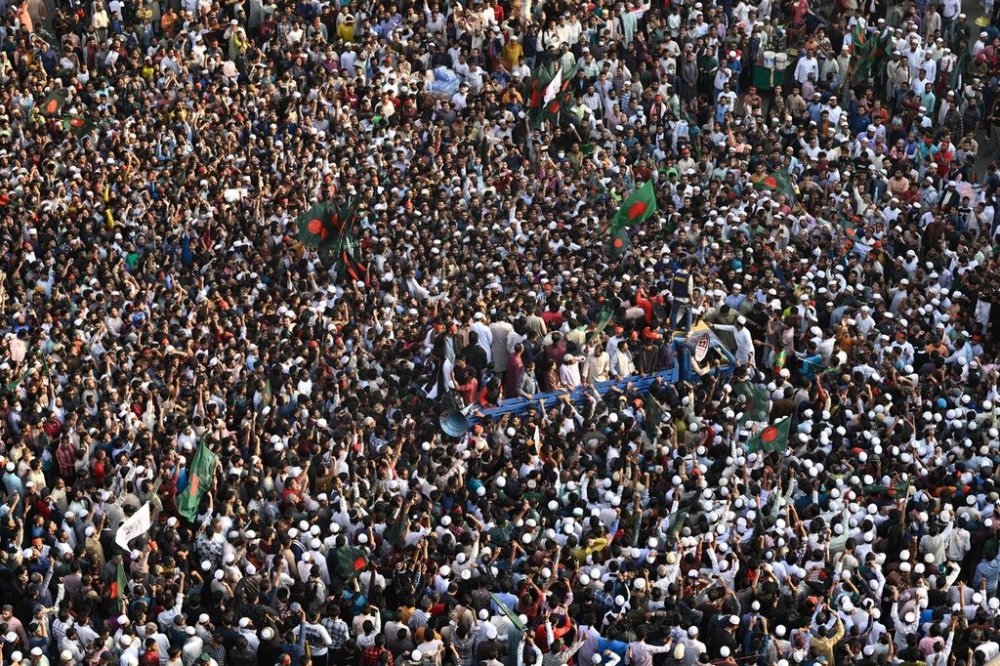
Hundreds of thousands of mourners gathered in Dhaka on December 16, 2024, for the funeral of Sharif Osman Hadi, a prominent activist who succumbed to gunshot wounds sustained during an attack earlier this month. His death has intensified political tensions in Bangladesh, particularly as the country approaches national elections scheduled for February 2025.
Hadi, a vocal critic of both the government and neighboring India, died on December 14 in a hospital in Singapore, two days after being shot in Dhaka. The police have reported that suspects have been identified in connection with the attack, with indications that the shooter may have fled to India, where former Prime Minister Sheikh Hasina is currently in exile. This situation has led to diplomatic friction, prompting India to summon Bangladesh’s envoy while Bangladesh reciprocated by calling on the Indian envoy.
Security measures were heightened in Dhaka as the funeral took place outside the national Parliament complex. Hadi’s body returned to Bangladesh on the evening of December 15, and the government declared December 16 a national day of mourning. As a spokesperson for the Inqilab Moncho culture group, Hadi was known for his activism and was to be interred beside the national poet, Kazi Nazrul Islam, on the Dhaka University campus.
The atmosphere at the funeral was charged, with mourners waving flags and chanting slogans such as “We will be Hadi, we will be fighting decades after decades,” and “We will not let Hadi’s blood go in vain.” His death has already sparked unrest, with reports of protests resulting in violence against the offices of two prominent newspapers.
In the wake of Hadi’s death, Muhammad Yunus, Bangladesh’s interim leader and a Nobel Peace Prize laureate, has called for calm among the populace. Hadi was not only an activist but also planned to run as an independent candidate in the upcoming elections, positioning himself against the ruling party.
The political landscape in Bangladesh remains volatile. Under Yunus’ leadership, the country is attempting to navigate a transition back to democracy. The ruling Awami League, led by Sheikh Hasina, faces significant challenges from the Bangladesh Nationalist Party (BNP), led by former Prime Minister Khaleda Zia, and the Jamaat-e-Islami, which is seeking to expand its influence in the current political climate.
As the country prepares for elections, the situation remains precarious. Hadi’s assassination highlights the ongoing struggles for political power and civil rights in Bangladesh, as well as the challenges posed by historical tensions with India. Despite calls for peace and stability, the path forward remains fraught with uncertainty, underscoring the urgent need for a peaceful resolution to the ongoing political strife.











Morris Churches Unite for Annual Good Friday Walk With the Cross

Chloe Zhao’s ‘Buffy’ Reboot Cancelled: Sarah Michelle Gellar Speaks Out

Essential Ingredients for Life Found in Ryugu Asteroid Samples

Urgent Rescue: NSR Airlifts Injured Climber from Nanaimo

Riverside Heart Ball Achieves Record $815,000 for Mental Health

Cognizant Launches AI Factory to Enhance Enterprise AI Scalability

Samsung’s Galaxy Watch 9 to Feature Larger Battery Than Before

Toronto’s AIDS Memorial Faces Potential Redesign Amid Community Concerns

Bayern Munich Loses Luis Díaz Red Card Appeal Despite Referee’s Admission

Secwepemc First Nation Seeks Aboriginal Title Over Kamloops Area

Fatal Crash on Highway 11 Claims Three Lives, Major Closure Ongoing

Manitoba’s Burger Champion Shines Again Amid Dining Innovations

Canadian Curler E.J. Harnden Announces Retirement from Competition

Urgent Fire Erupts at Salvation Army on Christmas Evening

Scientists Unearth Ancient Antarctic Ice to Unlock Climate Secrets

Minister Faces Scrutiny Over Delayed Foreign Interference Watchdog Appointment

Trump and McCormick to Announce $70 Billion Energy Investments

Monika Hibbs Unveils Acres Market & Interiors in Major Rebrand
-
 Politics5 months ago
Secwepemc First Nation Seeks Aboriginal Title Over Kamloops Area
-
 Top Stories4 months ago
Fatal Crash on Highway 11 Claims Three Lives, Major Closure Ongoing
-
 Lifestyle7 months ago
Manitoba’s Burger Champion Shines Again Amid Dining Innovations
-
 Sports3 months ago
Canadian Curler E.J. Harnden Announces Retirement from Competition
-
 Top Stories4 months ago
Urgent Fire Erupts at Salvation Army on Christmas Evening
-
 World9 months ago
Scientists Unearth Ancient Antarctic Ice to Unlock Climate Secrets
-
 World5 months ago
Minister Faces Scrutiny Over Delayed Foreign Interference Watchdog Appointment
-
 Entertainment9 months ago
Trump and McCormick to Announce $70 Billion Energy Investments
-
 Lifestyle9 months ago
Monika Hibbs Unveils Acres Market & Interiors in Major Rebrand
-

 Science9 months ago
Four Astronauts Return to Earth After International Space Station Mission
-

 Lifestyle9 months ago
TransLink Launches Food Truck Program to Boost Revenue in Vancouver
-

 World1 month ago
Ranchman’s Cookhouse & Dancehall to Relocate by Early 2027