
World
Iran’s Protest Death Toll Rises Amid Internet Blackout and Crackdown

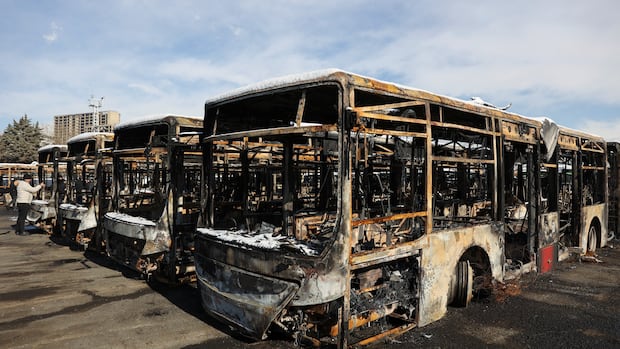
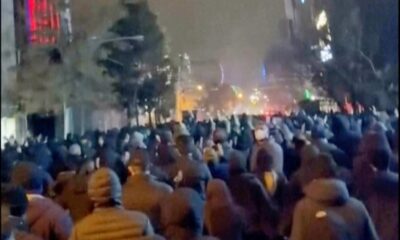
The death toll from the recent anti-government protests in Iran continues to rise, with more than 4,000 fatalities reported by various non-governmental organizations (NGOs). This surge in violence is deemed to be the most severe crackdown since the establishment of the Islamic Republic nearly 50 years ago. The Iranian regime’s internet blackout has significantly obscured the true extent of the violence, leaving rights groups and activists scrambling to verify casualties.
According to the U.S.-based Human Rights Activists News Agency, which has a track record of providing reliable figures during previous crackdowns, the death toll is expected to climb further. In contrast, state media in Iran has reported over 3,000 deaths, following a statement from Supreme Leader Ayatollah Ali Khamenei, who acknowledged “several thousand” fatalities during a recent address.
As families mourn their losses, many are left in despair, waiting for updates on their loved ones. Soran Mansournia, an activist assisting the Hiwa Foundation, stated, “After connecting to Iranians through the internet and after finishing this shutdown, [the number] will be shocking for all of us.” He revealed that approximately 50,000 users in Iran rely on Starlink satellite internet to bypass the blackout, which has severely limited communication.
Reports have emerged of security forces targeting injured protesters in hospitals and arresting individuals while they attempt to donate blood. In a particularly grim development, families have been asked to pay “bullet fees” to recover the bodies of their deceased relatives.
In a televised address, Khamenei vowed to “not back down” against the protests, characterizing demonstrators as agents of foreign opposition groups. The regime’s crackdown appears to have quelled protests that initially erupted in response to economic grievances, transforming into calls for an end to the theocratic rule.
The international reaction to the violence has been muted, overshadowed early on by U.S. President Donald Trump‘s remarks promising support for the protesters. Despite the rising death toll, Trump praised Iranian authorities for cancelling planned executions of 800 political prisoners, stating, “And I greatly respect the fact that they cancelled that.”
Since then, Trump’s rhetoric has softened, although speculation surrounding the deployment of the U.S. navy’s aircraft carrier USS Abraham Lincoln raises questions about potential military action in the region. Reza Pahlavi, the exiled son of Iran’s last Shah, has voiced his belief that Trump is “a man of his word,” while Mahmood Amiry-Moghaddam of the Iran Human Rights group emphasized the need for the international community to act against potential massacre threats within Iranian prisons.
The Iranian regime has maintained a tight grip on power, with few signs of internal dissent among its leaders. Eskandar Sadeghi-Boroujerdi, a lecturer at the University of St Andrews, suggested that the regime remains resilient despite external pressures. He noted, “The Iranian regime doesn’t really have an out,” attributing this to the persistent economic sanctions imposed by the United States.
The protesters, many of whom risked their lives for change, face an uncertain future. Mansournia reflects a mix of hope and fear, stating, “Even if the Islamic Republic suppresses these movements again, I think in the near future — and I expect in less than three years — we [will] have another wave of protests in this scale and even much bigger than this one.”
Without increased support from the international community, the regime may continue to suppress dissent. Mansournia advocates for the designation of the Islamic Revolutionary Guard Corps (IRGC) as a terrorist organization and calls for the closure of Iranian embassies abroad, emphasizing that the perception of the regime has irrevocably changed among the Iranian populace. “What we can say is that the Islamic Republic, in people’s minds, is over for sure,” he concluded.









Strategy Transforms into Leveraged Bitcoin Vehicle Amid $12.4B Loss

Ride App Faces Off Against Google Maps in Transport Challenge

Liam Draxl Secures Dramatic Davis Cup Victory for Canada

Canada Must Revise Education Strategies to Improve Math Scores

American Airlines: A Century of Evolution and Dominance

Doug Ford Rides Snowmobile to Support Muskoka Hospital Fundraising

Winnipeg’s Shivers & Shimmies Gala Features International Star THIS WEEKEND

Money Williams Leads Montana to Last-Minute 73-68 Win Over Idaho

Seahawks Logo Sparks Cultural Awakening Ahead of Super Bowl

Secwepemc First Nation Seeks Aboriginal Title Over Kamloops Area

Scientists Unearth Ancient Antarctic Ice to Unlock Climate Secrets

Urgent Fire Erupts at Salvation Army on Christmas Evening

Canadian Curler E.J. Harnden Announces Retirement from Competition

Manitoba’s Burger Champion Shines Again Amid Dining Innovations

Fatal Crash on Highway 11 Claims Three Lives, Major Closure Ongoing

Trump and McCormick to Announce $70 Billion Energy Investments

Four Astronauts Return to Earth After International Space Station Mission

TransLink Launches Food Truck Program to Boost Revenue in Vancouver
-
 Politics3 months ago
Secwepemc First Nation Seeks Aboriginal Title Over Kamloops Area
-
 World7 months ago
Scientists Unearth Ancient Antarctic Ice to Unlock Climate Secrets
-
 Top Stories1 month ago
Urgent Fire Erupts at Salvation Army on Christmas Evening
-
 Sports1 month ago
Canadian Curler E.J. Harnden Announces Retirement from Competition
-
 Lifestyle5 months ago
Manitoba’s Burger Champion Shines Again Amid Dining Innovations
-
 Top Stories2 months ago
Fatal Crash on Highway 11 Claims Three Lives, Major Closure Ongoing
-
 Entertainment7 months ago
Trump and McCormick to Announce $70 Billion Energy Investments
-
 Science7 months ago
Four Astronauts Return to Earth After International Space Station Mission
-
 Lifestyle7 months ago
TransLink Launches Food Truck Program to Boost Revenue in Vancouver
-

 Technology5 months ago
Apple Notes Enhances Functionality with Markdown Support in macOS 26
-

 Top Stories1 month ago
Blue Jays Sign Kazuma Okamoto: Impact on Bo Bichette’s Future
-

 Top Stories2 months ago
NHL Teams Inquire About Marc-André Fleury’s Potential Return