
World
Italian Expert Davide Cerato Shapes Snow for Milan Cortina 2026

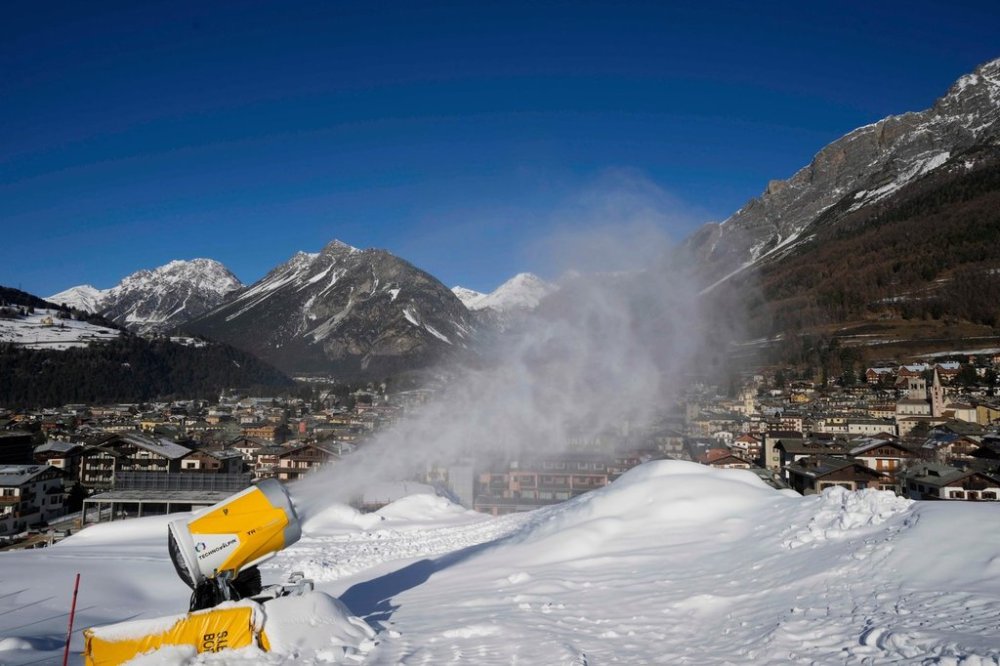
As the 2026 Milan Cortina Winter Games approach, Davide Cerato stands out not as an athlete, but as a pivotal figure ensuring the success of skiing and snowboarding events. The Italian snowmaking expert is responsible for the technical preparation of several courses, enhancing the competitive environment for athletes who will participate in the Olympics.
Cerato’s role is crucial. He emphasizes, “It’s the most important race of their life. Our duty is to give them the best, to deliver the best courses where they can perform their best after training so hard.” His meticulous oversight extends to venues where advanced snowmaking systems have been installed, notably in Bormio for Alpine ski racing and Livigno for freestyle skiing and snowboarding events.
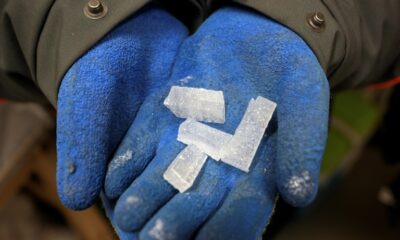
The significance of manufactured snow, referred to as “technical snow” by Cerato, has grown in importance due to the challenges posed by climate change. The organizing committee for the Games anticipates a need for approximately 946 million liters (250 million gallons) of water, enough to fill nearly 380 Olympic swimming pools, for snowmaking purposes. To meet this demand, Cerato has overseen the development of high-elevation water reservoirs, including a major basin at Livigno capable of storing about 200 million liters (53 million gallons).
At Bormio, a new lake has been constructed at an elevation of 2,300 meters (2,515 yards) to hold 88 million liters (23 million gallons) of water, complemented by the installation of 75 snow guns. Cerato compares the enhanced slope to a “Ferrari with new gears,” illustrating the significant upgrades made to meet International Ski Federation (FIS) standards.
By producing artificial snow, organizers can ensure the quality and consistency of race surfaces, which is vital for fair competition. Cerato explains, “We can deliver better, safer and fair courses. That is the difference — a fair course from bib No. 1 to bib No. 50.” The use of technical snow allows for better control over slope conditions, reducing the unpredictability associated with natural snow.
To maintain optimal snow conditions, Cerato and his team employ advanced technology. State-of-the-art sensors monitor snow depth, triggering snow guns when necessary to fill in gaps, while controlling outputs to prevent excess production. In Bormio, snow groomers equipped with GPS systems facilitate precise management of snow quality, ensuring efficiency in resource use. “You produce the minimum amount of snow that you need,” Cerato adds, highlighting the sophistication of the snow management process.
Preparing slopes for elite competitions differs significantly from commercial ski operations, and Cerato acknowledges the challenges of working with natural snow. Despite his professional focus on technical snow, he maintains a personal affection for skiing in powder, stating, “I was born on the mountain. I love snow.”
As the Milan Cortina Winter Games draw near, Cerato’s expertise in snowmaking will play a fundamental role in shaping the experiences of athletes and spectators alike. His dedication to providing optimal conditions reflects a commitment not only to the sport but also to the future of winter athletics in a changing climate.









Morris Churches Unite for Annual Good Friday Walk With the Cross

Chloe Zhao’s ‘Buffy’ Reboot Cancelled: Sarah Michelle Gellar Speaks Out

Essential Ingredients for Life Found in Ryugu Asteroid Samples

Urgent Rescue: NSR Airlifts Injured Climber from Nanaimo

Riverside Heart Ball Achieves Record $815,000 for Mental Health

Cognizant Launches AI Factory to Enhance Enterprise AI Scalability

Samsung’s Galaxy Watch 9 to Feature Larger Battery Than Before

Toronto’s AIDS Memorial Faces Potential Redesign Amid Community Concerns

Bayern Munich Loses Luis Díaz Red Card Appeal Despite Referee’s Admission

Secwepemc First Nation Seeks Aboriginal Title Over Kamloops Area

Fatal Crash on Highway 11 Claims Three Lives, Major Closure Ongoing

Manitoba’s Burger Champion Shines Again Amid Dining Innovations

Canadian Curler E.J. Harnden Announces Retirement from Competition

Urgent Fire Erupts at Salvation Army on Christmas Evening

Scientists Unearth Ancient Antarctic Ice to Unlock Climate Secrets

Trump and McCormick to Announce $70 Billion Energy Investments

Minister Faces Scrutiny Over Delayed Foreign Interference Watchdog Appointment

Monika Hibbs Unveils Acres Market & Interiors in Major Rebrand
-
 Politics5 months ago
Secwepemc First Nation Seeks Aboriginal Title Over Kamloops Area
-
 Top Stories4 months ago
Fatal Crash on Highway 11 Claims Three Lives, Major Closure Ongoing
-
 Lifestyle7 months ago
Manitoba’s Burger Champion Shines Again Amid Dining Innovations
-
 Sports3 months ago
Canadian Curler E.J. Harnden Announces Retirement from Competition
-
 Top Stories3 months ago
Urgent Fire Erupts at Salvation Army on Christmas Evening
-
 World9 months ago
Scientists Unearth Ancient Antarctic Ice to Unlock Climate Secrets
-
 Entertainment9 months ago
Trump and McCormick to Announce $70 Billion Energy Investments
-
 World5 months ago
Minister Faces Scrutiny Over Delayed Foreign Interference Watchdog Appointment
-
 Lifestyle9 months ago
Monika Hibbs Unveils Acres Market & Interiors in Major Rebrand
-

 Science9 months ago
Four Astronauts Return to Earth After International Space Station Mission
-

 Lifestyle9 months ago
TransLink Launches Food Truck Program to Boost Revenue in Vancouver
-

 World1 month ago
Ranchman’s Cookhouse & Dancehall to Relocate by Early 2027