
World
Oil Prices Surge as Middle East Conflict Intensifies

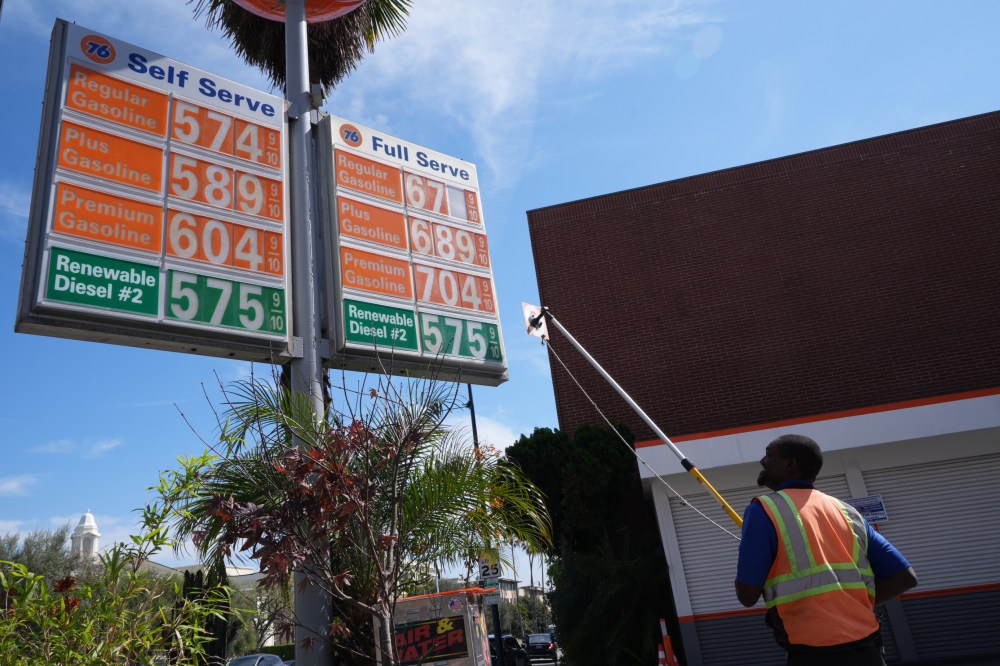
The price of oil has experienced a significant surge, reaching over $90 a barrel, following intensified military operations by the United States and Israel against Iran. This escalation in conflict has severely impacted oil supply routes, particularly affecting daily shipments through the strategically crucial Strait of Hormuz.
The recent military actions have led to widespread damage across the Middle East, with nearly every country in the region suffering from missile and drone strikes. This turmoil has left approximately 20 million barrels of oil stranded in the Persian Gulf, unable to transit safely through the Strait of Hormuz, which is bordered by Iran on its northern side.
As a consequence, oil prices have risen sharply, with American crude settling at $90.90 on Friday, marking a 36% increase from the previous week. Brent crude, the international benchmark, has climbed to $92.69, a 27% rise over the same period. The escalating prices are already impacting consumers, with gasoline and diesel costs rising sharply in various markets.
Mark Doran, a motorist in Middlebury, Vermont, expressed frustration at the rising fuel costs, stating, “It’s crazy. It’s not needed, especially at a time when people are already struggling.” He highlighted a growing skepticism regarding the prospects of a quick resolution to the conflict, noting, “The Middle East is a place that the U.S. is not going to solve.”
As military operations continue, President Donald Trump indicated that U.S. forces could remain engaged in the conflict for four to five weeks, with the possibility of extending operations if necessary. He also ruled out negotiations with Iran unless they agree to “unconditional surrender.”
In the U.S., the average price for a gallon of regular gasoline has increased to $3.32, an 11% rise from the previous week, while diesel prices have surged to $4.33 per gallon, a 15% increase. The impact is even more pronounced in Europe and Asia, where diesel prices have doubled and jet fuel costs have skyrocketed by nearly 200% in parts of Asia, according to Claudio Galimberti, chief economist at Rystad Energy.
Energy prices have continued to escalate as Iran has engaged in retaliatory actions, including a drone strike on the U.S. Embassy in Saudi Arabia and attacks on a major refinery and liquefied natural gas (LNG) facility in Qatar. These actions have resulted in the disruption of approximately 20% of the world’s LNG supply.
Al Salazar, head of macro oil and gas research at Enverus, noted that around 9 million barrels of oil per day are currently off the market due to these disruptions. He stated, “Right now, with all of this shut in, we are in a situation of extreme deficit.”
While the U.S. is a net exporter of oil, the global nature of oil trading means that American consumers are not insulated from rising prices. Salazar explained that increasing domestic production takes time, and U.S. refineries are primarily designed to process heavier crude, necessitating imports of refined products such as gasoline.
Individuals like Jerry Dalpiaz from Covington, Louisiana, have begun stockpiling fuel due to anticipated price increases. “I feel sorry for my fellow citizens who are living paycheck to paycheck,” he remarked, emphasizing the need for relief amid rising costs.
In response to the escalating situation, President Trump has announced a plan to provide insurance for losses up to approximately $20 billion in the Gulf region. This initiative aims to restore confidence in maritime trade and stabilize international commerce in the region. However, experts warn that additional insurance alone will not alleviate the underlying issues affecting oil trade.
Amy Jaffe, director of the Energy, Climate Justice and Sustainability Lab at New York University, highlighted concerns regarding counterterrorism in the oil shipping industry. She stated, “There has to be some credible demonstration of solutions to the counter-terrorism problem” to create a safer trading environment in the region.
As the conflict continues, questions remain about the future stability of oil supply routes and the broader implications for global energy markets. The situation in the Middle East is evolving rapidly, and the effects of the ongoing conflict are likely to reverberate through economies worldwide.










Morris Churches Unite for Annual Good Friday Walk With the Cross

Chloe Zhao’s ‘Buffy’ Reboot Cancelled: Sarah Michelle Gellar Speaks Out

Essential Ingredients for Life Found in Ryugu Asteroid Samples

Urgent Rescue: NSR Airlifts Injured Climber from Nanaimo

Riverside Heart Ball Achieves Record $815,000 for Mental Health

Cognizant Launches AI Factory to Enhance Enterprise AI Scalability

Samsung’s Galaxy Watch 9 to Feature Larger Battery Than Before

Toronto’s AIDS Memorial Faces Potential Redesign Amid Community Concerns

Bayern Munich Loses Luis Díaz Red Card Appeal Despite Referee’s Admission

Secwepemc First Nation Seeks Aboriginal Title Over Kamloops Area

Fatal Crash on Highway 11 Claims Three Lives, Major Closure Ongoing

Manitoba’s Burger Champion Shines Again Amid Dining Innovations

Canadian Curler E.J. Harnden Announces Retirement from Competition

Urgent Fire Erupts at Salvation Army on Christmas Evening

Scientists Unearth Ancient Antarctic Ice to Unlock Climate Secrets

Minister Faces Scrutiny Over Delayed Foreign Interference Watchdog Appointment

Trump and McCormick to Announce $70 Billion Energy Investments

Monika Hibbs Unveils Acres Market & Interiors in Major Rebrand
-
 Politics5 months ago
Secwepemc First Nation Seeks Aboriginal Title Over Kamloops Area
-
 Top Stories4 months ago
Fatal Crash on Highway 11 Claims Three Lives, Major Closure Ongoing
-
 Lifestyle7 months ago
Manitoba’s Burger Champion Shines Again Amid Dining Innovations
-
 Sports3 months ago
Canadian Curler E.J. Harnden Announces Retirement from Competition
-
 Top Stories3 months ago
Urgent Fire Erupts at Salvation Army on Christmas Evening
-
 World9 months ago
Scientists Unearth Ancient Antarctic Ice to Unlock Climate Secrets
-
 World5 months ago
Minister Faces Scrutiny Over Delayed Foreign Interference Watchdog Appointment
-
 Entertainment9 months ago
Trump and McCormick to Announce $70 Billion Energy Investments
-
 Lifestyle9 months ago
Monika Hibbs Unveils Acres Market & Interiors in Major Rebrand
-

 Science9 months ago
Four Astronauts Return to Earth After International Space Station Mission
-

 Lifestyle9 months ago
TransLink Launches Food Truck Program to Boost Revenue in Vancouver
-

 World1 month ago
Ranchman’s Cookhouse & Dancehall to Relocate by Early 2027