
World
Saskatchewan Premier Scott Moe Challenges Federal Equalization Payments

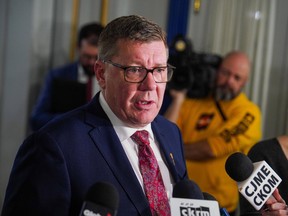
Saskatchewan Premier Scott Moe is intensifying his campaign to reform the federal equalization payment system, which he argues disproportionately benefits Eastern and Central Canada at the expense of Western provinces. In a recent post on X, Moe shared a map illustrating that Saskatchewan, along with Alberta and British Columbia, will receive no equalization payments in 2026, while provinces like Quebec will obtain $13.9 billion, and Nova Scotia and New Brunswick will receive $3.5 billion and $3.3 billion, respectively.
The federal government announced next year’s equalization amounts to provincial finance ministers, highlighting significant disparities. Ontario is set to receive $406 million, while Newfoundland and Labrador will get $182 million, and the smallest province, Prince Edward Island, will receive $723 million. The only exception among Western provinces is Manitoba, which will receive $5 billion.
Moe has long criticized the equalization formula, asserting it is unfair to resource-dependent provinces like Saskatchewan. He contends that the current system penalizes provinces with substantial natural resource revenues. According to Jill McAlister-Lane, Saskatchewan’s executive director of media relations, “The equalization formula doesn’t reflect the economic realities of the western provinces.” She emphasized that while equalization aims to ensure comparable public services, the existing formula obscures fiscal challenges in some areas while supporting others.
The debate surrounding equalization payments has the potential to create tensions among provinces, but McAlister-Lane stressed that the issue is not about one province against another. Instead, it is about reforming the formula to accurately represent Saskatchewan’s contributions to the national economy, particularly in sectors such as energy, mining, and agriculture.
Calls for Reform and Legal Challenges
In 2018, Moe proposed a significant reform to the equalization system, suggesting a reduction of total payments by approximately 50 percent, redistributing the savings to all provinces on a per-capita basis. His plan would result in “have” provinces like Saskatchewan, Alberta, and British Columbia gaining funds, while “have-not” provinces would see a decrease. Notably, Quebec, which currently receives over half of all equalization payments, would lose funding under this proposal.
The Saskatchewan government has also engaged in legal battles regarding the equalization formula. The province joined a legal challenge initiated by Newfoundland and Labrador in 2024 against the federal equalization program. This challenge is currently before the Supreme Court of Newfoundland and Labrador, where the province argues that the formula unfairly penalizes it by not considering service delivery costs associated with its dispersed population. The case highlights concerns over a fiscal capacity cap and a GDP growth ceiling that could deprive Newfoundland and Labrador of billions.
Moe has reiterated that Saskatchewan has not received equalization payments for several years. He argues that the formula fails to account for the structural costs incurred by provinces with low populations. The legal proceedings are ongoing, with no trial date established. The Canadian Taxpayers Federation and the Saskatchewan government have been granted intervenor status, opposing demands for increased payments due to potential risks for net-payer provinces.
The issue remains a focal point in Moe’s agenda, as he echoes previous criticisms from Alberta’s Premier Danielle Smith, stating that Saskatchewan, Alberta, and British Columbia are “helping support the rest of Canada” while receiving no equalization payments themselves.
As the discussion continues, the provincial government seeks a reform that not only addresses its concerns but also promotes a more equitable distribution of resources across Canada.







Toronto Police Identify 79-Year-Old Homicide Victim in Wychwood

Nutrien Set to Surge: Top TSX Stock to Outperform in 2026

Urgent Call for Direct Entry Medical Programs Amid Physician Shortage

Local Caterers Brace for Holiday Rush with Record Demand

Surge in Medicine Hat Airport Traffic Driven by Student Pilots

Discover the Top 5 Non-Tech Gifts for Creative Designers

NFL Week 15 Preview: Key Matchups and Fantasy Insights

New Study Challenges Bilingualism Myths for Quebec Parents

Saskatchewan Premier Scott Moe Challenges Federal Equalization Payments

Secwepemc First Nation Seeks Aboriginal Title Over Kamloops Area

Scientists Unearth Ancient Antarctic Ice to Unlock Climate Secrets

Trump and McCormick to Announce $70 Billion Energy Investments

TransLink Launches Food Truck Program to Boost Revenue in Vancouver

Four Astronauts Return to Earth After International Space Station Mission

Manitoba’s Burger Champion Shines Again Amid Dining Innovations

Apple Notes Enhances Functionality with Markdown Support in macOS 26

Urgent Update: Fatal Crash on Highway 99 Claims Life of Pitt Meadows Man

Homemade Houseboat ‘Neverlanding’ Captivates Lake Huron Voyagers
-
 Politics1 month ago
Secwepemc First Nation Seeks Aboriginal Title Over Kamloops Area
-
 World5 months ago
Scientists Unearth Ancient Antarctic Ice to Unlock Climate Secrets
-
 Entertainment5 months ago
Trump and McCormick to Announce $70 Billion Energy Investments
-
 Lifestyle5 months ago
TransLink Launches Food Truck Program to Boost Revenue in Vancouver
-
 Science5 months ago
Four Astronauts Return to Earth After International Space Station Mission
-
 Lifestyle3 months ago
Manitoba’s Burger Champion Shines Again Amid Dining Innovations
-
 Technology4 months ago
Apple Notes Enhances Functionality with Markdown Support in macOS 26
-
 Top Stories2 months ago
Urgent Update: Fatal Crash on Highway 99 Claims Life of Pitt Meadows Man
-
 Top Stories2 weeks ago
Homemade Houseboat ‘Neverlanding’ Captivates Lake Huron Voyagers
-

 Politics4 months ago
Ukrainian Tennis Star Elina Svitolina Faces Death Threats Online
-
 Sports5 months ago
Search Underway for Missing Hunter Amid Hokkaido Bear Emergency
-
 Politics5 months ago
Carney Engages First Nations Leaders at Development Law Summit