
World
South Korea’s President Lee Urges China’s Xi to Curb North Korea’s Nuclear Ambitions

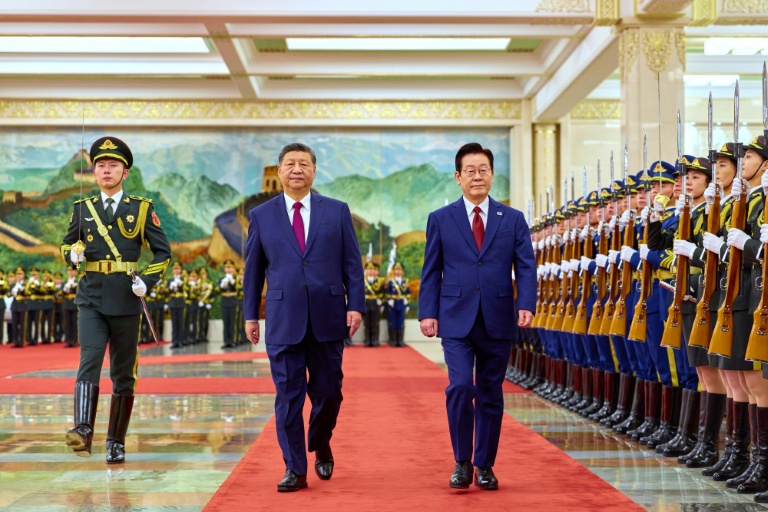
South Korean President Lee Jae Myung has called on Chinese leader Xi Jinping to assist in curbing North Korea’s nuclear weapons program. During a crucial visit to China, Lee proposed that a freeze in Pyongyang’s development of weapons of mass destruction could be “feasible” under the right circumstances. This visit marks the first by a South Korean president to China in six years, highlighting Seoul’s desire to reset relations with its largest trading partner and address the ongoing challenges posed by North Korea.
Lee met with Xi in Beijing on Monday, shortly after North Korea launched two ballistic missiles into the Sea of Japan. Concluding his visit in Shanghai, the South Korean leader emphasized to journalists the need for Beijing’s support in encouraging Pyongyang to return to negotiations. He expressed his desire for China to take on a mediating role regarding the Korean Peninsula, particularly concerning North Korea’s nuclear program.
“We hope China can serve as a mediator — a mediator for peace,” Lee stated. He acknowledged that “all our channels are completely blocked,” indicating significant diplomatic obstacles that have arisen in recent years. In response, Xi urged Seoul to exercise “patience” with the North, recognizing the strained ties between the two Koreas. Lee agreed, noting that past military actions by South Korea may have been perceived as threatening by North Korea.
In a strategic proposal, Lee outlined a plan for North Korea to freeze its nuclear program in exchange for “compensation.” He suggested that halting current levels of nuclear weapons production, prohibiting the transfer of nuclear materials abroad, and ceasing the development of Intercontinental Ballistic Missiles (ICBMs) would represent a significant achievement.
“In the long term, we must not give up the goal of a nuclear-free Korean Peninsula,” he added. This statement comes amid heightened tensions, as North Korea has repeatedly asserted its status as an “irreversible” nuclear state. Relations between the two Koreas have deteriorated significantly, with Lee’s predecessor facing criticism for his approach to North Korea, which many believe provoked hostilities.
On the same day as Lee’s discussions, North Korea announced that its nuclear forces were “ready for war,” citing recent geopolitical crises as a concern. The leadership in Pyongyang perceives military actions from the United States, such as a recent attack on Venezuela, as potential threats.
For decades, North Korea has justified its nuclear and missile programs as necessary for deterring what it claims are regime change efforts by Washington. Recent years have seen a notable increase in missile testing, with analysts suggesting that these efforts aim to enhance strike capabilities, challenge the United States and South Korea, and potentially prepare for weapon exports to Russia.
As global attention remains focused on the Korean Peninsula, Lee’s visit and his calls for collaboration with China may represent a pivotal moment in addressing the ongoing nuclear threat posed by North Korea. The implications of these discussions could resonate throughout the region as leaders navigate an increasingly complex geopolitical landscape.










Morris Churches Unite for Annual Good Friday Walk With the Cross

Chloe Zhao’s ‘Buffy’ Reboot Cancelled: Sarah Michelle Gellar Speaks Out

Essential Ingredients for Life Found in Ryugu Asteroid Samples

Urgent Rescue: NSR Airlifts Injured Climber from Nanaimo

Riverside Heart Ball Achieves Record $815,000 for Mental Health

Cognizant Launches AI Factory to Enhance Enterprise AI Scalability

Samsung’s Galaxy Watch 9 to Feature Larger Battery Than Before

Toronto’s AIDS Memorial Faces Potential Redesign Amid Community Concerns

Bayern Munich Loses Luis Díaz Red Card Appeal Despite Referee’s Admission

Secwepemc First Nation Seeks Aboriginal Title Over Kamloops Area

Fatal Crash on Highway 11 Claims Three Lives, Major Closure Ongoing

Manitoba’s Burger Champion Shines Again Amid Dining Innovations

Canadian Curler E.J. Harnden Announces Retirement from Competition

Urgent Fire Erupts at Salvation Army on Christmas Evening

Scientists Unearth Ancient Antarctic Ice to Unlock Climate Secrets

Minister Faces Scrutiny Over Delayed Foreign Interference Watchdog Appointment

Trump and McCormick to Announce $70 Billion Energy Investments

Monika Hibbs Unveils Acres Market & Interiors in Major Rebrand
-
 Politics5 months ago
Secwepemc First Nation Seeks Aboriginal Title Over Kamloops Area
-
 Top Stories4 months ago
Fatal Crash on Highway 11 Claims Three Lives, Major Closure Ongoing
-
 Lifestyle7 months ago
Manitoba’s Burger Champion Shines Again Amid Dining Innovations
-
 Sports3 months ago
Canadian Curler E.J. Harnden Announces Retirement from Competition
-
 Top Stories4 months ago
Urgent Fire Erupts at Salvation Army on Christmas Evening
-
 World9 months ago
Scientists Unearth Ancient Antarctic Ice to Unlock Climate Secrets
-
 World5 months ago
Minister Faces Scrutiny Over Delayed Foreign Interference Watchdog Appointment
-
 Entertainment9 months ago
Trump and McCormick to Announce $70 Billion Energy Investments
-
 Lifestyle9 months ago
Monika Hibbs Unveils Acres Market & Interiors in Major Rebrand
-

 Science9 months ago
Four Astronauts Return to Earth After International Space Station Mission
-

 Lifestyle9 months ago
TransLink Launches Food Truck Program to Boost Revenue in Vancouver
-

 World1 month ago
Ranchman’s Cookhouse & Dancehall to Relocate by Early 2027