
World
Syrians Navigate Recovery One Year After Assad’s Fall


HOMS, Syria — A year after the fall of Bashar Assad, Syrians are grappling with the aftermath of a tumultuous regime change and the physical and psychological scars left by years of conflict. The dramatic shift in power came on December 8, 2024, when rebel forces seized Damascus, leading to the end of Assad’s repressive 50-year rule. The country now faces significant challenges in its journey toward recovery.
One of the many individuals impacted by this change is Mohammad Marwan, who was released from the notorious Saydnaya Prison as rebel forces advanced. Arrested in 2018 for evading compulsory military service, Marwan endured six years of brutal treatment in a facility infamous for its atrocities. Upon his release, he returned to his village in Homs province, where he experienced both the joy of reunion with family and the burden of overcoming the trauma of imprisonment.
Marwan has since struggled with health issues, including tuberculosis and anxiety, which have resulted from his time in prison. He is currently receiving treatment and attending therapy at a rehabilitation center in Homs. While he notes improvements in his mental and physical health, he reflects on the stark contrast between his past and present, stating, “We were in something like a state of death in Saydnaya. Now we’ve come back to life.”
As Syrians like Marwan seek to reclaim their lives, the country itself faces a daunting path to healing. The civil war has left an estimated half a million dead and millions displaced, creating a landscape of devastation that complicates recovery efforts. The sudden collapse of Assad’s regime surprised even the insurgent groups involved in the uprising, allowing for a swift transition of power.
The offensive that led to Assad’s downfall was spearheaded by Hayat Tahrir al-Sham (HTS) and other allied forces. Their campaign began in late November 2024, initially aimed at preempting a potential attack from Assad’s forces in opposition-held Idlib. The rebels took advantage of Assad’s weakened military presence and international distractions, including Russia’s focus on its conflict in Ukraine.
In the wake of this upheaval, Ahmad al-Sharaa, the leader of HTS, has emerged as the interim president. His administration has made strides in establishing diplomatic relations with Western and Arab nations that previously distanced themselves from Assad. Notably, al-Sharaa became the first Syrian president since the country’s independence in 1946 to visit Washington, signaling a shift in international attitudes.
Despite these diplomatic achievements, the new government faces challenges, including sporadic violence among sectarian groups. Reports indicate that pro-government Sunni fighters have perpetrated attacks against civilians from minority communities, contributing to an unstable environment. Tensions persist between the new government and Kurdish-led forces in the northeast, exacerbated by a fragile agreement aimed at unifying their military efforts.
The economic landscape remains bleak, with the World Bank estimating that rebuilding Syria’s war-damaged infrastructure will cost approximately $216 billion. While Gulf countries have expressed intentions to invest in reconstruction, tangible progress has been limited. Most repair efforts have been on an individual scale, with residents paying out of pocket to restore their homes and businesses.
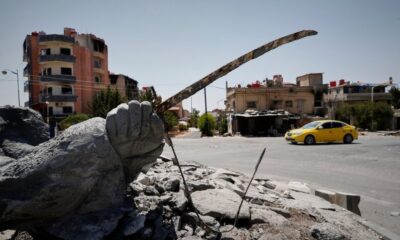
In Yarmouk, a once-bustling Palestinian camp on the outskirts of Damascus, signs of life are slowly returning. The camp, which suffered extensive damage from militant groups and government bombardments, is gradually seeing former residents return. However, large-scale reconstruction remains a distant goal. Local residents express frustration over the slow pace of rebuilding and the lack of basic infrastructure, such as water connections.
Marwan, like many others, now faces economic hardships despite the regime change. He occasionally finds work that pays only 50,000 to 60,000 Syrian pounds daily, equivalent to about $5. His future plans include seeking better employment opportunities in Lebanon once he completes his treatment for tuberculosis.
As the anniversary of Assad’s fall approaches, Syrians are left to navigate a complex landscape of recovery. While many express hope for a freer and more prosperous future, the road ahead remains fraught with challenges as the nation strives to rebuild amidst ongoing instability.








Swiss National Bank Confirms Zero Rates Amid Inflation Concerns

Disney Faces Lawsuit Over Controversial Disability Policy Changes

Syrians Navigate Recovery One Year After Assad’s Fall

Trump and Putin Envoy Agree to Controversial Peace Plan for Ukraine

Rotary Club of LaSalle Centennial Raises $6,956 to Combat Polio

Brandon City Hall Welcomes Over 200 to Annual Christmas Open House

Agentic AI Revolutionizes Sustainability and Risk Management

Megan and Lauren’s Pajama Drive Brings Joy to Hospitalized Kids

Raiders Secure Thrilling 4-3 Overtime Victory Over Oil Kings

Secwepemc First Nation Seeks Aboriginal Title Over Kamloops Area

Scientists Unearth Ancient Antarctic Ice to Unlock Climate Secrets

Trump and McCormick to Announce $70 Billion Energy Investments

Four Astronauts Return to Earth After International Space Station Mission

TransLink Launches Food Truck Program to Boost Revenue in Vancouver

Apple Notes Enhances Functionality with Markdown Support in macOS 26

Manitoba’s Burger Champion Shines Again Amid Dining Innovations

Urgent Update: Fatal Crash on Highway 99 Claims Life of Pitt Meadows Man

Homemade Houseboat ‘Neverlanding’ Captivates Lake Huron Voyagers
-
 Politics1 month ago
Secwepemc First Nation Seeks Aboriginal Title Over Kamloops Area
-
 World5 months ago
Scientists Unearth Ancient Antarctic Ice to Unlock Climate Secrets
-
 Entertainment5 months ago
Trump and McCormick to Announce $70 Billion Energy Investments
-
 Science5 months ago
Four Astronauts Return to Earth After International Space Station Mission
-
 Lifestyle5 months ago
TransLink Launches Food Truck Program to Boost Revenue in Vancouver
-
 Technology3 months ago
Apple Notes Enhances Functionality with Markdown Support in macOS 26
-
 Lifestyle3 months ago
Manitoba’s Burger Champion Shines Again Amid Dining Innovations
-
 Top Stories2 months ago
Urgent Update: Fatal Crash on Highway 99 Claims Life of Pitt Meadows Man
-
 Top Stories1 week ago
Homemade Houseboat ‘Neverlanding’ Captivates Lake Huron Voyagers
-

 Politics4 months ago
Ukrainian Tennis Star Elina Svitolina Faces Death Threats Online
-
 Sports5 months ago
Search Underway for Missing Hunter Amid Hokkaido Bear Emergency
-
 Politics5 months ago
Carney Engages First Nations Leaders at Development Law Summit